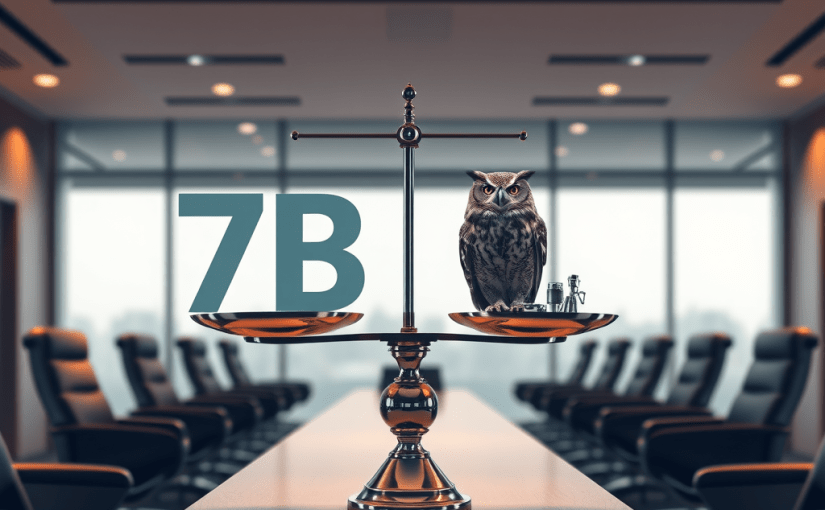
“In 2025, the AI industry stopped making models faster and bigger and started making them slower, maybe smaller, and wiser.”
Late 2023. Conference room. Vendor pitch. The slides were full of parameter counts—7 billion, 70 billion, 175 billion—as if those numbers meant something to the CFO sitting across from me. The implicit promise: bigger equals better. Pay more, get more intelligence. That pitch feels quaint now.
In January, 2025, DeepSeek released a model that matched OpenAI’s best work at roughly one-twentieth the cost. The next day, Nvidia lost half a trillion dollars in market cap. The old way—more data, more parameters, more compute, more intelligence—suddenly looked less like physics and more like an expensive habit.
Chinese labs face chip export restrictions. American startups face investor skepticism about burn rates. Enterprises face CFOs demanding ROI. “Wisdom over scale” sounds better than “we can’t afford scale anymore.”
Something genuinely shifted in how AI researchers think about intelligence. The old approach treated model training like filling a bucket—pour in more data, get more capability. The new approach treats inference like actual thinking—give the model time to reason, and it performs better on hard problems.
DeepSeek’s mHC (Manifold-Constrained Hyper-Connections) framework emerged in January 2026 from limited hardware. U.S. chip export bans forced Chinese labs to innovate on efficiency. Constraints as a creative force—Apollo 13, Japan’s bullet trains, and now AI reasoning models. The technique is now available to all developers under the MIT License.
But the capability is real. DeepSeek V3.1 runs on Huawei Ascend chips for inference. Claude Opus 4.5 broke 80% on SWE-bench—the first model to do so. The computation happens when you ask the question, not just when you train the model. The economics change. The use cases change.
The “autonomous AI” framing is a marketing construct. The reality is bounded autonomy.
This is the unse** truth vendors don’t put in pitch decks.
A bank deploys a customer service chatbot, measures deflection rates, declares victory, and wonders why customer satisfaction hasn’t budged. A healthcare company implements clinical decision support, watches physicians ignore the recommendations, and blames the model. A manufacturing firm develops predictive maintenance alerts, generates thousands of notifications, and creates alert fatigue that is worse than the original problem. In each case, the AI performed as designed. The organization didn’t adapt.
The “wisdom” framing helps because it shifts attention from the model to the system. A wise deployment isn’t just a capable model—it’s a capable model embedded in workflows that know when to use it, when to override it, and when to ignore it entirely. Human judgment doesn’t disappear; it gets repositioned to where it matters most.
AI transformation is fundamentally a change-management challenge, not only a technological one. Organizations with mature change management are 3.5 times more likely to outperform their peers in AI initiatives.
The companies that break through share a common characteristic: Senior leaders use AI visibly. They invest in sustained capability building, not only perfunctory webinars. They redesign workflows explicitly. They measure outcomes that matter, not vanity metrics like “prompts submitted or AI-generated code.”
None of this is glamorous. It doesn’t make for exciting conference presentations. But it’s where actual value gets created.
Bottomline
The AI industry in early 2026 is simultaneously more mature and more uncertain than it’s ever been. The models are genuinely capable—far more capable than skeptics acknowledge. The hype has genuinely exceeded reality—far more than boosters admit. Both things are true. The hard work of organizational change remains. The gap between pilot and production persists. The ROI demands are intensifying. But the path forward is clearer than it’s been in years.
The AI industry grew in 2025. In 2026, the rest of us get to catch up.

 Digital Journey