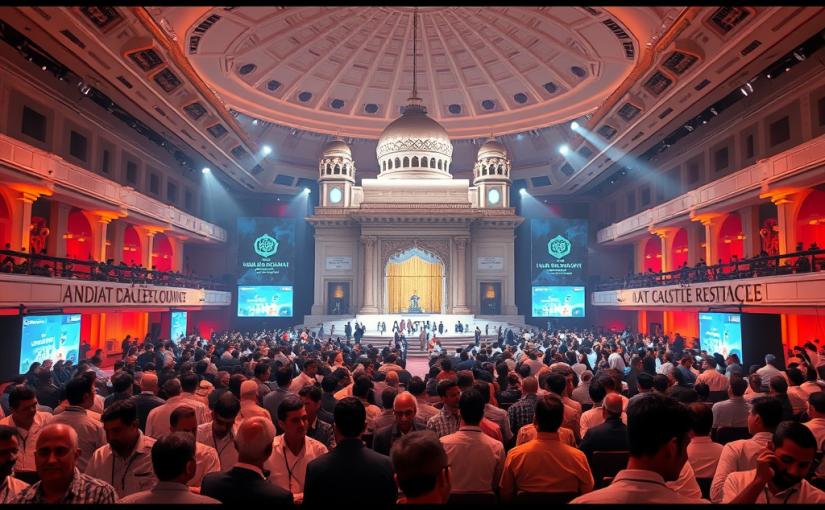
What I Heard and Read Between the Lines about the India AI Impact Summit 2026
Last week, India did something unprecedented. It hosted the fourth global AI summit. This was the first time a Global South nation hosted such an event. The India AI Impact Summit 2026 spanned six days at Bharat Mandapam in New Delhi. It drew over 100 country delegations and 20+ heads of state. Global AI leaders, including Sundar Pichai, Sam Altman, Dario Amodei, Demis Hassabis, and Mukesh Ambani, gathered together.
They all converged on a single question: What does AI look like when 1.5 billion people are part of the equation? and, What is in it for them?
I have tracked this space closely through my work in AI deep tech consulting. I have also worked in AI adoption strategy. I want to share what I think it means. This is relevant for India, for the enterprise, and for those of us building in this space.
The $250 Billion Infrastructure Bet
The headline number is staggering: over $250 billion in AI infrastructure commitments announced in a single week.
Reliance Industries and Jio committed $110 billion over seven years. The funds will support gigawatt-scale data centres in Jamnagar. A nationwide edge computing network and 10 GW of green solar power are also included. Mukesh Ambani’s framing was blunt: “India cannot afford to rent intelligence.”
Adani Group pledged $100 billion by 2035. This pledge is for renewable-energy-powered, hyperscale AI-ready data centres. They are expanding AdaniConnex from 2 GW to a 5 GW target.
Microsoft committed $50 billion by the decade’s end. This commitment aims to expand AI access across the Global South. India is a major recipient of this effort.
Google announced subsea optical fibre cable routes connecting India, the US, and the Southern Hemisphere.
TCS announced OpenAI as the first customer for its new data centre business. This includes 100 MW of AI capacity, which is scalable to 1 GW. This is part of OpenAI’s $500B Stargate initiative.
Larsen & Toubro and Nvidia are building India’s largest gigawatt-scale “AI factory” in Chennai and Mumbai.
These are not token announcements. This is nation-scale infrastructure being laid down.
My take: I don’t think the big conglomerates are delivering intelligence — they’re removing friction. Geo-political friction. Scaling friction. The bottom layers of this cake — energy and infrastructure — are the critical ones. We’ve already seen the US government push back on its own AI companies. The US government argues that energy and infrastructure are scarce. US energy is not for Indian users to consume, even if it is a paid subscription. They should be diverted to building America’s intelligence edge.
Reliance’s $110B and Adani’s $100B represent significant investments in this friction. They aim to control the compute, energy, and network layers. This strategy ensures India isn’t dependent on renting intelligence from abroad.
India has three structural advantages that make it an attractive infrastructure partner. The OpenAI-TCS Hypervault deal is the first proof point. The AI-Energy-Finance trifecta that the World Bank hosted a session on isn’t a coincidence — it’s the foundational equation.
- Democratic values align with the West.
- Being a peninsula provides abundant water for cooling for data centers.
- The sun in regions like Rajasthan, Gujarat, and Andhra Pradesh offers natural energy.
Sovereign AI: Made-in-India Foundation Models
Under the ₹10,372 cr IndiaAI Mission, India unveiled three sovereign AI model families. This signals a shift from being a consumer of global AI to becoming a creator of indigenous intelligence.
Sarvam AI (Bangalore) launched Sarvam 30B and Sarvam 105B. These models were trained entirely in India from scratch. They were not fine-tuned from foreign models. The 105B model handles complex reasoning with a 128K context window and agentic capabilities. Both support all 22 Indian languages and outperformed several global peers on MMLU-Pro benchmarks.
BharatGen (IIT Bombay consortium) unveiled Param2 17B MoE. It was developed with Nvidia AI Enterprise. The model is optimized for governance, education, healthcare, and agriculture. It is also being open-sourced via Hugging Face.
Gnani.ai launched Vachana TTS — a voice-cloning system. It supports 12 Indian languages from under 10 seconds of audio.
My take: Building foundational models for India’s languages, culture, and legal context is genuinely important. Why is clear! It’s also partly a convenient wrapper around the real questions. There will be something to lose, and something to gain; and it’s not going to be equity for all states.
- Where will infrastructure be built? Andhra Pradesh, Gujarat, Rajasthan, UP, …
- What infrastructure essentials will be made in India? Renewables, Chips, …
- Which infrastructure will be built? Energy, Data Centers, …
- Who controls the natural resources (land, water)? PPP, Gov, Private, …
- What do people lose? Land, Agriculture economy size, …
- What do people gain? Intelligence access, New infrastructure economy, …
- What does the government gain? Defence autonomy, …
IT Services: Reset, Not Requiem
India’s top IT companies addressed fears of obsolescence head-on — and the narrative was more nuanced than the headlines suggest.
TCS leadership acknowledged that while roles will evolve, the fundamental need for system integrators remains. The real constraint isn’t access to models. It’s structural. Organisations are layering AI onto fragmented digital estates built for transactions. These estates are not designed for real-time execution.
Infosys assessed a $300 billion AI opportunity across six sectors. Tata Sons issued a “defend-and-grow” mandate for TCS, accelerating AI acquisitions and up-skilling. The consensus was clear: true scale requires enterprise-wide process re-imagination, not just pilots.
A pragmatic insight that resonated: only 16% of developer time is spent writing code. The other 84% goes to production troubleshooting. That’s where agentic AI’s real value lies. AI won’t kill tech services. It will reset them.
In India, the chief AI officer in four out of five companies is effectively the CEO. Leaders stressed the importance of building on platforms rather than individual models. They emphasised the need for a talent strategy and values-based guardrails. Leaders also encouraged the courage to move from pilots to organisation-wide transformation.
My take: Bolting on an AI layer to existing systems is one way to solve the problem. The other way is to re-look into the enterprise in an AI-first world. Consulting firms in a system-integration or pure-technology consulting role will be relevant. Nonetheless, for pure software engineering, the demand for speed (in the name of productivity) will increase. This means that there will be more failed projects before the light at the end of the tunnel. Consulting that can evolve customers into an AI-first world will succeed, and those that are bolting on capabilities will survive. Consulting companies need to leverage their domain depth and partner on value creation rather than outsourcing for cost or risk. The CDO (Chief Digital Officer) is more critical to AI-driven than the CEO.
Five Impressive Products
EkaScribe (https://ekascribe.ai/) — an AI clinical scribe that lets doctors in busy rural clinics see patients without touching a keyboard. It handles prescriptions, history, and filing automatically.
Ottobots (https://ottonomy.io/) — autonomous hospital robots navigating corridors and elevators to deliver medicines independently.
Sarvam Kaze — AI smart spectacles. They see what you see. They explain the world in your local language via bone conduction. Launching May 2026.
Sarvam Edge (https://www.sarvam.ai/blogs/sarvam-edge) — on-device AI translating 22 languages in real-time with zero internet connectivity.
Mankomb’s “Chewie” (https://www.mankomb.com/chewie) — a kitchen appliance using real-time AI sensors to convert wet waste into nutrient-rich soil in hours.
Cooperation with Clenched Fists
The summit concluded with the New Delhi Declaration, endorsed by 88 countries including the US, China, EU, and UK. It delivered a Charter for the Democratic Diffusion of AI, a Global AI Impact Commons, a Trusted AI Commons, and workforce development playbooks.
But the tensions were palpable. The US delegation made its position explicit: “We totally reject global governance of AI.” The US framed AI squarely as a geopolitical race. Many middle powers used the summit to discuss building their own AI sovereignty. They focused on models, on chips, and on escaping Silicon Valley’s gravity. AI governance is rapidly moving from compliance afterthought to boardroom priority.
The Agentic Shift
The summit’s defining motif was the shift from traditional AI. In traditional AI, you ask, and it answers. It shifted to Agentic AI, where you instruct, and it executes everything. The progression started with ML and pattern recognition. It moved through deep learning and generative AI, leading to AI agents. Finally, it reached fully autonomous multi-agent systems. This progression was framed as the decade’s defining trajectory.
The message was clear: if your systems matter to your business, then AI across the SDLC is not optional.
Where the Value Gets Captured
Here’s the question I kept coming back to throughout the week: India has 1.5 billion walking, talking, naturally general intelligence. This is not just a population — it’s a market that needs expertise augmentation at scale. AI can transform agriculture with crop advisory. It can revolutionise healthcare with point-of-care diagnostics. It can enhance education with personalisation. AI can also allow strong but lean digital governance without becoming a surveillance state.
The summit’s “AI for All” framing is in the right direction. But the real test will be whether these infrastructure investments benefit the village clinic. They need to reach the smallholder farm. They must also support the government school.
The summit’s overarching message is unmistakable: India is not just adopting AI. It is building it. It is governing it. It is deploying it at scale. The real question is about who captures the value. Is it the infrastructure builders? Is it the model makers? Or is it the domain consultants/integrators who wire intelligence into the last mile & workflow?
Seems like everyone who will prevent the AI bubble from bursting is going to capture value. The “Planet” should not die in the process.

 Digital Journey