Our family’s summer vacation began with a road trip to Coorg, timed perfectly with the end of my daughter’s school year. She’s always loved Coorg’s cooler climate and rope activities making it an ideal destination for our getaway.
This visit was special—we arrived during the coffee flowering season, something we hadn’t experienced in our previous trips. Rather than rushing between tourist attractions, we focused on immersing ourselves in the region’s tranquility and the facilities at the resort. The lush green landscapes provided a welcome contrast to Bangalore’s busy traffic.
The fragrance of coffee blossoms filled the air as we spent our days simply enjoying the peaceful surroundings, creating memories in this serene hill station.
The Journey
The drive from Bangalore to Coorg took approximately 7 hours. We started our day early, leaving home at 7:30 AM and picking up my parents by 8:15 AM. Our route took us via Mysore, though we didn’t enter the city itself, instead taking the direct road to Coorg.
Unlike our previous trips where we would traditionally stop for lunch at the Novotel hotel in Mysore, this time we decided to continue straight to our destination. Bangalore’s morning traffic necessitated a breakfast stop in the city before we could reach the highway.
Once on the Bangalore-Mysore highway, the journey became much smoother. The excellent road conditions allowed for comfortable cruising, with most vehicles maintaining speeds under 100 KMPH, though some drivers tested both speed limits and the patience of fellow travelers. We noticed that the number of food and refueling options along the route had increased significantly in recent months.
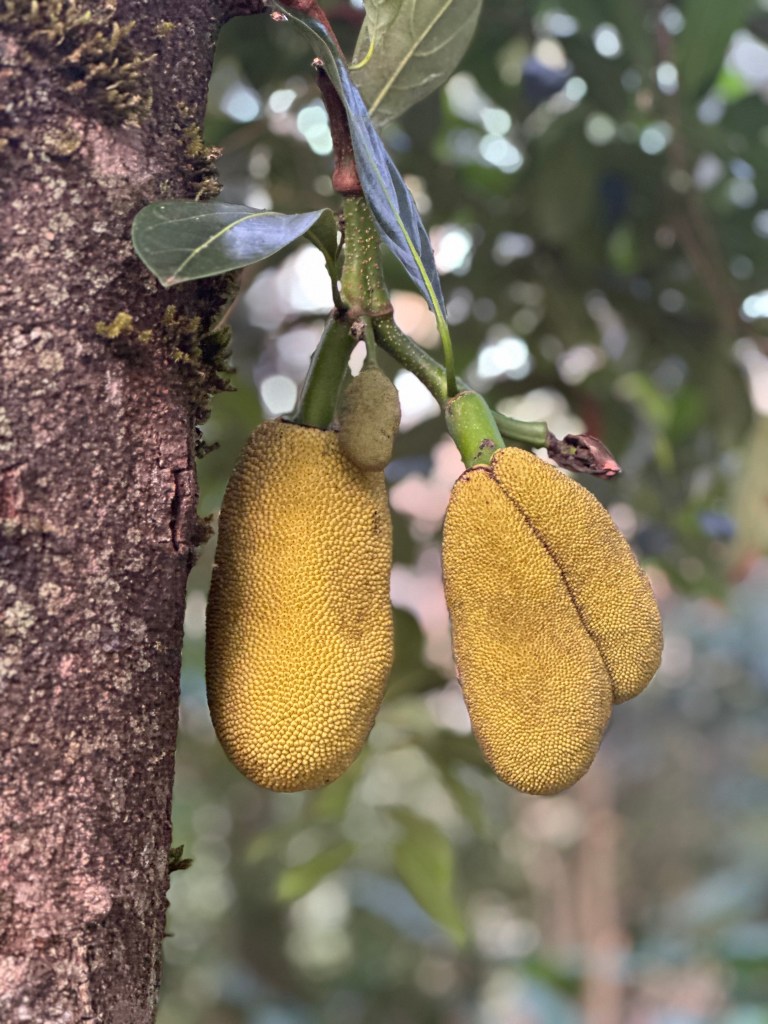
We drove non-stop on the highway stretch, but after passing Mysore and heading toward Coorg, we needed a break. We stopped at McDonald’s for burgers and coffee, which gave us the energy to continue. The road quality from Mysore to Coorg wasn’t as good as the highway we had just left. Along this stretch, we made another stop to buy jackfruits – a fruit with a strong smell but delicious taste that’s definitely an acquired preference. This detour provided enough sustenance to complete our journey to Coorg.
We had reservations at the Coorg Marriott Resort and Spa. Following Google Maps’ directions led us through extremely narrow plantation roads during the final stretch. While the scenery was beautiful, we worried about getting stuck. We did encounter a vehicle coming from the opposite direction, but thankfully that driver skillfully reversed to a point where I could maneuver past. I later discovered there were alternative routes available – a lesson that trusting Google Maps isn’t always advisable, especially when it directs a car onto what seems like a bike path. Perhaps someday navigation systems will better differentiate between vehicle types!
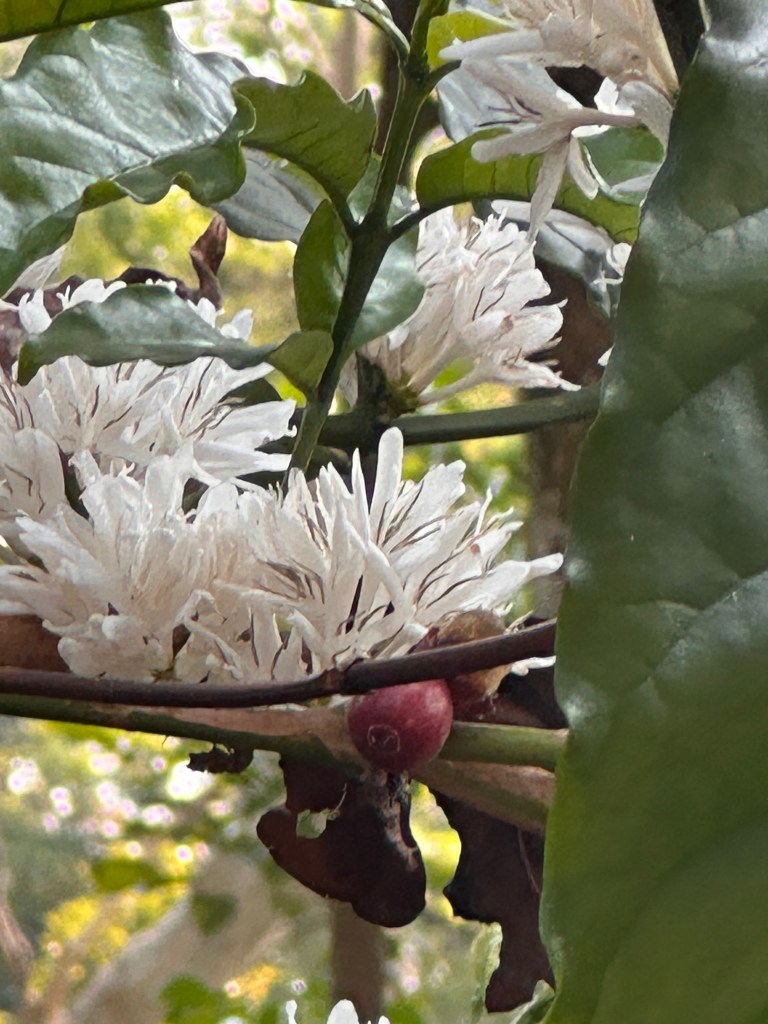
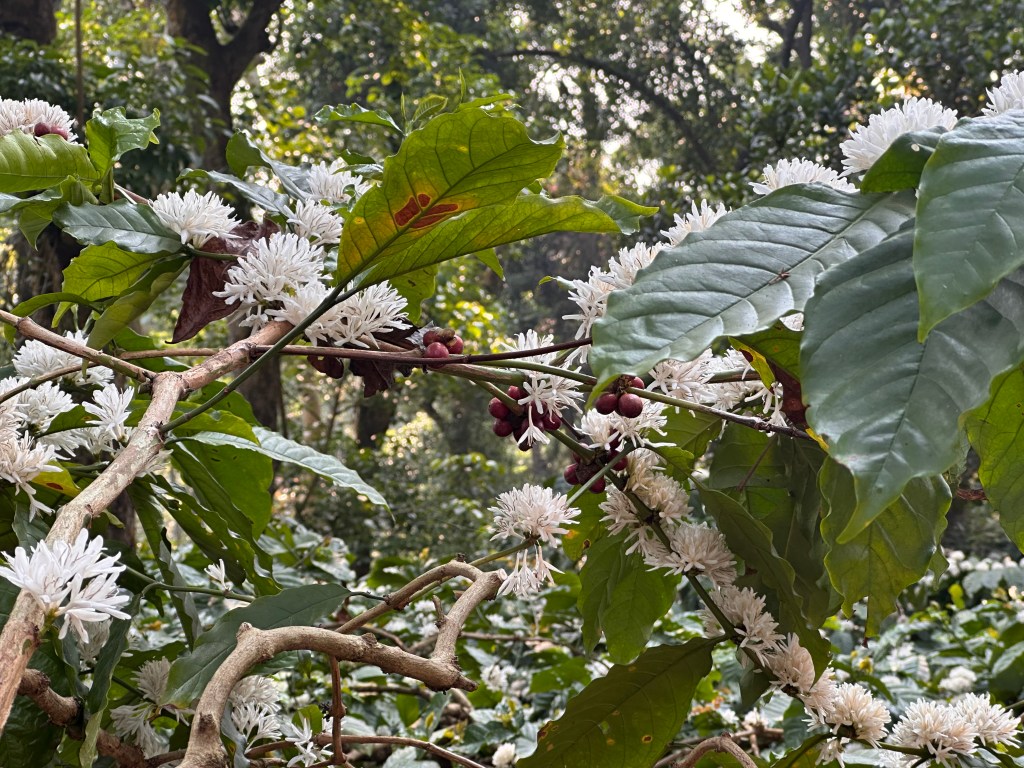
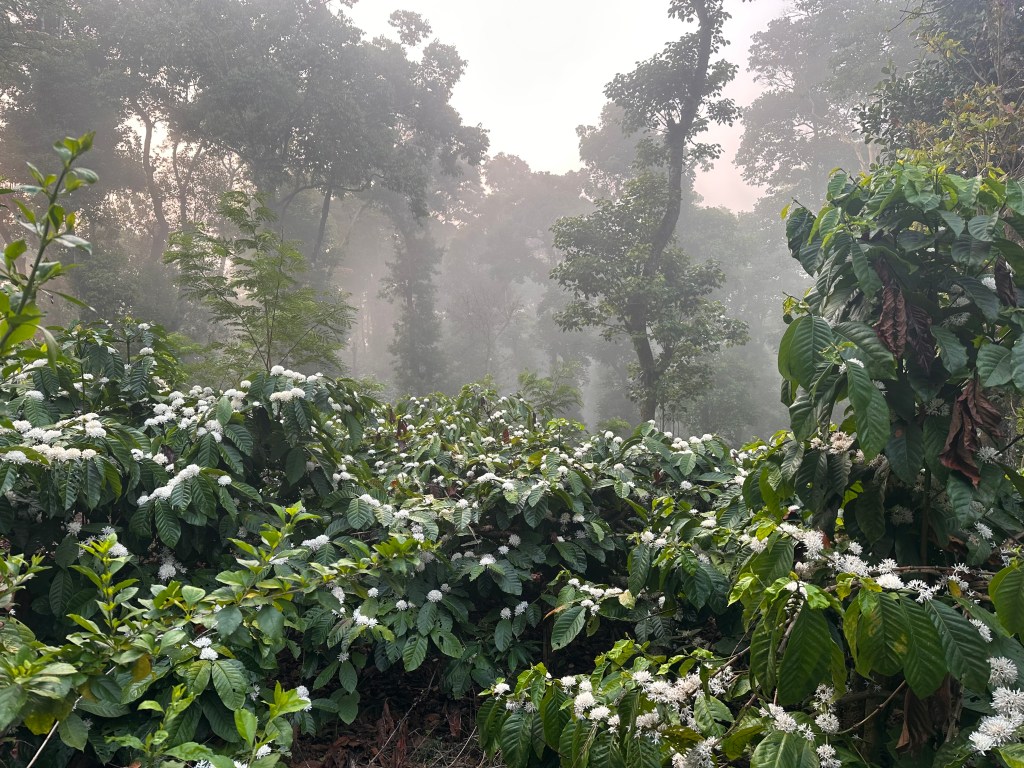
Once we arrived, one of the first things that struck me was the unique aroma in the air — a jasmine-like scent coming from the coffee flowers. We were lucky enough to visit during the coffee blooming season, and the sight of coffee plants with tall, flower-covered stems was nothing short of mesmerizing.
Coffe @ Coorg
Coorg is renowned for its coffee, cultivating both Robusta and Arabica varieties. Each bean type offers distinct characteristics:
Robusta lives up to its name with a stronger, more robust profile. It delivers bitter notes with earthy or woody aftertastes and possesses a fuller body. Robusta contains higher caffeine levels than Arabica but has lower acidity, sugar, and oil content.
Arabica produces a lighter-bodied coffee with sweeter, floral flavors.
Most coffee brands blend these varieties in different ratios. Traditional South Indian coffee typically contains 70% Robusta and 30% Arabica. Premium cappuccinos, such as those served at Third Wave Coffee, generally use mostly Arabica beans as they complement milk better. While Robusta plants have larger leaves than Arabica, their beans are actually smaller.
The local coffee possesses a unique flavor profile influenced by Coorg’s rainforest environment. I was intrigued to learn about the region’s traditional practice of growing coffee under trees, unlike the open-field plantations found elsewhere. This canopy provides essential shade and protection for the coffee plants, allowing them to thrive harmoniously with their surroundings. Since coffee plants still require sunlight, farmers strategically trim the taller trees to allow filtered light to reach the coffee bushes below.
Coorg coffee plants follow a deliberate growth timeline before reaching their productive potential. Farmers must be patient, as the first yields only appear after 2-3 years of planting. Full production capacity isn’t achieved until the plant reaches 5-7 years of age.
These plants are remarkably long-lived, with most coffee plants in Coorg surviving well beyond 50 years. Under ideal conditions, some even reach 80 years of age while still producing coffee cherries.
Plantation management requires ongoing attention. Farmers regularly remove volunteer seedlings that sprout from fallen seeds to maintain proper spacing and organization within the plantation. Trimming is an essential practice that improves overall yield, reduces excessive foliage, promotes lateral branching where coffee cherries develop, and creates more accessible plants for efficient harvesting.
This careful cultivation process contributes to Coorg’s reputation for high-quality coffee production. Generations of farmers have refined these management techniques over decades.
Coffee flowers are one of Coorg’s seasonal treasures, appearing typically once a year. The blossoms are small, white, star-shaped flowers that cluster along coffee branches, resembling jasmine in appearance. Their fragrance is exceptionally sweet and delicate – often described as a blend of jasmine, orange blossom, and honey with subtle vanilla undertones. The flowering period is brief but memorable, lasting only 2-3 weeks. In Coorg, this typically occurs between February and April, depending on weather conditions and the timing of the first pre-monsoon showers. The scent is most intense in the early morning when the flowers release their fragrance in waves that can carry for surprising distances. About 6-9 months after flowering, these blossoms will develop into the coffee cherries that contain the beans.
Beyond coffee, Coorg is a treasure trove of spices. A highlight of my visit was exploring local ingredients like pepper, which is extensively cultivated in the region. Coorgi pepper stands out for its exceptionally robust flavor, making it distinctive.
A Relaxing Stay
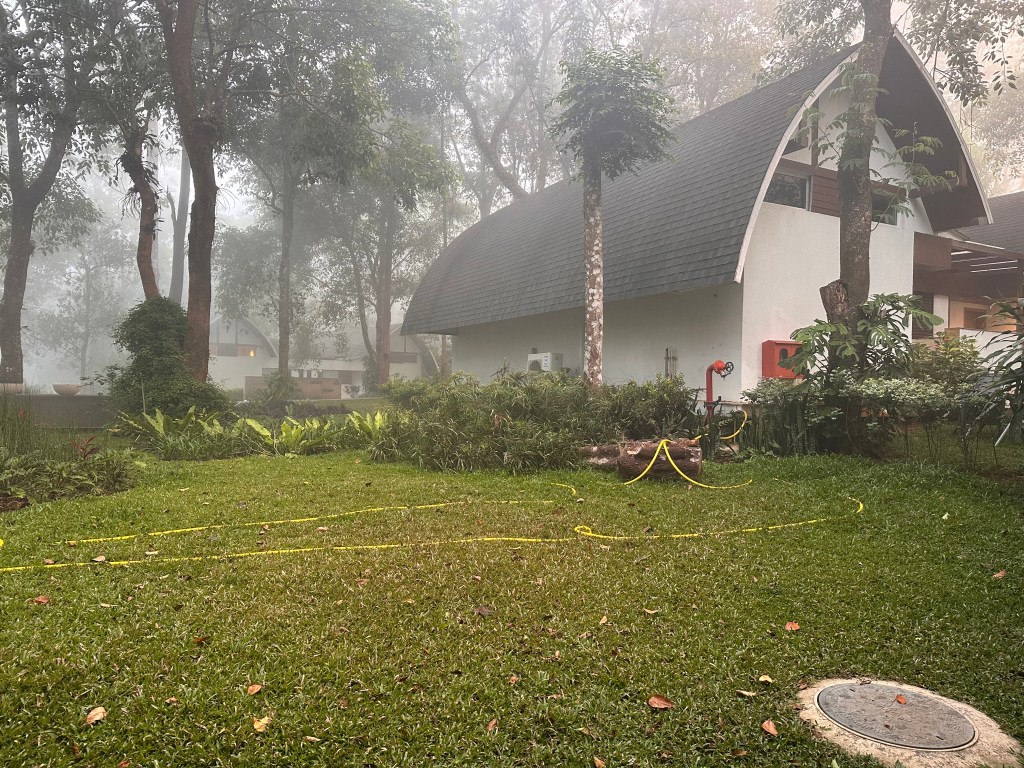
Our accommodation at the Marriott Resort & Spa in Coorg exceeded expectations. We chose a plantation villa that provided the perfect retreat after our long journey. The comfortable beds ensured restful nights, while the spacious balcony offered an ideal setting for morning meditation overlooking the lush plantation landscape.
The resort’s well-maintained pathways provided excellent routes for our morning walks, allowing us to explore the property while enjoying the crisp Coorg air. The bathrooms were impressively large—luxuriously so—with high-end fixtures and amenities that enhanced our comfort.
Situated in the heart of Coorg, the resort struck a perfect balance between luxury and natural beauty. We made the most of our stay by exploring the scenic surroundings, indulging in the resort’s delicious cuisine, and spending leisurely hours by the inviting swimming pool. Taking refreshing dips in the pool became a daily highlight, offering welcome relaxation amid Coorg’s serene environment.
Coorg—Where Peace Comes with a Side of Coffee
Our trip to Coorg wasn’t about frantically checking tourist attractions off a list. Instead, we embraced the simple pleasures: savoring great food, enjoying the natural surroundings, and spending quality time with family without the usual distractions.
Coorg’s coffee was a genuine highlight. Rich with distinctive local character, it made our morning cups special. The regional spices added unexpected depth to every meal, while the fresh fruits offered sweet rewards after our relaxing walks through the plantations.
The resort provided just the right atmosphere—a place where we could truly disconnect and find that elusive sense of calm that seems to evaporate in our daily lives. The days unfolded gentler, measured in conversations and quiet moments rather than schedules and obligations.
Coorg delivers beautifully if you’re seeking a getaway where crowds are scarce, and nature takes center stage. It’s the kind of place where you can finally exhale completely and remember what relaxation actually feels like—something increasingly rare in our hyperconnected world.
Vietnam had always been on my bucket list, but we hadn’t planned to visit it anytime soon. However, as 2024 drew to a close, perhaps inspired by the spirit of “revenge travel” or a spur-of-the-moment decision, we decided to make it happen—just in time. Our hectic work and travel schedules in November and December had left little room for early planning, but the allure of Vietnam proved irresistible, and we finally set our sights on this incredible destination.
This destination was initially tagged as a “plan-it-yourself” trip, but the last-minute nature of our decision made us turn to a holiday agent—MakeMyTrip. They were highly responsive and efficiently planned the key attractions for us, ensuring we didn’t miss the important highlights.
We managed to get our e-VISA just in time, though we were already considering a Plan B. The process typically takes 5-8 days and requires specific documents: a scanned, colored copy of the passport’s front and back pages with at least six months of validity, a recent photo (35 x 45 mm) with a white background (no visible teeth or glasses), and a PDF of the round-trip tickets. While it was a scramble, the heavy lifting and follow-up were expertly handled by the MakeMyTrip VISA team, leaving us with nothing to do but worry and wait.
While there are direct flights available, our last-minute travel plans meant we had to reach Hanoi with a layover in Bangkok.
Day 1: Hanoi – Where the Old Meets the New
We stayed at the Hanoi Daewoo Hotel, situated at 360 Kim Ma Street in the Ba Dinh District. The hotel provided a peaceful retreat in the heart of the city. Although it isn’t located directly in Hanoi’s bustling Old Quarter—approximately 4 to 5 kilometers away in the Hoàn Kiếm District—it offers convenient access to key attractions. A quick Grab ride, typically 15 to 20 minutes, easily takes you to the Old Quarter. After a tiring overnight journey with a layover in Bangkok, we were eager to rest yet excited to start exploring Hanoi.
Lotte Center Skydeck
Since we couldn’t get an early check-in, we started our day by visiting the Lotte Center Skydeck, conveniently located near the Hanoi Daewoo Hotel. The Skydeck offers breathtaking panoramic views of the city and is a must-visit for its stunning scenery. The highlight is the Skywalk, a glass-floored section that provides a thrilling experience and a unique perspective of Hanoi. Additionally, there are coffee shops where you can enjoy a classic Vietnamese coffee (more on that later) and some VR games that entertain the kids and add to the fun for everyone.
Hanoi Train Street
After visiting the Skydeck, checking into our room, and enjoying lunch at the hotel, we headed to Hanoi’s Train Street (HTS). Online, we found out there was a train scheduled at 3:30 PM. HTS is a unique and thrilling attraction where a narrow residential street comes alive as a train passes just inches away from homes and cafes. Lined with colorful buildings and bustling with local life, it’s a fascinating place to watch the train squeeze through while sipping Vietnamese elixirs (coffee, beer) and munching Vietnamese food from one of the cozy cafes. This blend of daily life and adventure makes it a must-see in Hanoi.
9:00 PM Train @ Hanoi Train Street
Unfortunately, we missed the 3:30 PM train due to traffic, and by the time we arrived, it had already passed. Determined not to miss the experience, we tried again on another night, and the photo we captured was of the nighttime train. The atmosphere was electrifying as the train approached—the warning bell rang, shopkeepers hurriedly moved their chairs indoors, guards cleared people off the tracks, and some even placed beer bottle caps on the rails to flatten them as the train sped by. When the train finally roared past, the crowd erupted in cheers and applause, awestruck by the thrilling spectacle.
If you’re wondering whether to visit this place during the day or at night, I’d highly recommend going at night! The glowing lanterns and the lively, international noisy crowd make it a truly magical experience. Be sure to check the train schedule in advance or ask the café owners for timings. One café owner told us there was a train at 8:30 PM, but the train we ended up seeing arrived at 9:00 PM. Initially, we thought it was a ploy to keep us there longer to eat, drink, and spend more, but it turned out to be worth the wait!
Lotte Aquarium
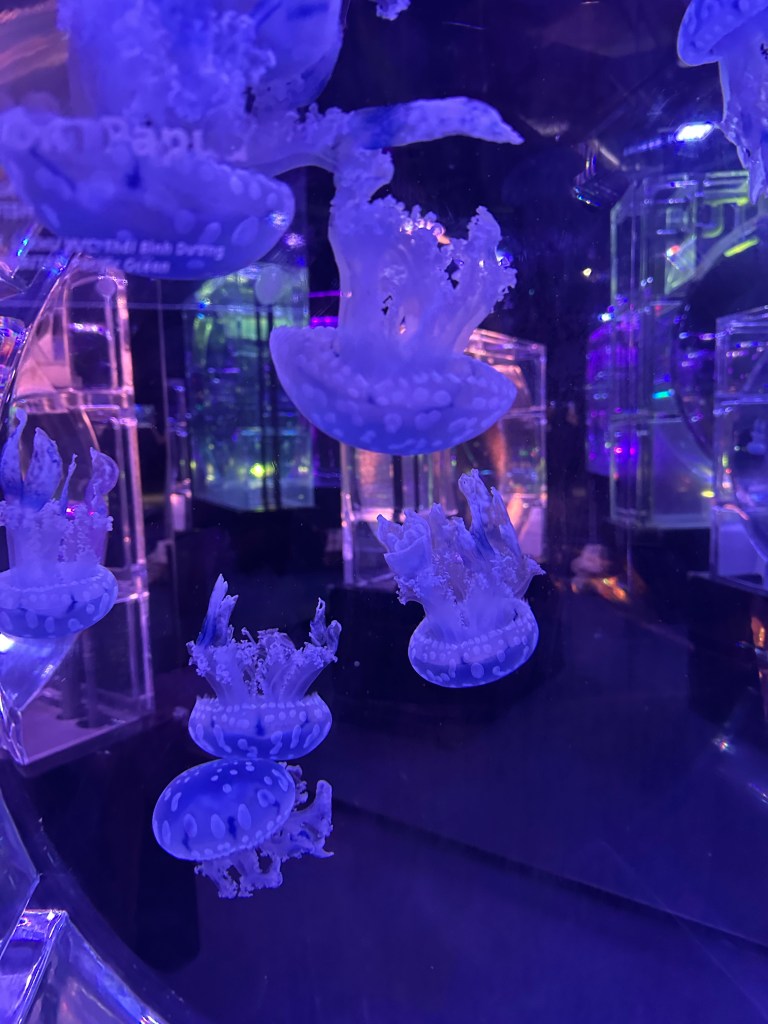
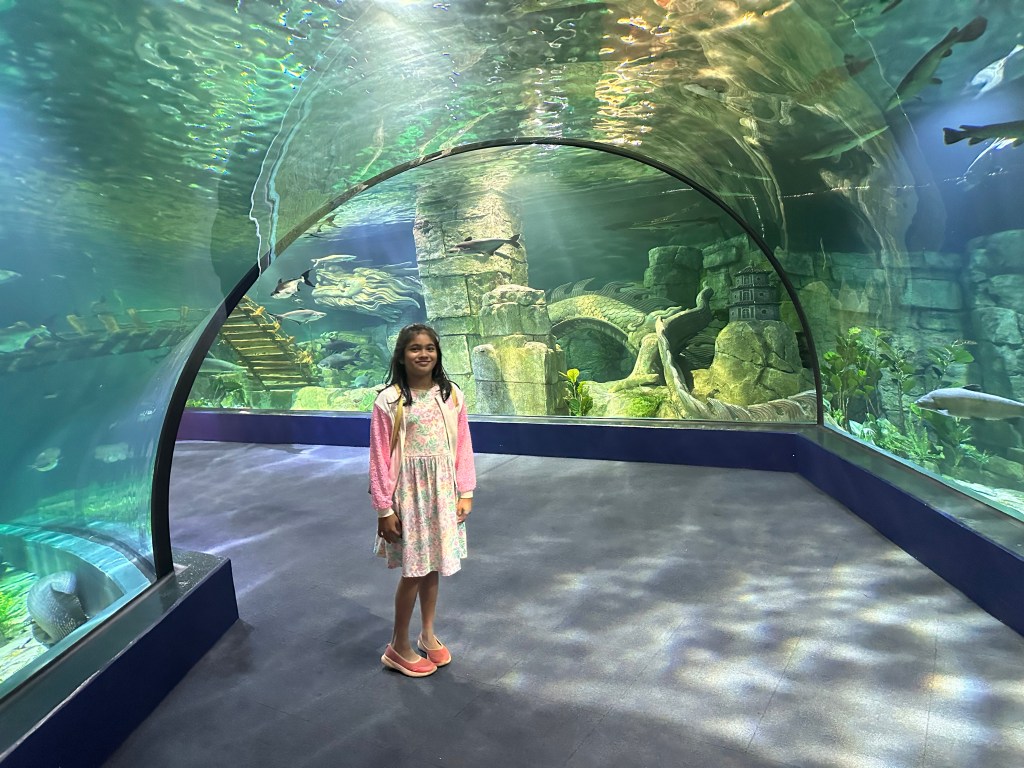
After visiting Hanoi Train Street (HTS), we headed to the Lotte Aquarium, having purchased a combined ticket for both the Skydeck and the aquarium. Located within the Lotte Center near West Lake, just a 20-minute drive from the Daewoo Hotel, this modern aquarium is an excellent destination for families. It offers an immersive experience showcasing diverse marine life, from vibrant coral reefs to mesmerizing jellyfish displays. A highlight for my child was participating in pearl harvesting, where she watched a pearl oyster being opened to reveal a pearl, which could then be crafted into jewelry. She also enjoyed the hands-on experience of touching marine creatures like shellfish, crabs, and starfish. The aquarium fosters a magical connection with the underwater world, making it a fun and educational outing for all ages!
The Dinner Disaster
The food in Vietnamese malls and hotels is predominantly non-vegetarian, with beef and pork being common ingredients. Both my wife and I stick to seafood and chicken but avoid red meat, while my daughter eats eggs and is just starting to experiment with chicken—though she won’t go near seafood or red meat. This made finding suitable food in the malls quite challenging, as most dishes contained beef or pork. In the end, we settled for ice cream instead.
Communication in Vietnam posed another challenge, as English is not widely spoken or understood. We quickly adapted by using Google Translate to communicate, a skill we relied on heavily. The girls were eager to try the iconic Vietnamese Pho, but given the limitations, we returned to our hotel and ordered chicken and vegetarian Pho instead as part of the dinner buffet. 80% of the buffet was out of reach!
Day 2: Ha Long Bay – Nature’s masterpiece
The day-long trip to Ha Long Bay began early, with a 7:30 AM meeting time at a designated point (for us, it was the Hanoi Opera House). A car transported us from our hotel to the meeting point, and punctuality was key—everyone adhered to the schedule, with a call from the driver/guide, 10 minutes in advance to ensure we were ready. From the meeting point, buses or limousines carried passengers to Halong Bay. At each stop, tour guides stepped off the bus to locate their assigned travelers, calling out names, scanning faces, and matching passengers with their groups—a lively process that felt like a cheerful treasure hunt.
The journey to Halong Bay shared with strangers (an international crowd from Japan, Taiwan, Mainland China, Australia, France, India, Germany, South Africa, and Jamaica), made for a lively and engaging travel experience. The tour guides, brimming with humor and charm, kept us entertained with amusing anecdotes, intriguing historical tidbits, and a detailed overview of the day’s itinerary. Their lively storytelling added a unique touch to the ride, making it both informative and enjoyable. However, when the tour guide took a break from narrating, the bus quickly fell into a peaceful silence as most passengers drifted off to sleep.
Cruise & Lunch
Tuan Chau Harbor
After a 2.5-hour drive, with a couple of planned and emergency pit stops, we arrived at Tuan Chau Harbor to board the boat and began our excursion exploring the stunning beauty of this UNESCO World Heritage Site. Onboard, we enjoyed a set menu lunch featuring a variety of Halong’s special dishes. Passengers were seated based on their dietary preferences, which ranged from vegan and vegetarian to non-vegetarian with specific preferences like eggs, beef, pork, or seafood. The guide carefully arranged seating to prevent conflicts, especially avoiding solo travelers claiming the best spots—a surprising number of whom were on the trip.
The food was excellent, and my wife and I opted for the seafood menu, which was a highlight for us. However, my daughter didn’t enjoy the vegetarian options and decided to rely on chips and chocolate for the rest of the day. Even that proved tricky, as many snacks in Vietnam are flavored with pork, beef, or seafood, making her scrutinize every label carefully before digging in.
TiTop Island
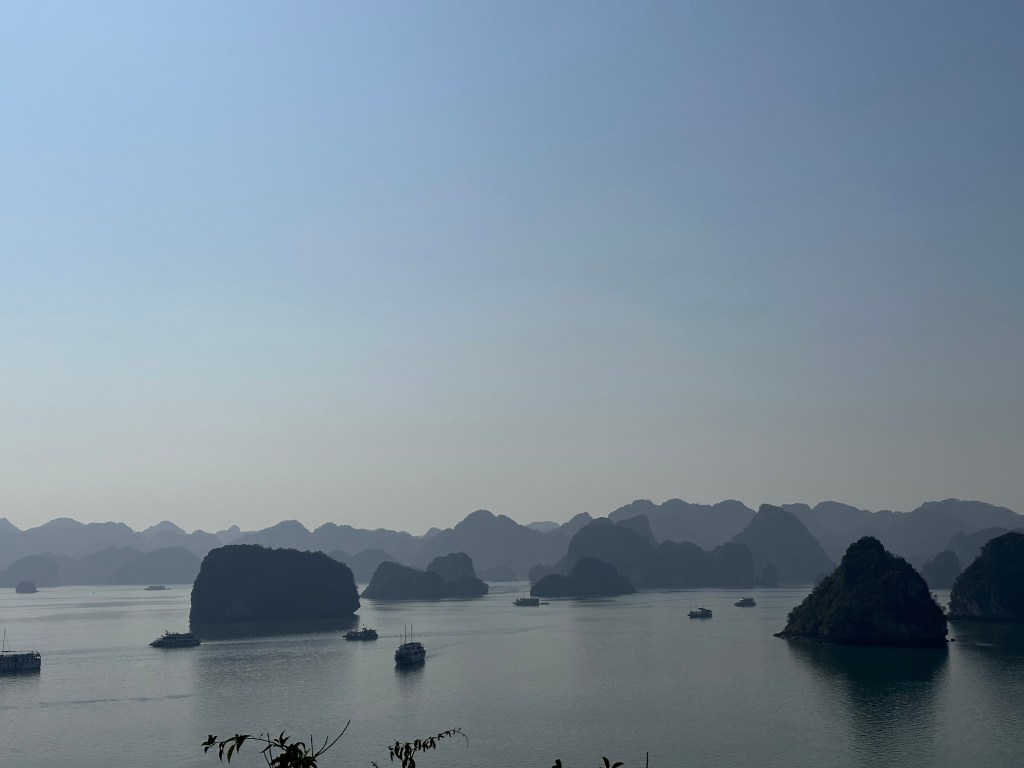
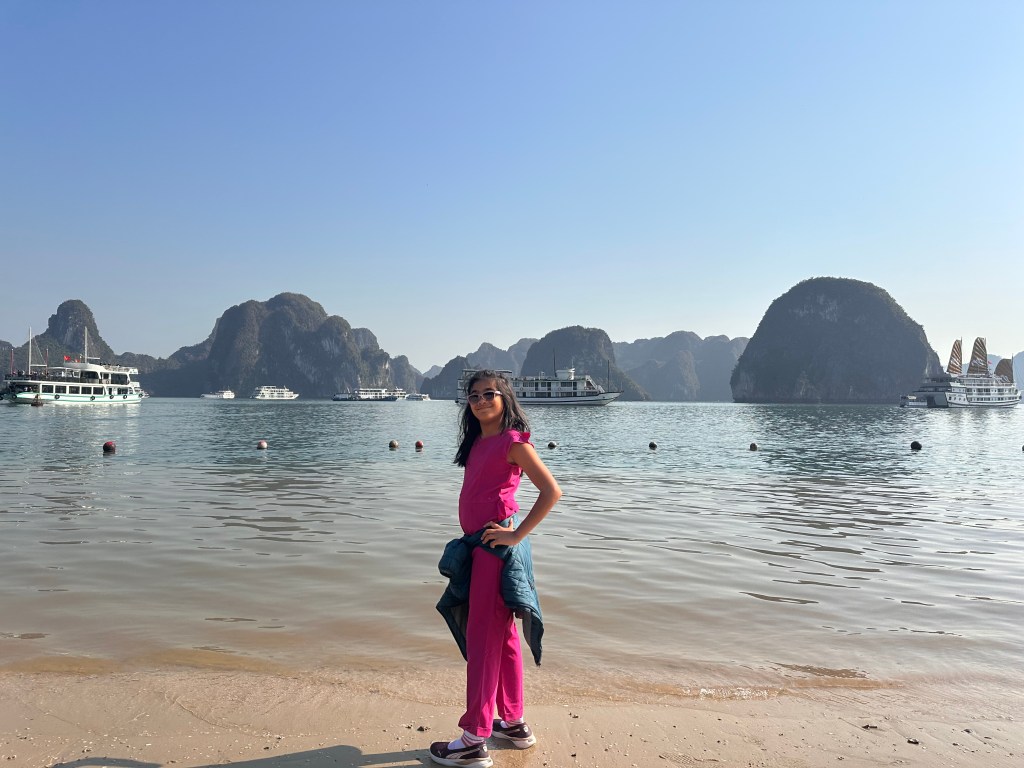
After lunch, we headed up to the deck to enjoy the stunning views of the islands and capture some photos. Our next stop was TiTop Island, where visitors could choose to swim or hike to the top for the best view. We opted for the trek, eager to take in the panoramic scenery. Each limestone island in Halong Bay is uniquely named based on its appearance, such as Chicken Island, adding to the charm of the experience. The hike to the top was steep, with over 500 steps, but the mesmerizing view made every step worth it. At the summit, we treated ourselves to refreshing coconut water, snapped some memorable pictures, and soaked in the breathtaking landscape before heading back down to rejoin the cruise.
Luan Cave
Luan CaveDragon CaveParty Cave
Our first stop after the hike was Luon Cave, located on Bo Hon Island. The area surrounding Luon Cave is rich with well-known attractions in Halong Bay, making it a hub of natural beauty. Directly in front of the cave is Turtle Island, while Heaven Gate lies to its right, adding to the picturesque setting.
Visitors have several options to explore Luon Cave: paddling through its waters by kayak, gliding on a traditional bamboo boat, or opting for a speedboat tour to see nearby attractions. We chose the speedboat, and it turned out to be an exhilarating experience. The driver skillfully maneuvered the boat, creating an adrenaline rush as we sped across the water. Along the way, our guide pointed out fascinating landmarks like Dragon Cave, Stone carved Lotus, and Mermaid, each adding a touch of wonder to the journey. It was a thrilling and memorable way to experience the beauty of Halong Bay.
Sung Sot Cave
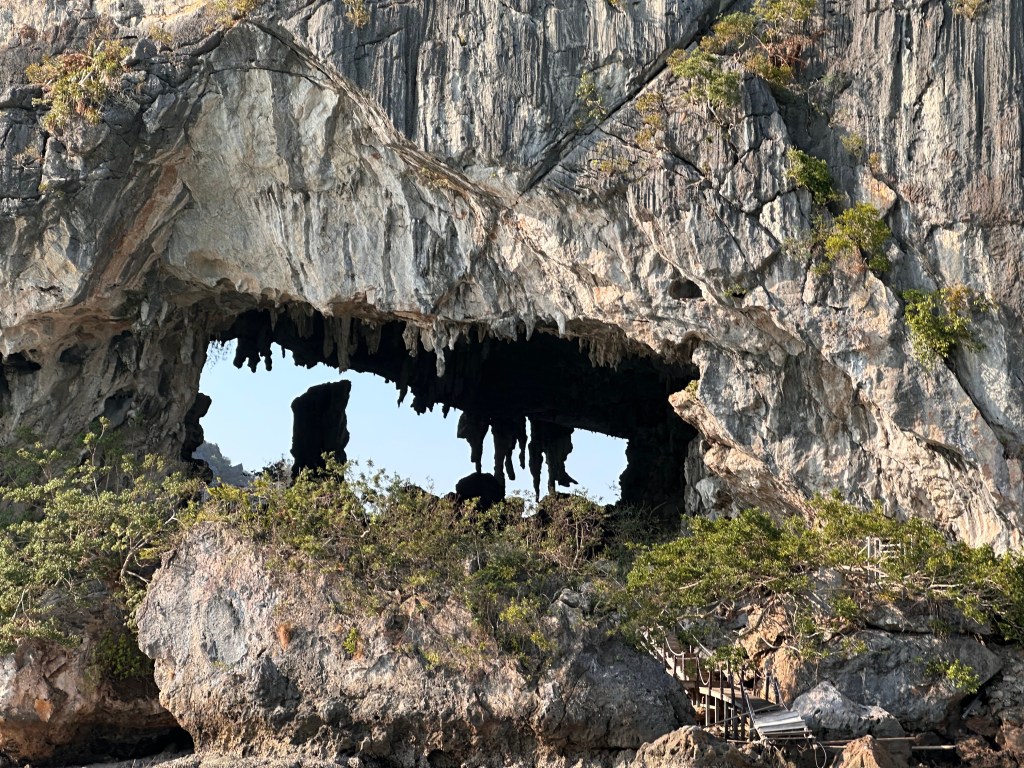
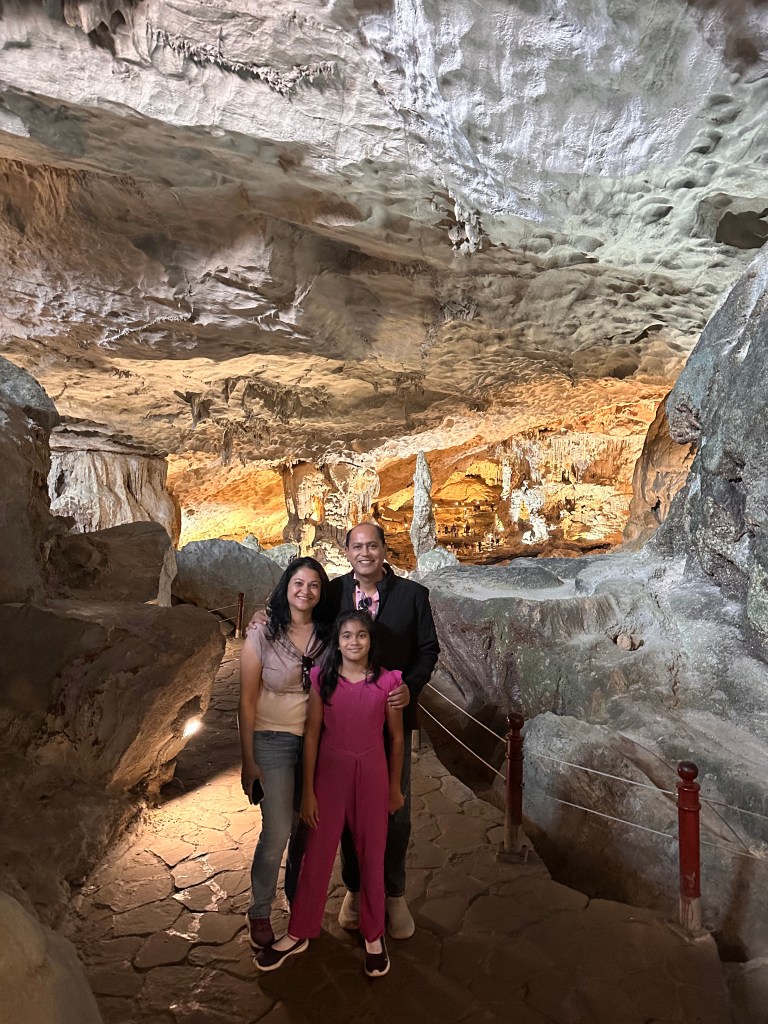
Our next destination was the famous Sung Sot Cave, or the “Surprising Cave,” located on Bo Hon Island. As we approached, our tour guide shared fascinating details about the cave’s history and its unique features, preparing us for the experience. However, we were greeted by a long line of eager tourists—proof of the cave’s popularity as one of Halong Bay’s must-see attractions. Sung Sot Cave is a natural marvel, consisting of three chambers: a small entry chamber, a middle chamber, and an expansive, grand chamber that lives up to its name. Spanning a 2-kilometer walk, the cave is adorned with stunning stalagmites and stalactites that have been shaped over millennia by dripping water and time. The formations take on fascinating shapes and textures, sparking the imagination as you stroll through the illuminated path. The grand chamber, the highlight of the cave, is particularly breathtaking, with its vast space and dramatic formations. It’s no wonder the cave is named “Surprising”—its sheer scale and beauty leave visitors awestruck. Despite the crowd, the experience was well worth it, as we explored one of the most beautiful caves in Halong Bay.
Sunset
The return to the harbor was serene, a perfect end to our day at Halong Bay. As the sun set, the golden light reflected on emerald waters, casting a warm glow over the limestone islands. A gentle breeze carried a sense of tranquility, washing away urban stress. Standing on the deck, surrounded by nature’s beauty, we felt a profound peace—a magical moment that makes Halong Bay unforgettable.
Day 3: Ninh Binh Tour
The day began even earlier than Day 2, as we prepared to meet a new group of strangers at a different meeting point. Our guide, Mr. Luca, was a bit of a newcomer to managing a large bus tour, having mostly handled smaller limousine groups before. The itinerary for the day included a 110 km drive filled with diverse activities planned by the tour team: a visit to a historic temple, a cycling adventure, a serene boat ride, and a trek through stunning landscapes.
Dinh King Temple
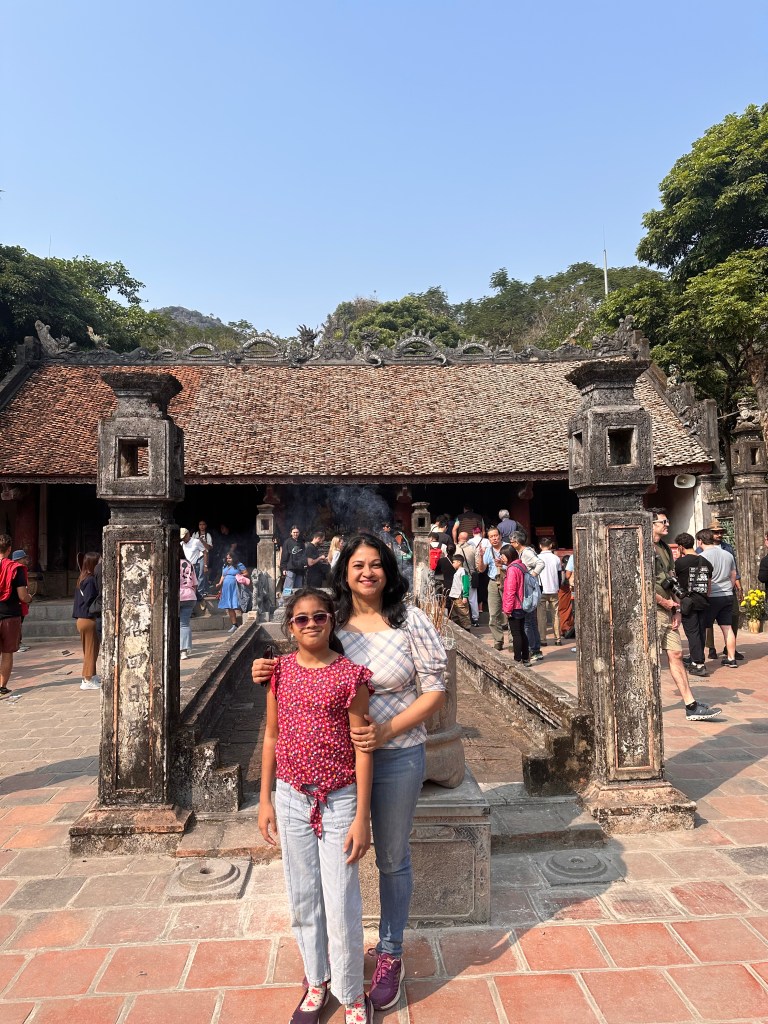
The first stop was a temple. The Dinh King Temple is located in the ancient capital of Hoa Lu and was built in honor of Emperor Dinh Tien Hoang, who founded the Dinh Dynasty in the 10th century. The temple reflects the spiritual depth of Vietnam’s early dynasties. Intricate carvings of dragons, phoenixes, and mythical creatures adorn the temple, symbolizing strength, prosperity, and protection.
Vietnamese culture has deep-rooted connections to kingship and spirituality, with temples serving as both places of worship and symbols of reverence for past rulers. The five elements—metal, wood, water, fire, and earth—play a significant role in traditional Vietnamese cosmology, representing harmony between humanity and the natural world. The Vietnamese people are believed to embody characteristics of these elements based on their birth year. These elements shape compatibility in relationships, especially marriage. For example, water nourishes wood, making individuals of these elements a harmonious match, while fire and water may clash.
Cycling and Lunch
Our second stop was for a short cycling tour followed by lunch. Cycling was a fun way to work up an appetite while exploring the land like traditional Vietnamese locals. However, the cycle was a bit too large for my daughter, so she decided to piggyback while I pedaled through the scenic route. She did try it when there was no traffic! Along the way, there were plenty of photographers (paparazzi) ready to capture the moment, making us feel like celebrities!
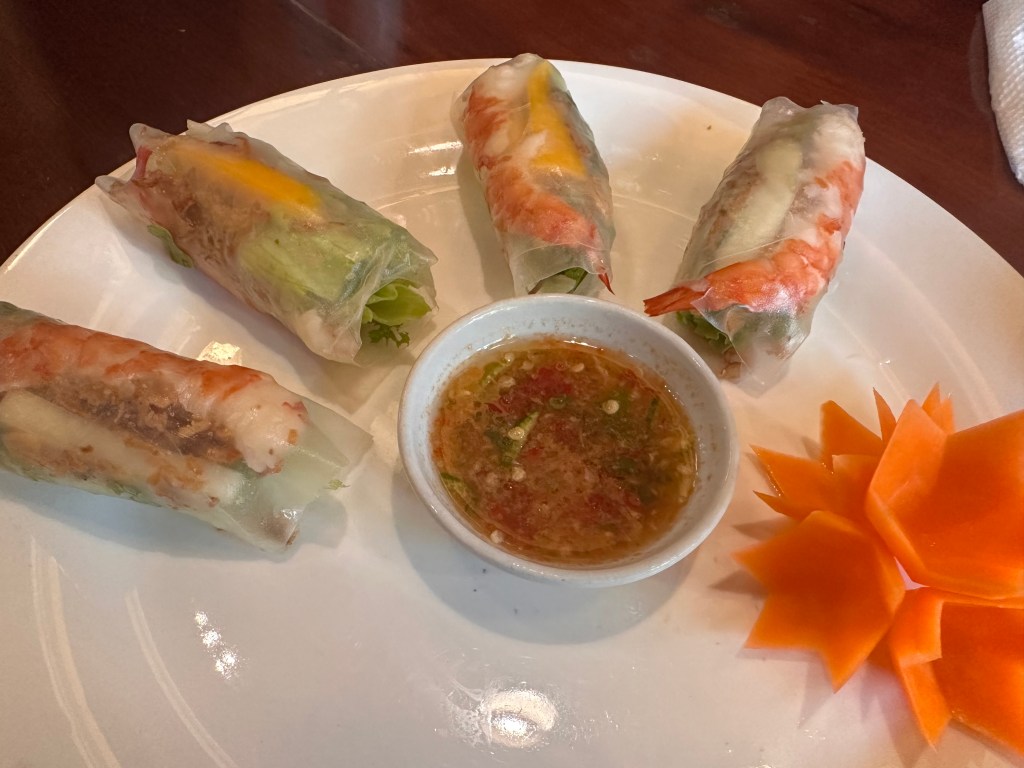
Exploring the countryside on a bicycle offered a unique perspective, reminiscent of our cycling adventure in the paddy fields of Bali. Though this tour was brief, lasting about 30 minutes, we spent a memorable time winding through peaceful villages. The activity got our metabolism going, and we rewarded ourselves with a delicious Vietnamese lunch. A highlight of the meal was the fresh spring rolls—thin rice paper wraps filled with vegetarian or other tasty fillings. Healthy, light, and full of flavor, they were a perfect treat after the ride.
Trang An Grottoes
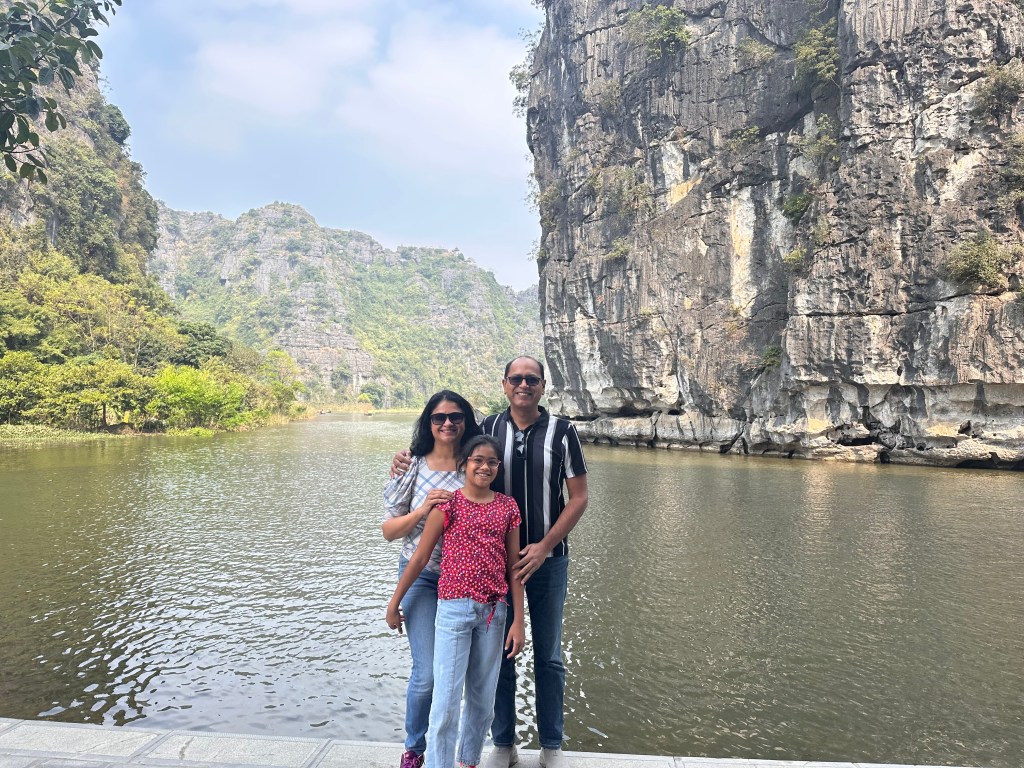
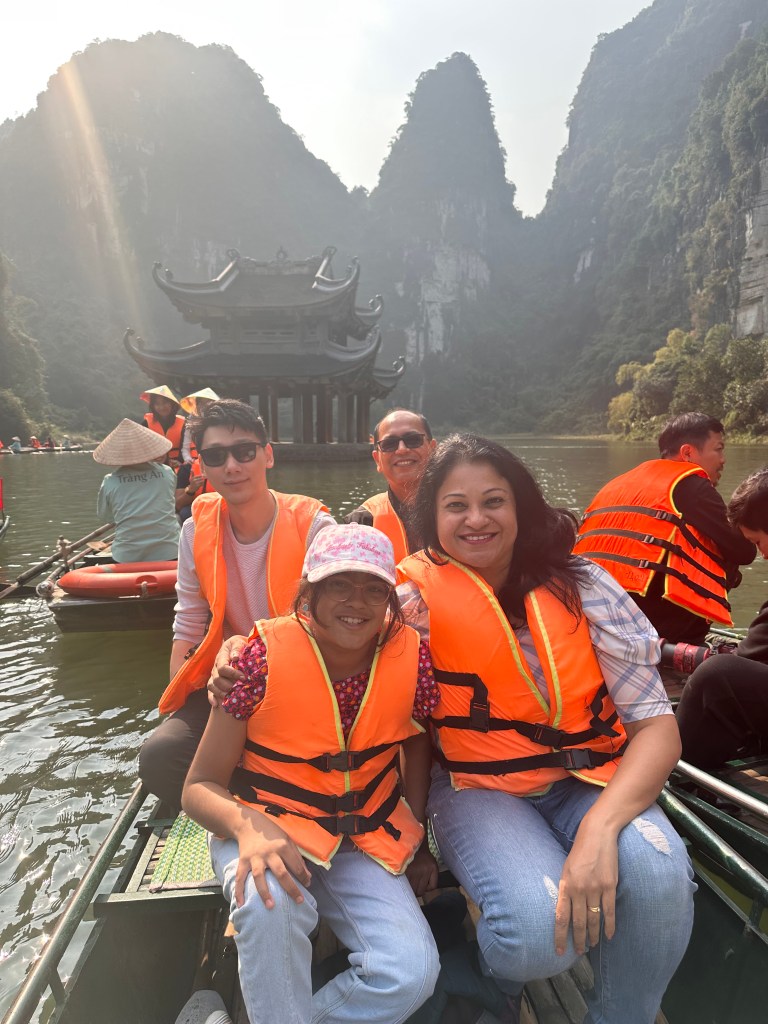
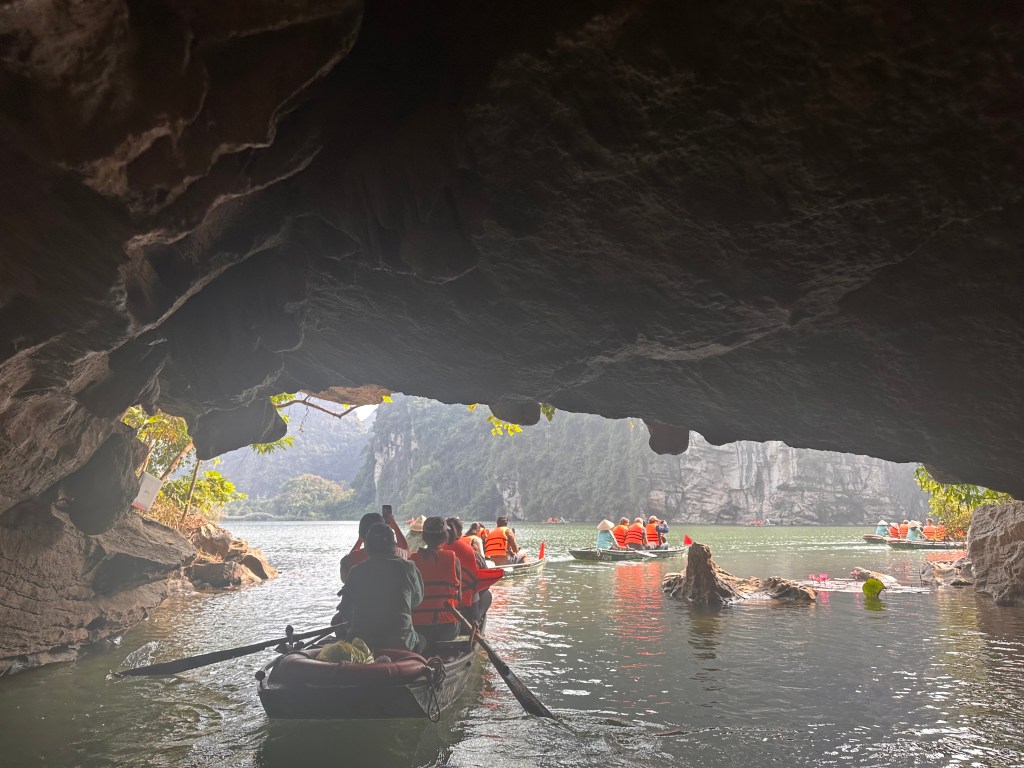
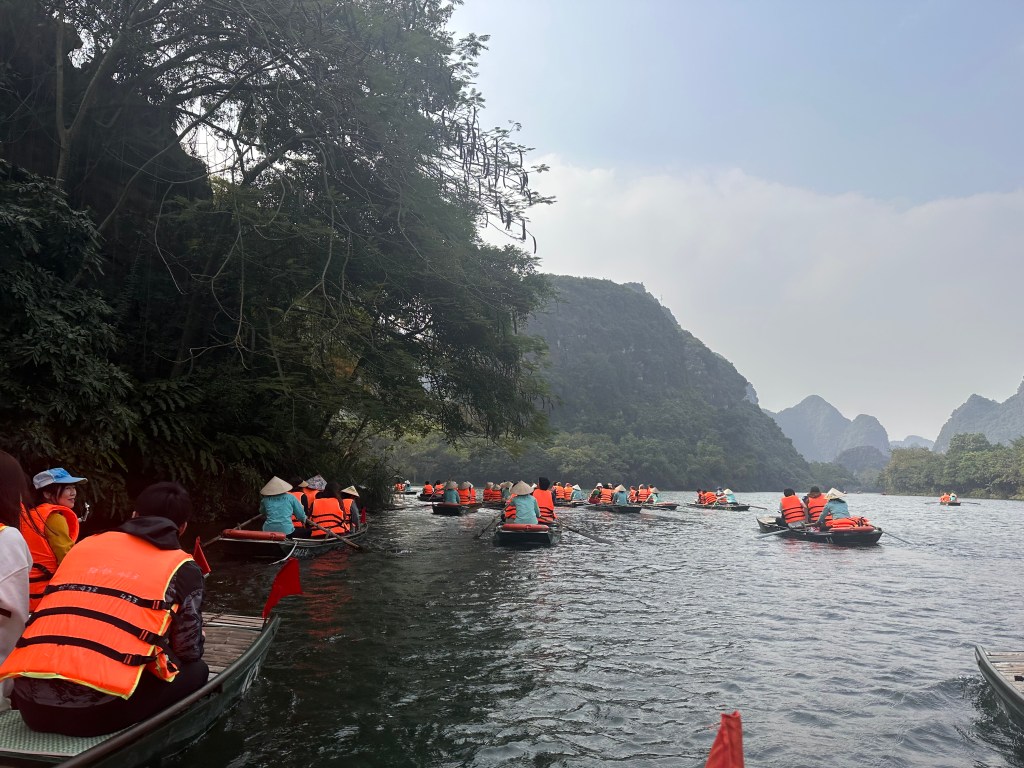
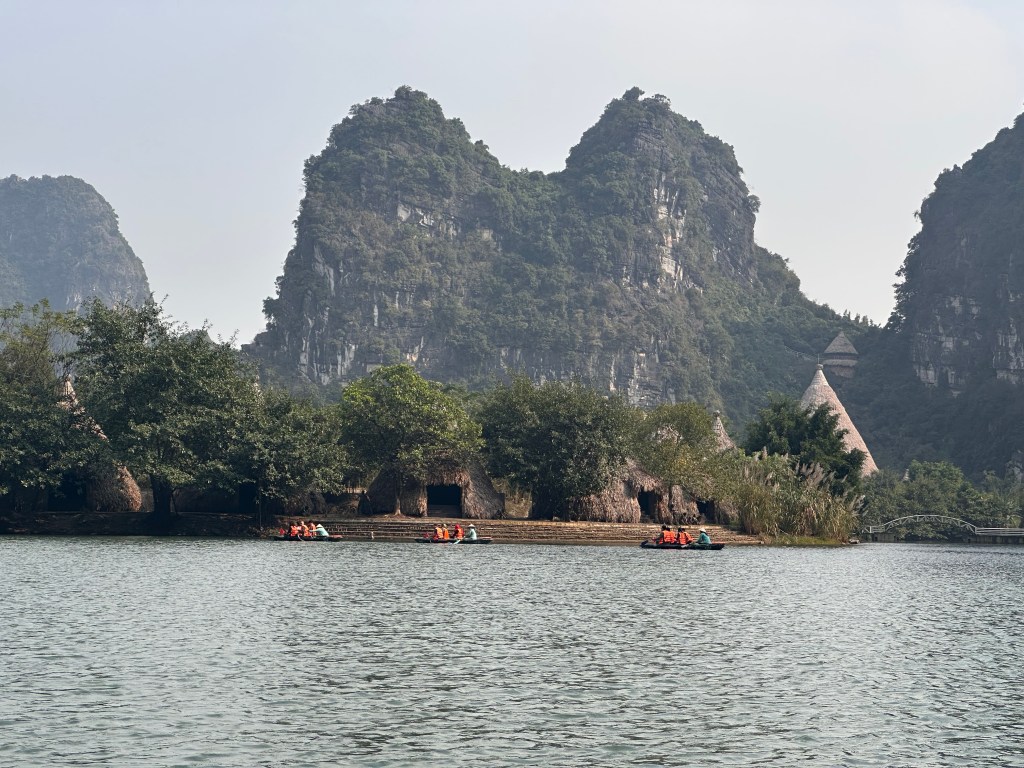
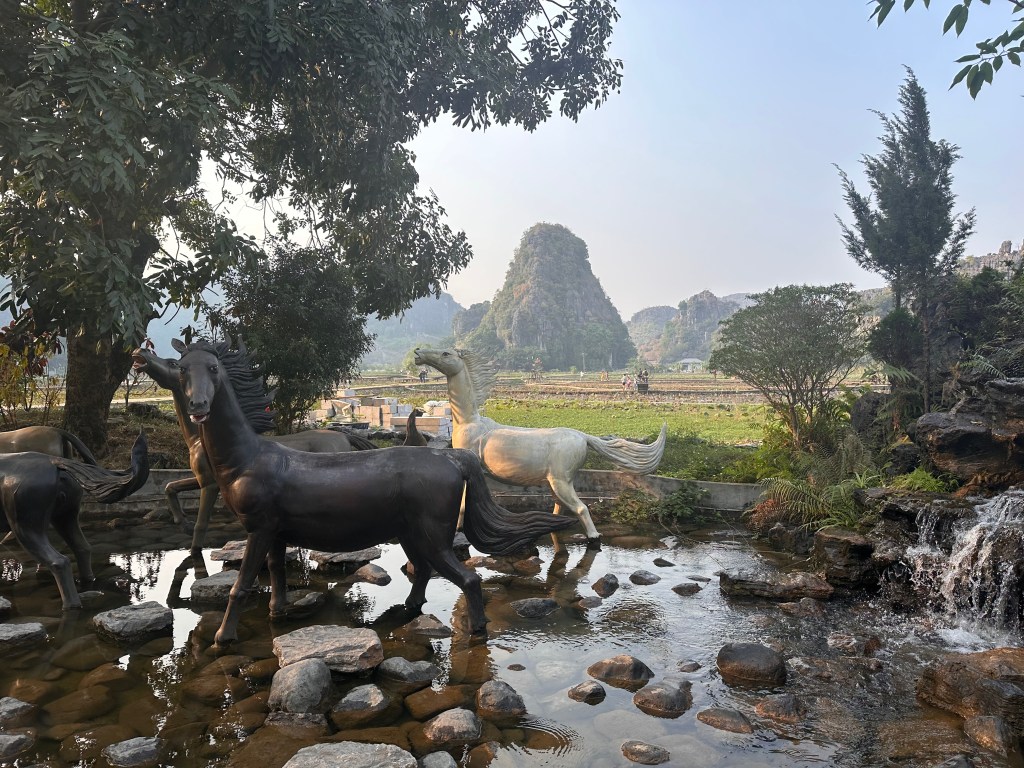
The afternoon was spent on a tranquil ride in traditional sampan boats, their unique design adding to the charm of the experience. These flat-bottomed wooden boats are rowed by local women (always talking and making jokes) and can accommodate up to four passengers. The ride felt like being part of a school of fish, effortlessly flowing together in perfect rhythm through the water. The cool weather enhanced the magic as we glided through the Trang An Caves, a mesmerizing network of interconnected caves and waterways surrounded by dramatic limestone mountains. However, caution was necessary—low cave ceilings meant you could easily bump your head if not careful!
Along the way, we stopped at ancient sites like Cao Son Temple and Suoi Tien Temple, nestled amidst lush greenery. These stops not only offered a chance to explore the spiritual history of the area but also served as a welcome restroom break during the two-hour journey.
Trang An’s ethereal beauty has also earned it international recognition as a filming location for Kong: Skull Island. Its otherworldly landscapes bring to life the feeling of stepping onto a movie set, blending stunning natural scenery, rich history, and a touch of cinematic magic.
Ngoa Long (Lying Dragon) mountain
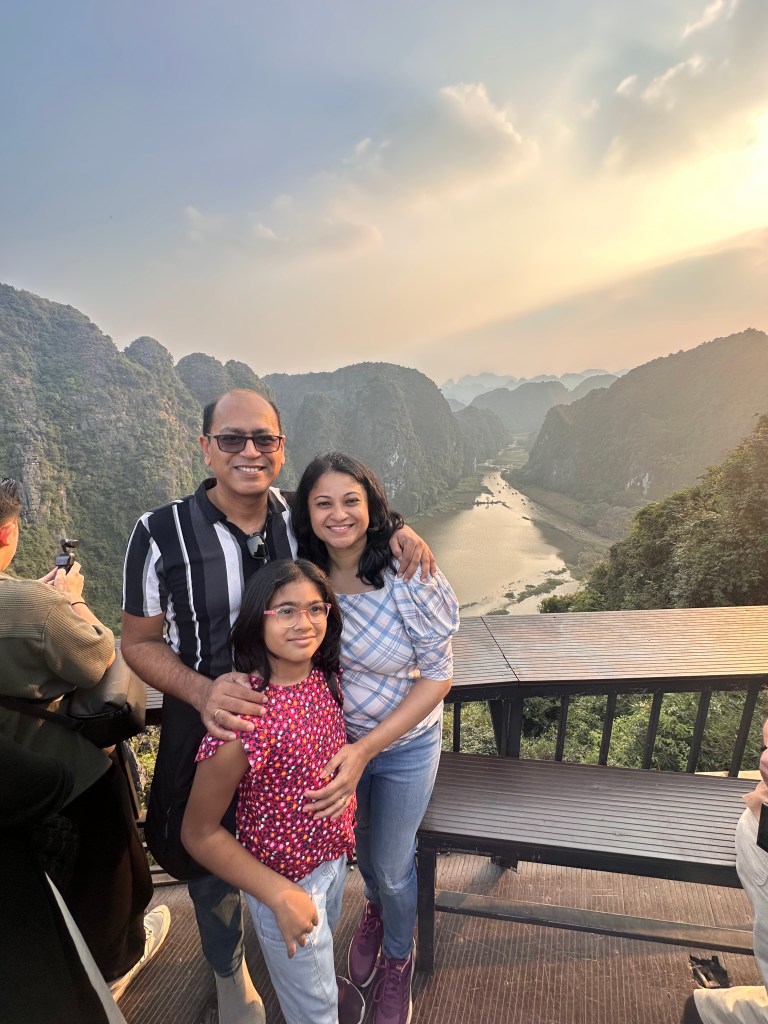
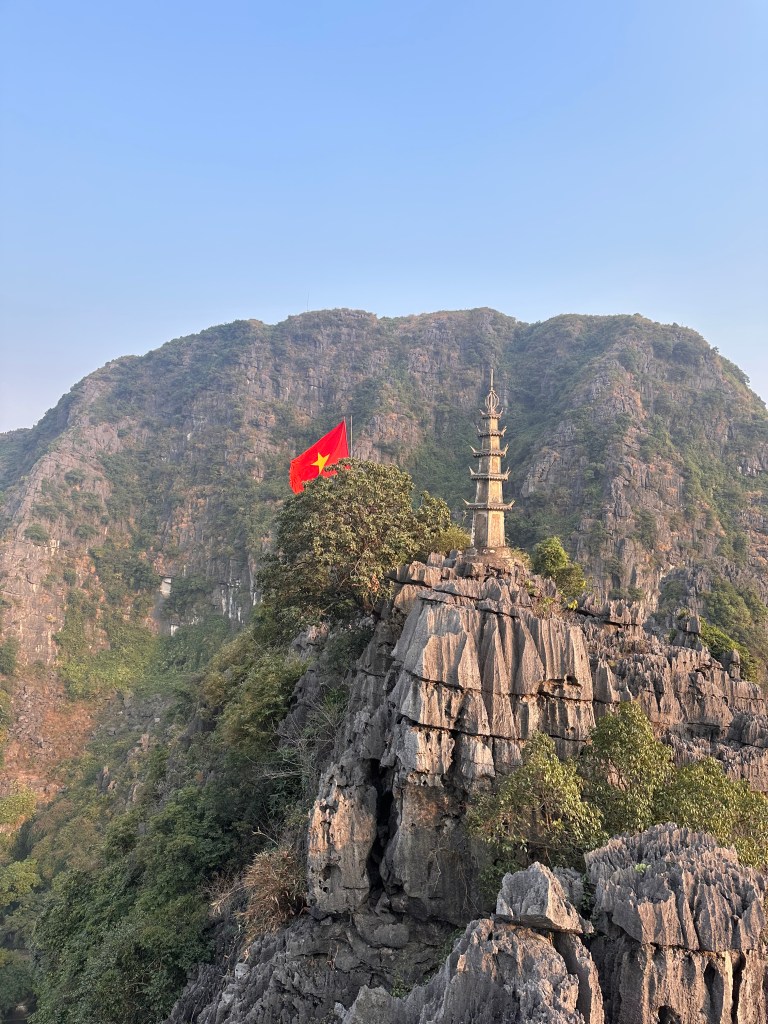
The Ngoa Long Mountain, located in the Mua Cave area, offers one of the most stunning panoramic views in Ninh Binh. A popular trekking spot, it’s often said, “A trek a day keeps stress away!” Our guide cheerfully estimated 20 minutes to climb up, 20 minutes to soak in the views, and 20 minutes to descend—but the reality is never quite so balanced. The climb is steep, with two routes: a steeper left side boasting spectacular vistas and a slightly easier right side. We opted for the more challenging left route, navigating short, steep steps that tested our endurance.
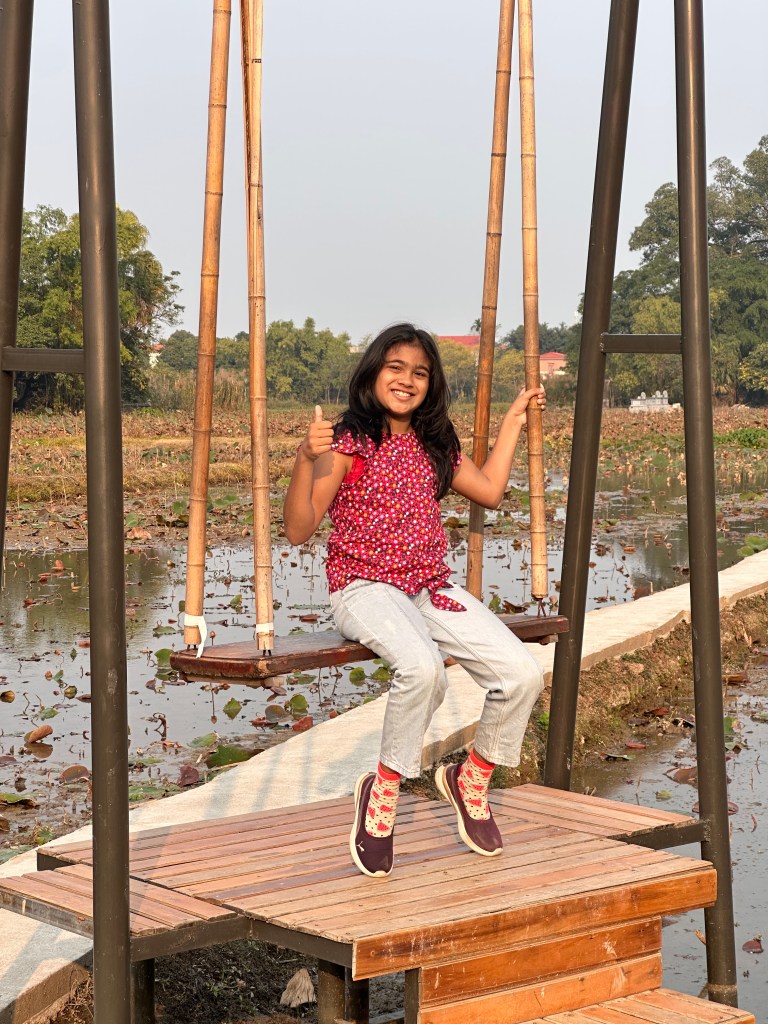
Before tackling the ascent, we took a leisurely walk around the tranquil lotus ponds, capturing some beautiful photos. The climb was rewarding, and at the summit, the breathtaking view of rice fields, limestone karsts, and the surrounding landscape made every effort worthwhile. Ngoa Long Mountain is truly a trekker’s delight and a photographer’s paradise.
Day 4: Da Nang
We had an early morning flight to Da Nang (Flight VJ 503: Hanoi [HAN] to Da Nang [DAD], departing at 7:20 AM), which meant a hectic night of packing and an early scramble to the airport. Adding to the chaos, we had squeezed in a night visit to Hanoi Train Street—an experience we didn’t want to miss.
Sleep was scarce, coming in short bursts during the car ride, at the airport, and on the flight. Still, those quick naps were enough to recharge us for the day ahead. Our walking pace had shifted to “turtle mode,” and every step was a not-so-gentle reminder that our muscles were staging a protest after the Day 3 climb!
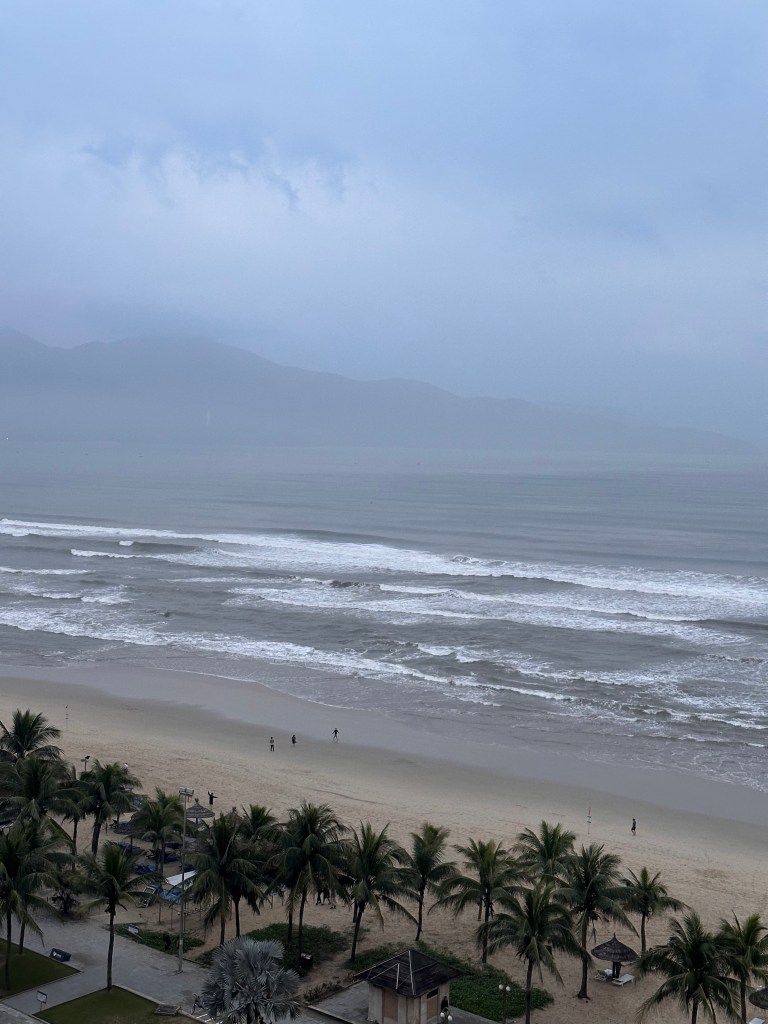
Once in Da Nang, we checked into Holiday Beach Resort, located on a beautiful stretch of My Khe beach. With no specific plans, we started the day with breakfast and a relaxing stroll along the shore. The waves were perfect for surfing, and we spent time watching skilled surfers and beginners alike tackling the high swells. We were not keen on jumping into the cold waters of the south china sea.
While soaking in the peaceful beach atmosphere, we spoke with our tour guide, who enthusiastically suggested visiting Hoi An. Her advice? “Just grab a taxi and go!” With no set plans, it felt like the perfect spontaneous next step.
Hoi An: Coconut Village
We visited the Hoi An Coconut Village and had an amazing time exploring its lush coconut groves. Riding in traditional round basket boats, expertly steered by local rowers (mostly men), we navigated through a maze of winding waterways. The guides entertained us with impressive boat tricks and even fished out crabs, adding to the excitement. The peaceful setting of the groves was beautifully complemented by the lively music and cheerful atmosphere. To make the experience even more special, we had a fun photo shoot, creating lasting memories of this vibrant slice of Vietnamese culture.
Hoi An: Old Town
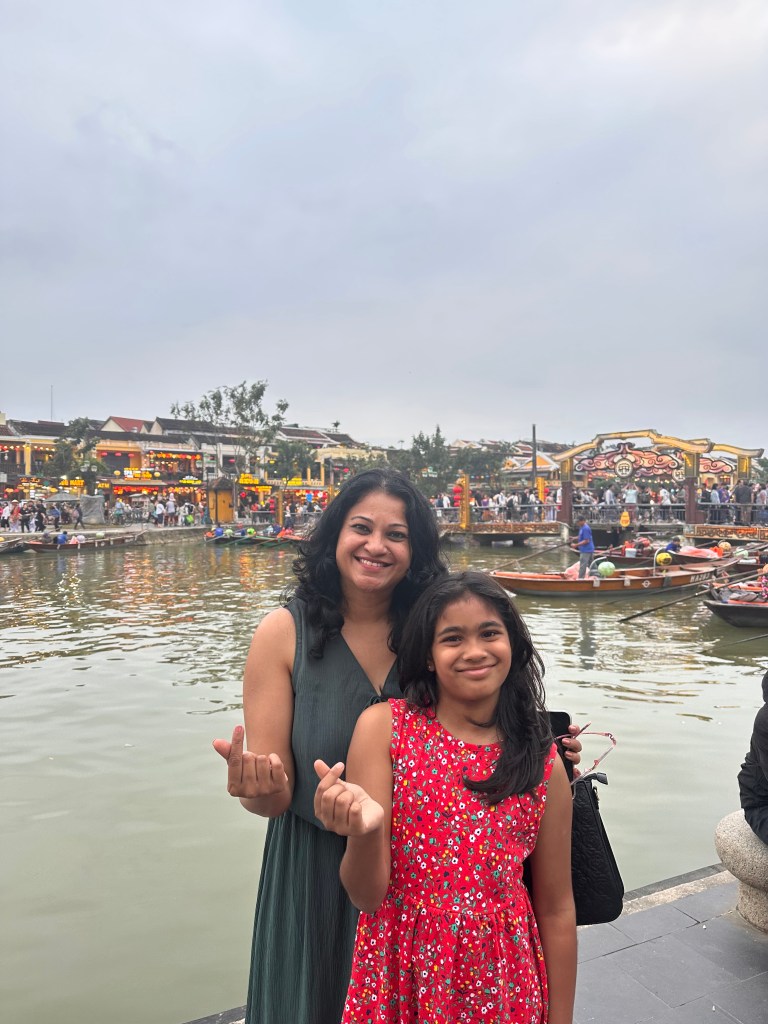
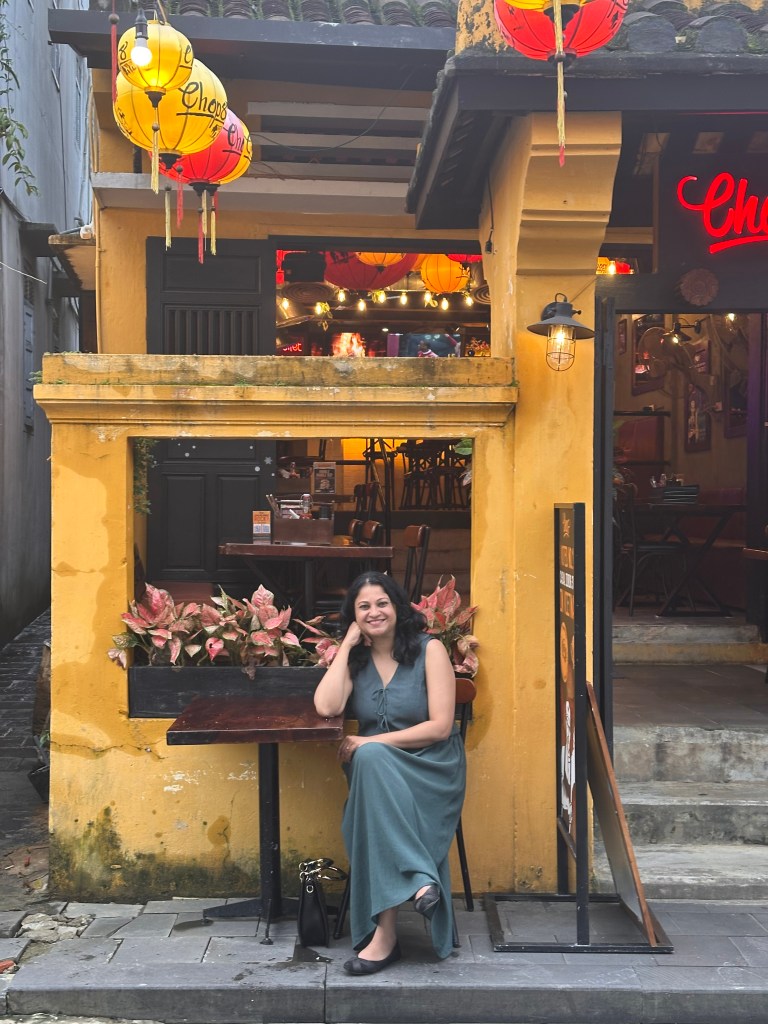
Awesome CafeFresh Spring RollsKorean Hearts!Yellow is the Pink here!Boats & LanternsStreet View
After visiting the Coconut Village, we hopped into another taxi and headed to Hoi An Old Town. The charming streets welcomed us with their iconic yellow buildings and bustling riverside vibe. Since most shops in Hoi An only accept cash, our first stop was an ATM before we began exploring.
We wandered through the streets, passing boatkeepers along the river and inviting us for the 10:00 PM lantern-lighting rides. Along the way, we stopped for ice cream and enjoyed a delicious Vietnamese lunch at Miss Ly Café. The town seemed to understand Indian travelers well—the kind waitress went out of her way to offer true vegetarian dishes alongside seafood and chicken options, which we really appreciated.
Of course, we couldn’t resist picking up a few souvenirs, but the highlight for the kids (and us!) was the smoky ice cream, which felt like a show in itself. We also tried some street fruits—mango and jackfruit—despite our kids’ humorous warnings not to. To end the evening, we watched a lively dance performance by the riverside, soaking in the cultural charm of Hoi An. It was truly a day to remember!
Smoking ice cream in Hoi An comes surrounded by liquid nitrogen vapor, creating a dramatic “smoking” effect as you eat it. The cool, foggy spectacle makes it feel like more than just dessert—it’s an experience! It’s a must-try for anyone looking to add a little flair to their culinary adventures in Hoi An.
Day 5: Ba Na Hills
It was the last day of the year, and we started early, joining a group of fellow travelers. This group was primarily “Indian,” but not everyone was from India. In Da Nang, the convenience of buses picking you up directly from your hotel was a nice touch. The ride to Ba Na Hills was scenic, and soon we were on the cable car, ascending through misty clouds with breathtaking views of the Mo Stream below.
The English of our Vietnamese tour guide took some effort to understand, but with patience on both sides, we managed just fine. Like school kids, we were assigned group numbers and had to respond to roll calls, adding a touch of humor to the experience.
Ba Na Hills, originally developed in 1919 as a French hill station, has since transformed into a vibrant tourist destination. It felt like a mix of Disneyland and Ocean Park Hong Kong. Nestled atop the Trường Sơn Mountains, it offered a fascinating blend of natural beauty and man-made attractions. The cloudy, cold, and rainy weather added an ethereal charm, making it feel as if we were walking among the clouds. Thankfully, we had packed umbrellas to stay prepared.
Our adventure began with the iconic Golden Bridge, held aloft by the massive “Hands of God.” We arrived early enough to snap some photos before the crowds descended. Getting a clear shot, however, was nearly impossible with so many visitors vying for the same goal. Professional photographers stationed there had software to remove other people from your photos, but their services came at a steep price.
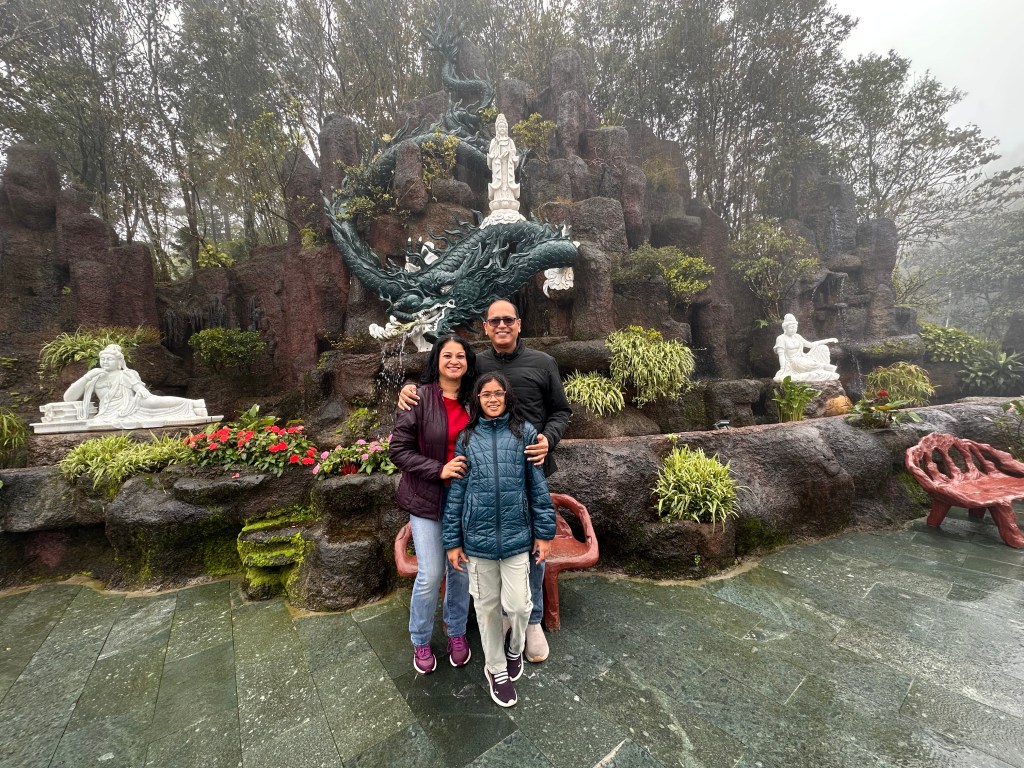
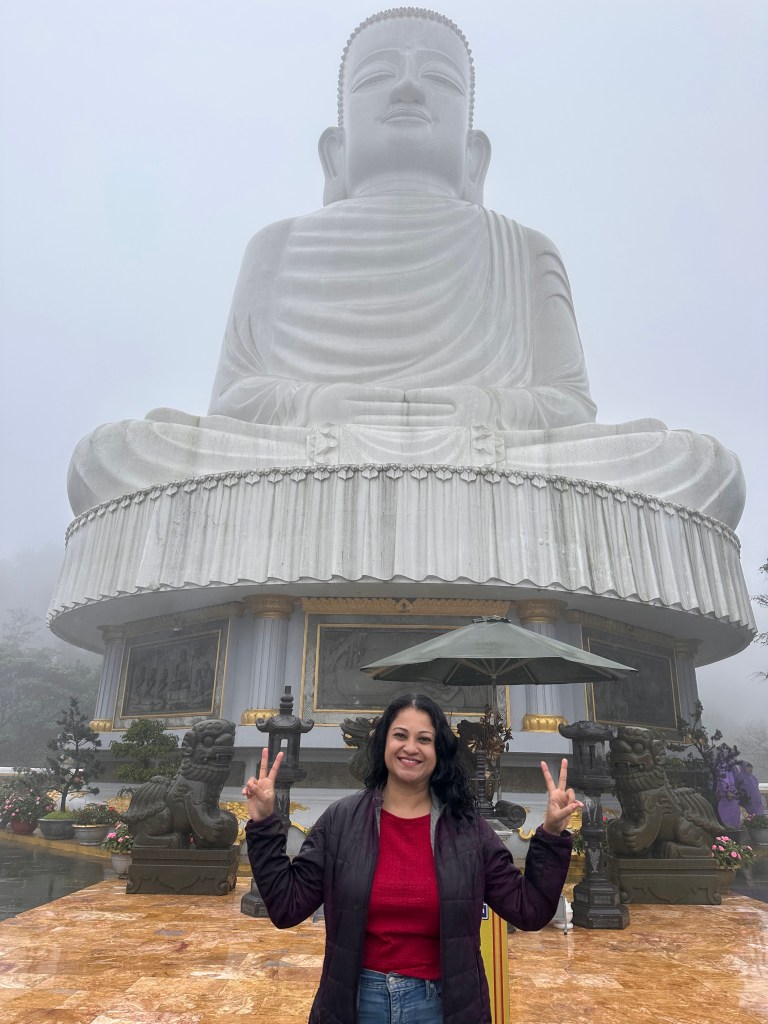
Expertly guided by our tour leader, we explored a variety of attractions, from the charming French Village to the peaceful 27-meter Buddha statue and the vibrant Flower Garden. Each stop felt like stepping into a different world, creating a truly diverse and exciting experience. We even took a tram ride to watch a 7D film, which transported us to fascinating places around the globe with its immersive visuals.
By lunchtime, my daughter was craving the comfort of a simple Indian meal. To help us beat the cold, we were treated to complimentary beers (truly elixirs from heaven). Our guide directed us to an Indian restaurant offering a buffet, which included plain dal and rice—just what my daughter wanted—alongside some pasta for variety.
After lunch, although we had some time left to explore Fantasy Park, the biting cold and windy weather (despite a forecast of 12°C, it felt much colder due to the rain and wind) forced us to seek warmth. We found ourselves, like many other families, huddled around a heater to warm our hands.
Ultimately, we decided to skip both the Fantasy Park and Linh Chua Linh Tu Temple. Instead, we opted to descend via the cable car and returned to the hotel by 5:30 PM, choosing comfort over braving the harsh weather in Ba Na Hills.
Happy New Year, 2025!
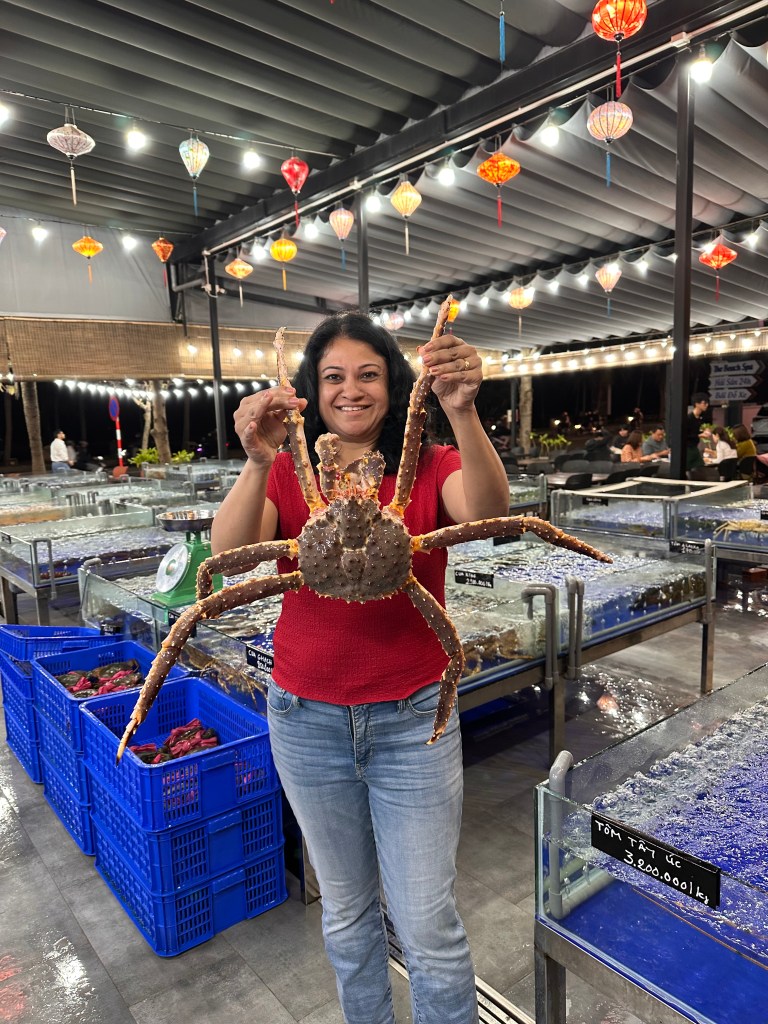
As the evening approached, we hoped the rain wouldn’t dampen our New Year’s plans—and luckily, it didn’t! We strolled around Da Nang, indulging in more Indian food for my daughter, sipping on unique Vietnamese coffees, getting a foot massage, and savoring fresh seafood, including a large crab. It was a perfect way to close out the year, blending familiar comforts with local flavors and experiences.
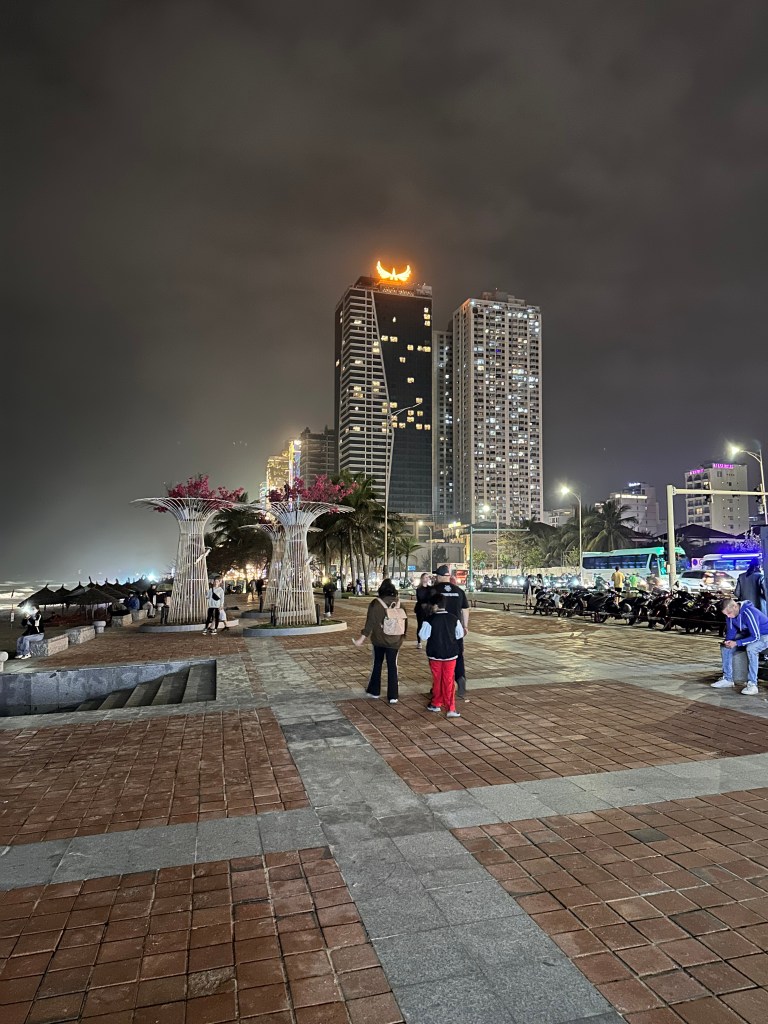
The streets were buzzing with life, packed with cafés serving every cuisine you can imagine, massage spas ranging from cozy to extravagant, and shopping marts eager to satisfy every whim of the visiting crowds. Every other corner seemed to have an Indian restaurant blaring ’90s Bollywood hits, adding a nostalgic desi touch to the lively atmosphere.
Big names like Sheraton and Marriott are racing to stake their claim along the beach, hinting at an even glitzier future for Da Nang. Meanwhile, the present was alive with loud party music echoing from various hotspots, each vying to pull in crowds for the midnight countdown.
Unfortunately, the famous 45-minute Da Nang fireworks show was canceled this year for environmental reasons, leaving some disappointed. But not all was lost—many families opted for a quieter celebration, strolling along the beach where small shops lit up the night with minor fireworks to keep the festive spirit alive. It was a vibrant mix of noise, nostalgia, and seaside serenity—a fitting end to the year!
We strolled back to our room, quietly responded to several New Year messages, and enjoyed a much-needed nap to prepare for another long (but last) day of travel.
Day 6: Hue
We reluctantly dragged ourselves out of bed for an early drive to Hue City. Hue is pronounced “h-way,” with an emphasis on the “h” sound at the start, followed by a drawn-out “u,” similar to saying “way.”
Once again, we were picked up and found ourselves among a group of sleepy international travelers, exchanging cheerful New Year wishes with everyone. Hue is renowned for its rich history and cultural significance, making it a must-visit destination.
The journey itself was an experience, taking us through the Hai Van Tunnel, the longest and most modern tunnel in Southeast Asia. This marvel of engineering not only made the drive smoother but also added a touch of awe to the trip.
Hue’s dialect is often considered more elegant and poetic compared to other regions in Vietnam. It’s said that the people of Hue speak with a soft, lilting tone that reflects the city’s historical ties to Vietnam’s royal past.
Lap An Lagoon
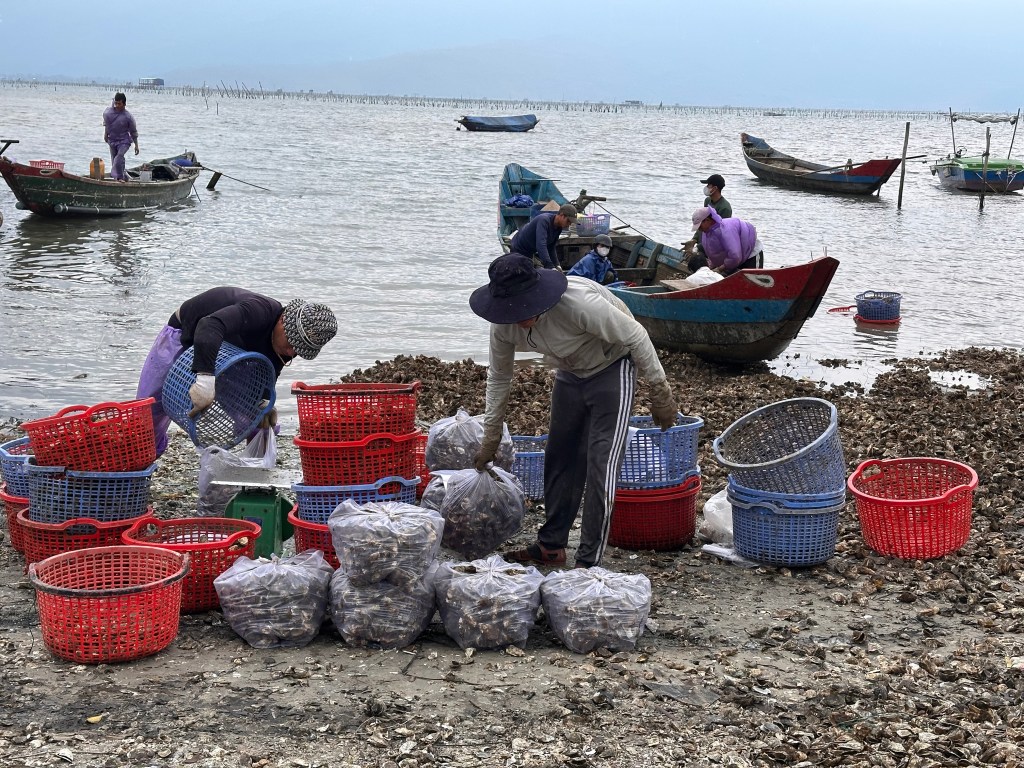
We made our first stop at Lap An Lagoon, located west of Lang Co Bay. This picturesque lagoon is surrounded by mountains and is home to several pearl farms. We spent some time taking in the serene views, sipping salt coffee, and watching local pearl farmers separating pearl oysters before continuing our journey.
Khai Dinh Tomb
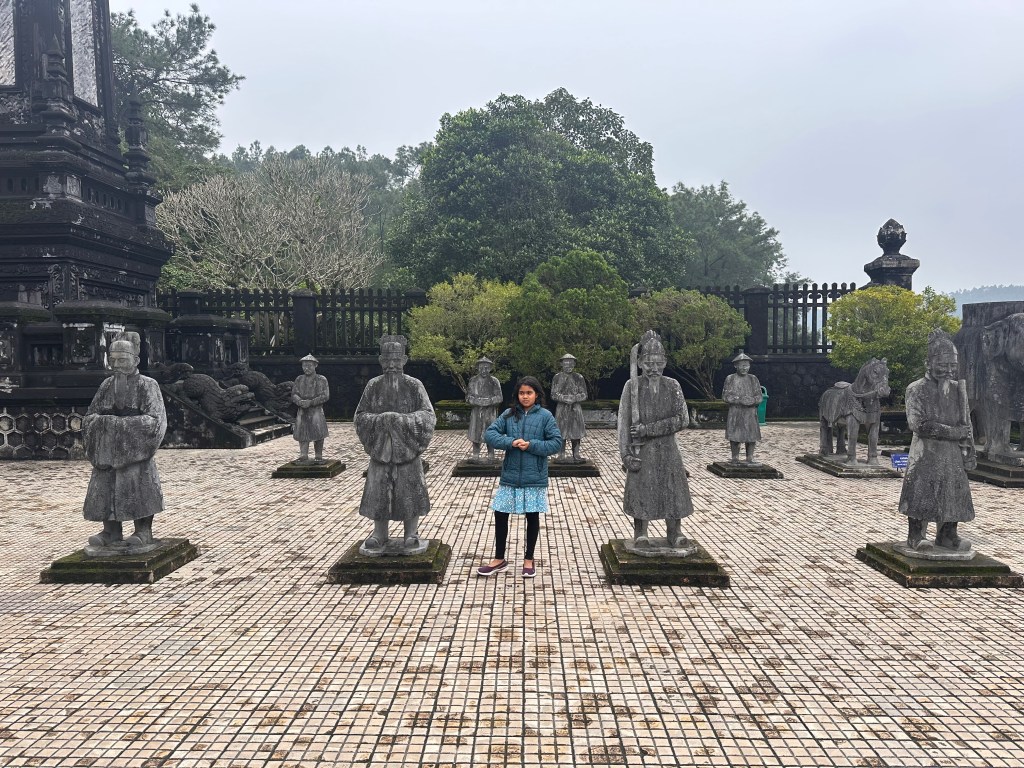
Upon arriving in Hue, our first visit was to the Khai Dinh Tomb, one of the most beautiful and intricate royal tombs of the Nguyen Dynasty. The stunning architecture combines traditional Vietnamese and European elements, making it a truly unique historical site. The detailed carvings and mosaics were a testament to the grandeur of the Nguyen kings.
Many of the intricate carvings and mosaics in Khai Dinh Tomb were reportedly created by artists using their feet—a technique viewed as a bad omen in Vietnamese culture. There are two fascinating stories behind this unusual technique. One suggests that the artists used their feet as an act of protest against Emperor Khai Dinh, who raised taxes to fund the construction of the tomb. Another version claims the method was purely practical—ceiling paintings and carvings were done using feet so the artists could lie back and see the artwork as they worked, ensuring better precision and perspective.
Towering at the top of 127 steps, the tomb exudes grandeur. The structure is covered in blackened concrete, which gives it an imposing presence against the lush green backdrop of the mountains. The interior, however, bursts into vibrant life with colorful glass and porcelain mosaics adorning the walls. The most striking feature is the statue of Emperor Khai Dinh, cast in bronze and seated beneath a celestial ceiling painting that depicts a lively dragon amidst clouds.
Thien Mu Pagoda
Bonsai TreePhuoc Duyen Tower
Post-lunch (at a local restaurant), we visited the Thien Mu Pagoda, Hue’s oldest and most beautiful pagoda. This iconic site, perched on a hill overlooking the Perfume River, is a symbol of Hue’s spiritual heritage but also a serene retreat that offered a peaceful pause in our journey.
The name “Thien” means “heavenly” or “celestial,” while “Mu” translates to “lady,” together symbolizing a divine feminine spirit. According to legend, an old woman appeared on the hill where the pagoda now stands, prophesying that a great leader would build a temple here to bring peace and prosperity to the region. Inspired by this, Lord Nguyen Hoang ordered the construction of the pagoda in 1601, marking the beginning of its storied history.
The pagoda is also tied to a tragic love story in local folklore. Legend has it that couples who visit the pagoda together—especially those holding hands—might face separation afterward. While this remains a superstition, it adds an intriguing and mystical element to the otherwise serene and spiritual site. As our tour guide jokingly remarked, “If you’re looking for separation, just hold hands here!”
The Phuoc Duyen Tower, a seven-story pagoda, stands as an iconic symbol of Hue here. Each of its seven stories represents a step on the Buddha’s path to spiritual awakening. This concept is tied to the legend of Buddha’s seven steps at birth, where each step was marked by a blooming lotus flower, symbolizing purity and enlightenment.
There were many bonsai trees in the gardens here. Miniature trees, commonly known as bonsai, are referred to as cây cảnh or “ornamental trees” in Vietnamese culture. These living art forms are meticulously shaped to balance natural beauty and artistic vision, showcasing the grower’s skill and patience. Bonsai symbolizes harmony, balance, and interconnectedness, often representing nature’s grandeur in a small form. For many, caring for bonsai is a meditative practice fostering mindfulness and inner peace. In Vietnamese and East Asian traditions, they are associated with Feng Shui, believed to attract positive energy, prosperity, and good fortune. Historically, bonsai also signified wealth and status, often adorning the homes of nobles and scholars. Whether for artistic, spiritual, or cultural reasons, bonsai remains cherished worldwide.
Hue Citadel
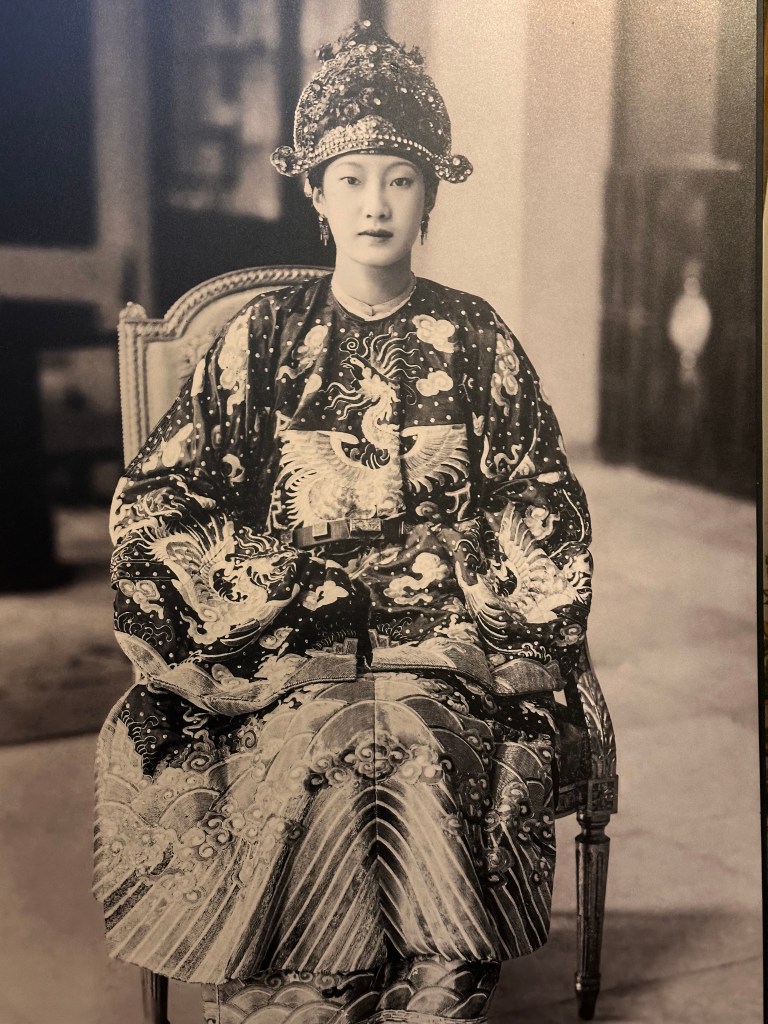
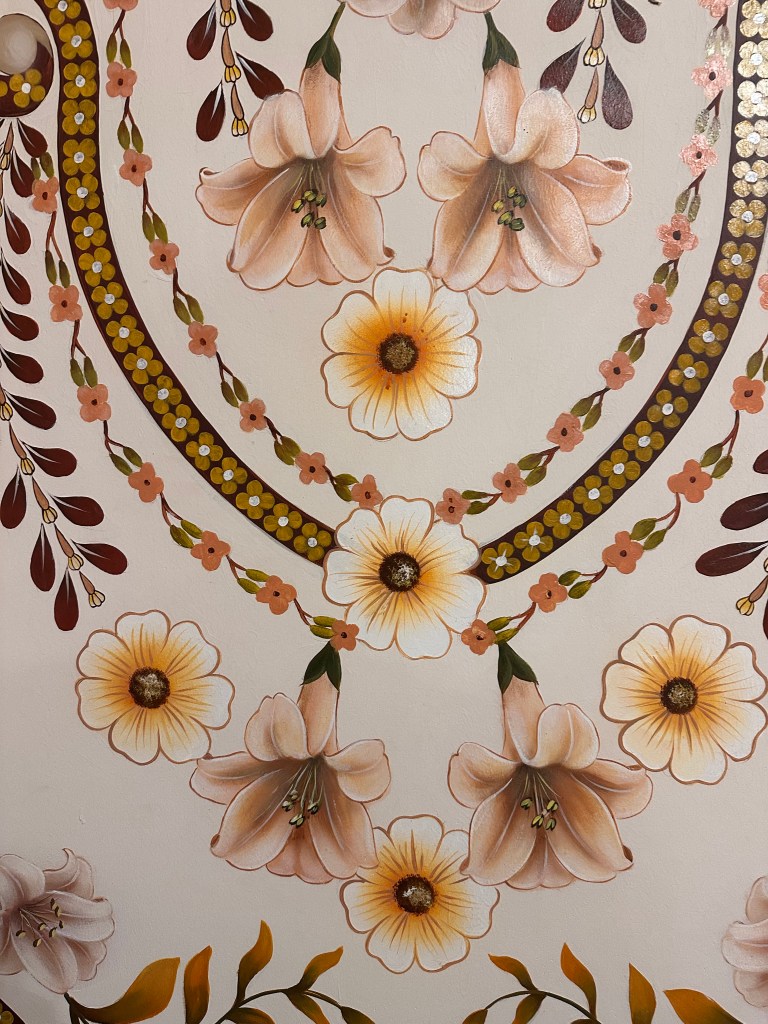
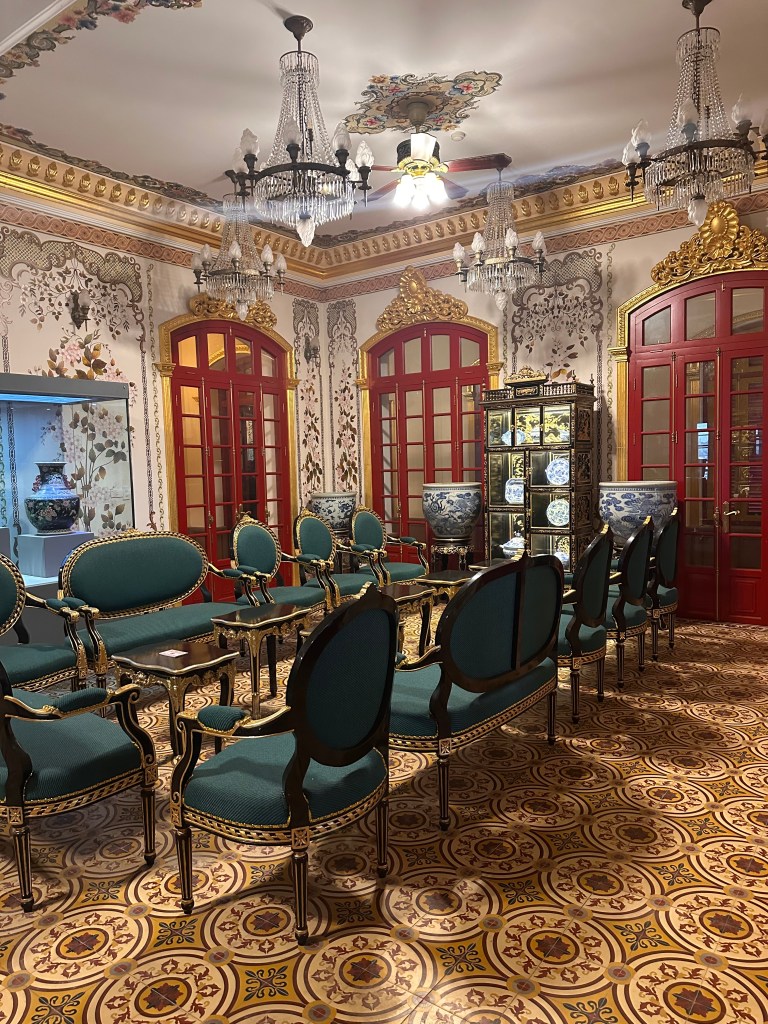
Hue CitadelPalace-IPalance-IIEmpress Nam Phuong (Most Beautiful Queen)Marble WorkEuropean Inspired Furniture
Our last destination was the Hue Citadel, a UNESCO World Cultural Heritage site since 1993. This massive complex, with its walls, palaces, and gates, holds the legacy of the 13 Nguyen dynasty kings who ruled for over 140 years. Despite enduring the ravages of time and war, the Citadel continues to preserve its historical significance and charm.
Approximately 40% of Vietnamese people have the surname Nguyen, making it by far the most common surname in Vietnam. The prevalence of this surname is linked to the Nguyen Dynasty, the last imperial dynasty of Vietnam, which ruled from 1802 to 1945. During this time, many people adopted the surname as a sign of loyalty or to align themselves with the ruling class.
The undisputed highlight of the day? Our royal visit to the royal toilet! Who knew history could be so flush with grandeur?
After a two-hour walk exploring Hue’s rich history and culture, exhaustion caught up with us, and we quickly fell asleep on the bus ride back to Da Nang. The driver smoothly navigated the route, and we arrived at our hotel by 6:30 PM, marking the official end of our holiday adventures.
Last Evening
To celebrate our final evening in Vietnam, we indulged in a feast of fresh seafood by the beach, including a mouthwatering lobster, and savored one last round of aromatic Vietnamese coffee—a fitting farewell to the culinary delights of this vibrant country.
Special Mention: Vietnamese Coffee
Vietnamese coffee culture is incredibly diverse, with a wide variety of options to explore. Popular choices include Cà Phê Sữa Đá (iced coffee with milk), Cà Phê Đen (black coffee), Cà Phê Trứng (egg coffee), Cà Phê Dừa (coconut coffee), Bạc Xỉu, and the luxurious Cà Phê Chồn (weasel coffee). Another unique offering is Avocado Coffee, a creative blend of flavors. Each type reflects the rich coffee heritage of Vietnam and offers something for every palate. You can have coffee hot or iced!
Done Done
If you’ve reached here, congratulations! This travelogue was penned down immediately after our trip, before the busy workdays started rolling in and the memories began to blur.
One thing that still makes us laugh is how I kept calling “Da Nang” “Ha Dang”, completely forgetting the real name. The names of the places we visited—Ha Noi, Hoi An, Ninh Binh, Ha Long, Da Nang, Ba Na, Hue, Sung Sot, Bo Hon, Luon, Trang An, Cao Son, Suoi Tien, Ngoa Long, Thien Mu, and Lap An—felt like tongue twisters at times. I couldn’t help but mix up Da Nang with Ha Dang, much to everyone’s amusement! My daughter made sure I was properly “punished” for my slip-up with endless giggles. We googled Ha Dang, and found that to be a real person’s name!
I suggest you put Vietnam on your bucket list! Cheers
It’s Tvisha’s summer vacation, and due to work pressures, we could not take her out of Bangalore in April. So she was bugging us to get out of Bangalore. After comparing Leh/Ladakh, Sikkim, Andamans, and Kashmir, we finally settled on Kashmir. I had been to Kashmir when I was very young and had fond memories of the place. I was unsure whether it was safe to visit Kashmir, and after much online research and talking to the travel agents, we zeroed in on Kashmir.
Some friends were going on a Bangalore-Leh drive (9K+ Kms), and others were going to monasteries in Sikkim. We had recently been to monasteries in Bhutan, and the girls were not in the mood for another long drive! In December 2021, we enjoyed a seven-day long drive (Bangalore-Coonoor-Kotagiri-Coimbatore-Mahabalipuram-Bangalore). The weatherman predicted rains in Andamans, and the daughter wanted to make Olaf! So, Kashmir was inevitable!
After comparing rates and dates with our favorite travel agent (SOTC), we finally booked our trip with the MakeMyTrip holidays.
Day 1 – Bangalore to Srinagar
There is a direct Indigo Flight (6E 797) from Bangalore to Srinagar that starts in Bangalore at a convenient time (~9:15 AM) and reaches Srinagar post noon (~2:00 PM) with a brief halt at Amritsar.
When the plane landed at the Srinagar airport, all passengers were in awe of Srinagar’s beautiful hills (some capped with snow). At the airport, our driver greeted us, and he instantly realized that we South Indians were in Kashmir to see snow in summer! He promised us ample snow in Sonmarg and Gulmarg, making Tvisha very happy!
It was a short drive from the airport to our first hotel in Srinagar. It was not a classic hotel but a houseboat. The houseboat we stayed in was Naaz Kashmir (https://www.naazkashmir.com/) and was located in Nageen Lake (and not Dal Lake). All the lakes in Srinagar are connected, but Nageen Lake is less commercial and crowded.
The rest of the day was free for us to enjoy the houseboat! We spent our time taking photos, watching fishermen and birds catch fish, eating pakoras, listening to the music of the water and birds, listening to the prayers from different surrounding Mosques, dressing up in a traditional dress, and a short shikara ride.
It was an abrupt stop to the fast life we are used to, staring back at nature and adoring its beauty. We talked to each other as a family and were not immersed in our gadgets! However, Tvisha was excited to show off her first day in Kashmir to her friends in a WhatsApp call!
Naaz Kashmir served us well – candlelight dinners, food per our needs, and recommendations about Shikara rides. So we took their advice and decided to take the 4:30 AM four hours Shikara ride from Nageen Lake to Dal Lake.
Staying in a houseboat is like sharing a house with other equally clueless and excited families.
Naaz KashmirDining HallSceneryWifey PosingTraditional View from RoomNaaz Kashmir, Srinagar, Day-1
Day 2 – Srinagar(Shikara Ride)
We kept the alarm to wake us up at 4:00 AM to prepare for our 4:30 AM shikara ride. We woke up to the alarm and morning prayers at the lake. It reminded me of my pre-college days when 4:00 AM had become a routine for studies. The caretakers were already up and knocked on our doors to ensure that we were ready and sent us on the shikara with some hot Kashmiri tea (Kahwa) and snacks.
It was bitter cold (for us) and pleasant for the locals. We tugged ourselves into the blanket available in the shikara. Our little braveheart sandwiched herself conveniently between her parents, refused to step out of the blanket throughout the ride, enjoyed the frequent warm rubs, and did not hesitate to nap. The shikara moved slowly, confidently, and thoughtfully through the lake.
The cold air on the face and the calming sound of the shikara moving in the lake is an unforgettable experience. Most of the locals and birds were up at 4:30 AM!! As we rowed through the lake, we could see the homes of the locals – men and women at work. Everyone that met the eye returned a welcoming smile.
We spotted a water snake, various colored water lilies, and birds like eagles, geese, mallards, pochards, gadwalls, pintails, waders, coots, and the common teal. The shikara rider helped us identify the birds.
We could see water vapor causing fog in some places due to the difference in water temperatures and the surroundings.
The shikara rider explained to us in detail the unique farming done by the locals in the lake, i.e., the process in which they grow vegetables. These farmers grow carrots, radishes, turnips, and other vegetables in the soil that floats on flora beds.
Such floating gardens are maintained all over the lake, and the farmers move through their plots on boats carrying their harvest to the lake’s market area. The rider took us through the floating gardens and the lotus farms to the floating vegetable market on dal lake. We bought some flowers and seeds and had some hot Kahwa (Kashmiri Tea) and snacks packed for us by the Naaz Kashmir at this market.
The rider then took us to the dal lake (pronounced as दल and not दाल), and at this time of the day, it was empty except for the locals fishing out the water weeds to compost them for use in their farms. It was a beautiful sunrise to watch at the dal lake, wade through the markets (Meena Bazaar), and spot traditional homes. The ride back was slow, and the gentle swaying motion of the shikara ride put us to sleep for a few minutes.
Floating Vegetable MarketEnjoying @ MarketHouse BoatFarmer Fishing out WeedsWood Bridge for LocalsA Parked ShikaraSunrisePhotographer Me or Wife?Floating GardensFarmer Selling FlowersFarmer on the way to the marketShikara Ride (Nageen Lake to Dal Lake)
Day 2 – Sonmarg (सोनमर्ग and not सोनमIर्ग)
At around 9:30 AM, after breakfast, we started driving to Sonmarg, a hill station in the Ganderbal district.
It was about two hours drive. The roads were not too good, and there were traffic jams in a few places. If we had left about an hour earlier, we might have saved about 1/2 hour of jam time. It was visitor traffic. However, after the early morning Shikara ride, we needed some time to fuel and freshen ourselves before our next adventure.
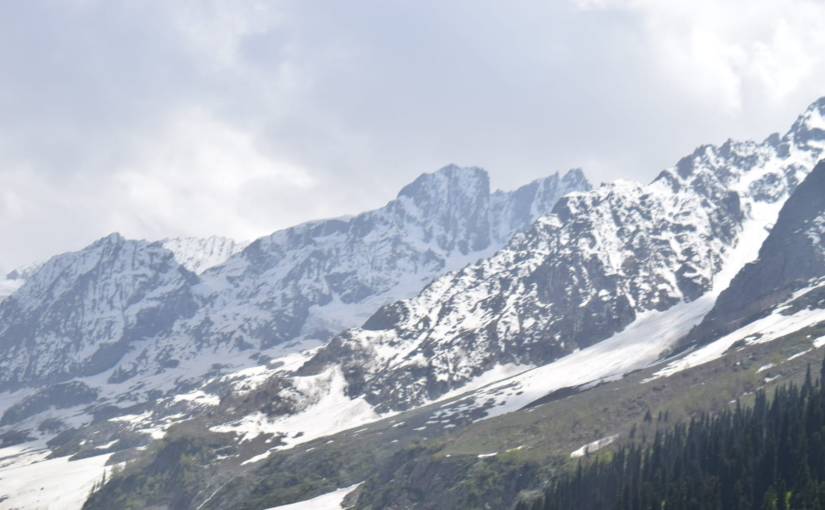
As we reached closer to Sonmarg, we could see the snow-capped mountains, feel the drop in temperature, and breathe the superior quality air. Sonmarg was much cooler than Srinagar but fortunately pleasant (even for our visitor skin).
During the drive, we could see streams of water – the tributaries of Jhelum – Lidder, Sind, and Neelum. The sight of white water forcing itself down the mountains was strangely peaceful. It reminded us of our stay in Salt Lake City, Utah.
The driver told us that during the winter months, heavy snowfall blocks NH-1. So a tunnel is being built to keep the road open year-round. We found trekkers ready to trek from Sonmarg to Leh (“the rooftop of the world”) and groups wanting to drive through the Zoji La pass. Our driver informed us that driving through the Zoji La pass is a must-do off-road adventure. However, he recommended we not take our city car and take a four-wheel drive as the roads are narrow and rocky. It seems it’s a trek worth doing! So, now this one is also added to the backlog!
However, our goal for today was relatively simple. We either trek or take ponies to the Thajiwas glacier. This glacier is a favorite summer destination at Sonmarg.
My daughter is always excited and happy around animals. We were not sure whether we (“The Adults”) needed ponies; however, the agents there convinced us that the pony ride is a “must-do” in Sonmarg. We gave in; however, it would have been a simple to moderate walk/trek and less burden on the animals in hindsight. The ponies were expensive, about 2750 INR / person (we negotiated out more than 50% of the original demand. Better negotiators got it at around 1500 INR / person). We also got a photographer for us to be more hands-free. The pony ride was uphill, downhill, and through cold water streams.
The scenery was picture perfect, a silvery scene set against green meadows and a clear blue sky. The views were captivating, and we outsourced the picture capture activity to our photographer and instead enjoyed the views. The air was too fresh to keep our masks on.
At the glacier, Tvisha finally made her Olaf! She was throwing snowballs at us in all directions, even when we were haggling with the locals to reduce the sledding costs! She was able to go up and down the snow and was soaking in the happiness, unlike us. Then, after an uphill trek in the snow, we sat down on a rock and came down sledding. The weather was not too cold, and if it were not for the time to return to Srinagar and limited food options, we would have spent more time up at the glacier.
We encountered the local police (to the surprise of the locals), who helped us reduce the cost of sledding from 3500/- to 500/- INR (though we ended up paying 1000 INR per person for sledding). It’s funny that the locals keep saying (क्या आप खुश है, हमे भी खुश कीजिये) “Are you happy? Make us happy!”, a method to get more money from the visitors. These people make money only during the summer months (visitor months) and try to make the most of it. COVID & CONFLICT closures have been hard on them. We found these people to be cheerful, happy, and helpful. So, we did not hesitate to give (tips) more than we thought was reasonable!
We stopped at a roadside restaurant to have some delicious chole-puri and dal-makhani for Tvisha on our way back. We reached back around 7:00 PM for another candlelight dinner at Naaz Kashmir. The owners of Naaz Kashmir had moved our luggage out of the room as they thought that we booked for only one night, and they realized that there was a communication issue between MakeMyTrip and their reservation team. They made up for it by giving us a superior room, a chocolate cake for Tvisha, and several apologies.
We took a warm bath and crashed soon after!
We were woken up by Tvisha mid-night as she started vomiting and was feeling very sick! She had no temperature but did not look well. We were not sure whether it was the altitude, change in food/water, or a stomach bug. Thankfully, we had carried medicines – “Enterogermina” and “Calpol” in our first aid kit!
Captivating ViewsNo MasksThajiwas GlacierSnow, Stream, and MeadowsSoaking HappinessStreamsSleddingSleddingRest after the Snow TrekIdle MomentsNever IdleOlaf!Can Never be Shahrukh!Posing Workoholic!Confident to Ride AloneSonmarg, Ponies to Thajiwas Glacier
Day 3 – Pahalgam
We started around 9:45 AM after thanking the caretakers for their service at Naaz Kashmir and completing the check-out formalities. Tvisha was sick and only managed to eat mangoes for breakfast. The drive to Pahalgam was long but on more convenient and motorable roads. We wanted to stop for Kahwa and visit apple farms, but Tvisha would only sleep in the car. So, we drove straight to our hotel, the Radisson Golf Resort.
The Pahalgam scenery was unique, with white water streams and a backdrop of pine trees and snow-capped mountains. The temperature was pleasant and leaning towards too cool.
All we could do on day-3 was check in and rest. Tvisha slept all afternoon and night. She was running a slight fever, so we consulted our family doctor, and she diagnosed her to have the stomach flu. So we requested the hotel to get us medicines (the medicine shop was ~2KMS far), and they helped us.
The trip managers advised us to visit Abu Valley, Betaab Valley, Chandanwari, and Baisaran valley (Mini-Switzerland). However, we had lost 1/2 a day and had to check out by 1:00 PM the next day (Day-4). So we decided that if Tvisha feels better on Day-4, we will do the Baisaran valley.
Pahalgam (First Village) gets its name from Hindi “पहला गांव” and Shiva devotees visit this place frequently in summer to pilgrimage to the Amarnath Cave for the Darshan of the only ice stalagmite Shiva Linga. The pilgrimage usually starts from Chandanwari but was closed due to road work during our travel.
Day 4 – Pahalgam
Tvisha woke up ready for her next adventure; however, I felt queasy in my stomach. It was my turn to fall sick. However, Dolo came to my rescue, and after an insignificant breakfast, we all jumped up on horses to visit the Baisaran valley. This trek is captivating, and it’s better to trek than take horses. However, a just recovered Tvisha and a queasy daddy were not in any state to trek. So, horses again!
Baisaran Valley is a hilltop green meadow dotted with dense pine forests and surrounded by snowcapped mountains. This famous offbeat tourist place is excellent for those wanting to spend a quiet time in the company of nature. It also serves as a campsite for trekkers going to Tulian Lake. Some of the famous tourist points you can see en route to Baisaran are Pahalgam Old Village, Kashmir Valley Point, and Deon Valley Point. You can also enjoy panoramic sights of Pahalgam town & Lidder Valley from here.
Water StreamsPhoto by TvishaFamily Phtoo @ BaisaranThe Recovered Baby!Hills of PahalgamWho is Cute?SmilesBaisaran Valley Trek, Pahalgam
We returned to our hotel after about four hours (~1:00 PM) ride to Baisaran. We completed our checkout and had a delicious rainbow trout tandoori (a local delicacy) for lunch. The driver told us that butter or olive fry is better. After a sumptuous meal, we departed by car to Gulmarg.
Day 4 – Pahalgam to Gulmarg (गुलमर्ग )
It took about 3.5 hours from Pahalgam to reach Gulmarg. Gulmarg is a ski destination and is famous for winter sports. It is called the meadow of flowers in summers. Our driver informed us that they have to use chains on wheels in winter, and the snowfall in Gulmarg is heavy. The beauty of Gulmarg was different (in a good sense) than Pahalgam and Sonmarg. The first thing that strikes out is the lush green meadows (in summers).
We camped in the Hilltop Hotel. At first glance, the hotel seems jaded, faded, and under maintenance. While that is true, the rooms were well designed, and the in-room dining service was good. The service at this hotel was better than any of our previous experiences in Kashmir, even though they were ok at room cleaning services, breakfast variety, bathroom accessories, changing towels, or responding to your hails. We were satisfied that we could have a warm bath, eat something edible, and reach on time for the gondola ride the following day. The hotel is close to the gondola ride and ice skating rink.
Dolo carried me only this far, and I had slight chills and crashed for the night. I hoped, wished, and prayed that the fever would help kill the virus/bacteria (stomach bug) for me to enjoy Gulmarg the next day.
Day 5 – Gulmarg – Gondola Ride to Kongdoori
The chills were gone in the morning; however, I was still queasy. So, I trusted my best friend (Dolo) and braved the gondola.
MakeMyTrip was able to arrange gondola tickets for the first stage (Base Station to Kongdoori). The tour guide told us that the second stage tickets (Kongdoori to Apharwat) were unavailable (sold out). However, in hindsight, we did not regret not being able to do the second stage.
The gondola wait lines and wait times are infamous. People start queuing at 7:00 AM, even though the ride opens at 9:30 AM. We reached the queue at around 8:00 AM and found our tour guide. The people standing in the line entertained themselves by fighting with others who tried to move ahead. Words and punches were flying until the ride opened at 9:30 AM. The locals were also amused at the sight. The trip was about 10 minutes, and the wait time to board the ride was 2 hours. Dolo kept me on my feet.
The gondola ride is short, and the views are terrific. The valley is picturesque, and we can spot the snowcapped Himalayas, Apharwat, and Mud houses from the ride. We could also see the unlucky visitors (those who could not get a gondola ticket) trekking or using horses to climb up to Kongdoori. This trek is a moderate to challenging hike.
At Kongdoori, people had to queue again to ride to Apharwat, and the queue was equally long. We were happy that we don’t have to wait in another queue.
Gondola Ride to Kongdoori (Friend: Dolo)
At Kongdoori, the horse owners were bugging us to take a horse ride to the waterfall. However, we discussed it with our tour guide and decided to trek. Trekking (and not horse riding) was the best decision. We could stop to look at the multi-colored flowers in the meadows, jump over streams, trek with the goats, stop to hear the sound of silence, spot lizards, take photos, and experience rocky trails.
Taking a BreathSound of SilenceMagic Faraway TreeClimb Down a HillRocky TrailsTvisha’s PhotographySereneGoats and MoreSay “No” to HorsesBackdrop of Faraway Himalayas
When we reached the waterfall, we had to trek in snow to get up to the mouth of the waterfalls. The snow trek was challenging.
However, the mountain water was delicious and pure. We drank from the waterfall, and this water tasted better than any mineral or filtered water. So we filled a bottle to quench our thirst for the return journey.
If I travel again to destinations like these, I will remind myself to buy shoes with some grip.
Finally, we sledded downhill and relished on some delicious maggie cooked in the mountains waters. Strangely, maggie gave us the strength to trek back to the gondola ride station.
We took a different route to see the valley and meadows from a different perspective. This route was shorter and required us to climb uphill and roll downhill.
Again, the view was picture perfect!
After reaching the base station, we rushed to feed ourselves a late lunch. The lunch was good. We did not have any energy left to do the ATV rides and decided to skip them and relax in the room. Then, in the evening, we went down to the cafeteria to have some snacks. Our legs could not tolerate any more walking and would only walk back in the direction of the hotel room. So, we snuggled back into the room and watched the evening walkers from the comfort of the room.
Days are long in Gulmarg, and it’s bright even at 7:00 P.M.
I recovered from the stomach bug (Thanks! Enterogermina), and now it was time for my wife to fall sick to the same bug! She had a better immune reaction to the bug than my daughter or me; however, she sought help from Dolo and Enterogermina to fight off the bug.
Day 6 – Back to Srinagar
Gulmarg is about ~50Kms from Srinagar. So, the return journey was short. We woke up late and lazy, and left for Srinagar after a late breakfast.
We stopped to see apple farms and drink delicious green apple juice. We tasted various homemade pickles and bought lotus stem pickles from the farmer. Lotus stem (कमल-ककड़ी), locally known as “Nadru” is grown in shallow parts of water bodies like ponds and lakes and is a vastly enjoyed ingredient in Kashmiri cuisine.
We also stopped to have some premium Kahwa and buy some dry fruits (Walnuts) and condiments (Kesar).
We checked into Radisson Srinagar, the first hotel in Kashmir, where we found women employees. My wife had a heart-to-heart talk about women empowerment with the ladies there!
After a good lunch, we headed to see the oldest temple in Kashmir, the Shankaracharya Temple, dedicated to Lord Shiva. The temple is a monument of national importance and is protected by ASI (Archeological Society of India). There are many steps to climb, and the view of Kashmir valley from the hilltop is superb. It was very windy up the hill and pleasant. Unfortunately, cameras were not allowed for a picture remembrance. After blessings from Lord Shiva, we decided to stroll the gardens of Srinagar.
Unfortunately, due to the holiday rush and this day being a Sunday (many locals were out sightseeing), we saw only the Botanical Garden and the Chashme Shahi. We missed the Tulips as the Tulip Garden was closed a few days back (Peak season: April). The botanical garden was a nice walk, and the flowers in Chashme Shahi were exquisite. My daughter enjoyed taking photos of several flowers.
We had earlier decided to ride the Shikara again at Dal Lake; however, we decided to dart back to the hotel, looking at the rush and weather. Finally, we finished the day with a lavish buffet dinner.
Day 7 – Back to Home @ Bangalore
The only eventful activity was the security checks at the Srinagar Airport. We must step out of our cars at least a kilometer before the airport and have to get ourselves, the car, and the bags checked.
We left Srinagar entirely mesmerized by the beauty of Kashmir, and I decided to pen this down in a blog (for us) so that this never fades from (our) memory. So this blog is my first travel blog.
After a few more doses of Enterogermina and home food, my wife got better. We have returned to our workaholic ways and keep discussing our Kashmir trip with friends and family.










































 Digital Journey