
This blog is my attempt to make sense of the transformative technology trends shaping 2024, organizing them into a structure that helps me—and hopefully you—grasp their impact. From sweeping macro shifts to granular micro innovations, I’ve distilled my observations and reflections into this post to explore how these trends are reshaping our world. My goal is to spark ideas and inspire curiosity as we navigate the ever-evolving frontier of technology.
From Star Trek Dreams to Today’s Realities

As a lifelong fan of Star Trek, I often find myself marveling at how much of its futuristic vision has seamlessly blended into our everyday lives. What was once the realm of science fiction is now science fact, and it’s astonishing to see how the imaginative worlds of Gene Roddenberry have inspired generations of innovators. Let me take you on a journey through some of these Star Trek dreams and their counterparts in today’s technology:
- Communicators → Smartphones: Captain Kirk’s communicator is today’s smartphone, letting us call, navigate, shop, and even control our homes.
- PADDs → Tablets: Starfleet’s sleek devices are now tablets like iPads and Kindles, offering portable, powerful access to information.
- Universal Translators → Google Translate: Star Trek’s universal translator lives on in Google Translate, breaking language barriers in real-time.
- Tricorders → Portable Medical Scanners: Dr. McCoy’s tricorder inspired tools like GE’s VScan, revolutionizing portable medical diagnostics.
- Replicators → 3D Printing: Captain Picard’s replicator echoes in 3D printing, creating tools, prosthetics, and more layer by layer.
- Holodeck → Virtual and Augmented Reality: The Holodeck is here with VR and AR, immersing us in gaming, collaboration, and virtual experiences.
- Voice-Activated Computers → Siri and Alexa: Starfleet’s voice-activated computers are now Siri, Alexa, and Google Assistant, responding to commands daily.
- Data → AI like ChatGPT: The android Data foresaw today’s AI, like ChatGPT (+Robotics), transforming creativity, problem-solving, and workflows.
- Memory Banks → Cloud Computing and Big Data: Starfleet’s vast knowledge banks mirror today’s cloud computing and data lakes, offering limitless storage.
Star Trek’s genius lies not just in its speculative tech but in how it inspires us to push the boundaries of the possible. We may not have cloaking devices, or the Prime Directive fully figured out yet, but the trajectory is clear—we’re steadily turning sci-fi into sci-reality. The question is no longer if but when.
A Quote from a modern-day philosopher and visionary
“Imagine a digital product as the spirit animal of a human, guiding and empowering her in her journey. The question isn’t just how we maintain these companions, but how we nurture them to thrive alongside us in the pursuit of seamlessness.”
— CHATGPT (Prompt Engineered by Nitin Mallya)
Every post needs a thought-provoking quote, right? But in the age of AI, why not ask ChatGPT, our modern-day philosopher? A little prompt engineering led to a quote that resonated with a Star Trek twist.
Remember Chakotay from Star Trek: Voyager and his guiding spirit animal? It was more than mystical—it was a companion, helping him navigate challenges. Today, AI is becoming just that: a copilot, not just a tool, but a partner empowering us to explore and solve problems.
Another Quote
There’s a quote I love: “A product/service that gets better after we sell it.” I’m not sure who first said it, but it perfectly captures the magic of today’s connected technologies. It’s not just about creating products; it’s about creating experiences that evolve and improve over time.
For a salesperson, this quote highlights the thrill of the sell. For a product manager or engineer, it’s all about delivering the better. But the real brilliance lies in the platform/ecosystem—the invisible engine that keeps adding value long after the sale is made.
In the world of hardware, this might mean something tangible, like adding a dashcam to your car. But in software, the possibilities are limitless. Think of apps that refine workflows, tools that make complex tasks effortless, or AI systems that transform product usage. The game has shifted; it’s about enhancing every moment of the user’s experience over the product’s entire lifecycle.
Quantum Digitalization: The Journey to Hyper-Personalization
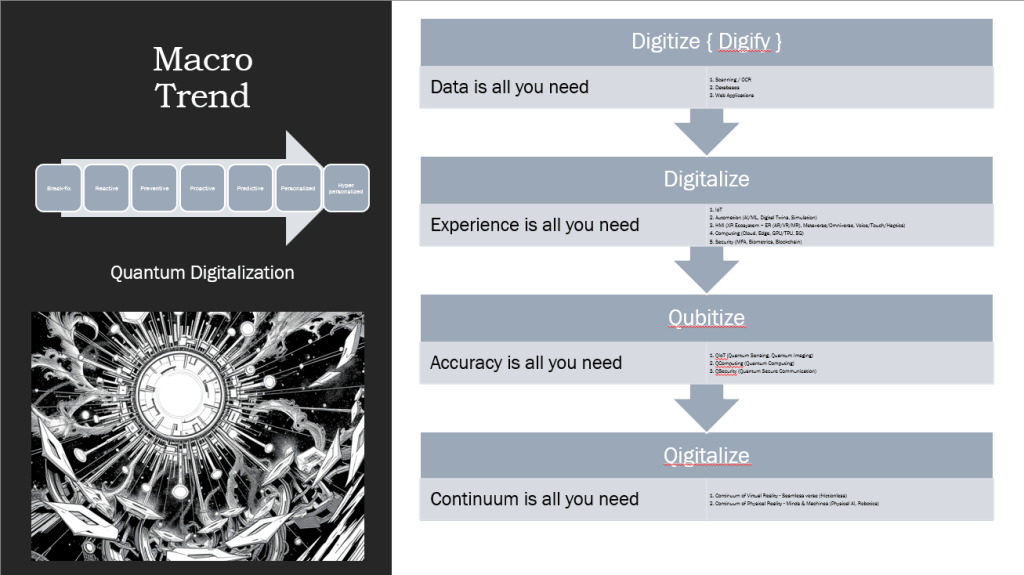
The trajectory of technology often feels like a dance between the micro and the macro, the tangible and the intangible. I call this journey Quantum Digitalization—a fusion of precision and expansiveness that is reshaping how we interact, innovate, and solve problems. It’s not just a trend; it’s a profound transformation unfolding in stages, each one moving us closer to a world where hyper-personalization isn’t merely possible—it’s inevitable.
I found inspiration in the AI paper, “Attention is All You Need,” and I’ve borrowed its clarity to describe the stages of this evolution. Each stage has a theme and a guiding principle that frames the technology and its impact.
Digitize: Data Is All You Need
The first step in this journey is to Digitize, or as we might say in India, Digify. This stage is about making sense of chaos—bringing structure to the unstructured and transforming information into a usable form. It’s the shift from paper to pixels, where workflows are streamlined, knowledge is centralized, and insights become attainable. However, the magic of digitization isn’t in collecting more data; it’s in collecting the right data. Too much can lead to a data swamp—overwhelming and unusable. Too little creates gaps that even the smartest algorithms cannot bridge. This stage is the foundation—the roots that support the tree of innovation. Without a strong base, the rest of the journey is shaky at best.
Digitalize: Experience Is All You Need
Once the data is in place, the next step is to Digitalize. This stage is often misunderstood. It’s not about Digitizing; it’s about creating meaningful, engaging experiences. Technology shifts here from being a tool to becoming a partner, enhancing how people interact with systems and processes. This stage is about connection—devices talking to each other, systems understanding users, and interactions that feel intuitive. Imagine seamless experiences, where diagnostics, decisions, and delivery happen almost invisibly. It’s no longer just about solving problems; it’s about delighting users. Unfortunately, many still confuse digitalization with digitization or equate it solely with software. But digitalization is much more—it’s about creating ecosystems where experience becomes the driver of adoption and innovation.
Qubitize: Accuracy is all you need
As the journey advances, we step into the stage of Qubitize, where the guiding theme is Accuracy is all you need. This is the realm of quantum technologies, which bring a level of precision, speed, and security that traditional systems simply cannot match. It’s here that the boundaries of what is possible begin to dissolve, unlocking a future once confined to science fiction.
At the heart of Qubitize are three transformative domains: quantum sensing, quantum computing, and quantum communications. Each represents a leap forward, reshaping how we measure, compute, and interact in ways that redefine accuracy.
Quantum Sensing is revolutionizing how we perceive the physical world. Traditional sensors—no matter how advanced—have limitations in precision and sensitivity. Quantum sensing taps into phenomena like quantum superposition and entanglement to deliver ultra-precise measurements of time, magnetic fields, gravity, and more. For example, quantum-enabled imaging devices could detect changes at the molecular level, opening doors to breakthroughs in fields like healthcare, geophysics, and environmental monitoring. Imagine medical scans with resolutions so high that they can detect diseases at their earliest stages or environmental sensors that can map underground resources with pinpoint accuracy. This level of sensing not only enhances accuracy but also expands what we can observe and understand.
Quantum Computing takes problem-solving to a whole new dimension. Unlike classical computing, where bits are either 0 or 1, quantum bits—or qubits—exist in multiple states simultaneously, enabling computations at unprecedented speeds. This allows quantum computers to solve complex problems, like optimization or molecular modeling, that would take classical systems centuries to process. For instance, quantum algorithms can revolutionize logistics by finding the most efficient routes in real time, or they can accelerate drug discovery by simulating molecular interactions at a scale and speed previously unimaginable. Quantum computing isn’t just faster; it’s smarter, enabling us to approach problems in ways that were previously inconceivable.
Quantum Communication offers a paradigm shift in data security and transfer. At its core is Quantum Key Distribution (QKD), which uses the principles of quantum mechanics to create encryption keys that are theoretically unbreakable. By leveraging entangled particles, QKD ensures that any attempt to intercept or tamper with the transmission is immediately detectable, making it a cornerstone for ultra-secure communications. Beyond security, quantum communication networks are laying the groundwork for a quantum internet—an interconnected web of quantum devices that could transform how information is shared globally. This leap will redefine the concept of trust in digital systems, safeguarding sensitive information in ways that traditional cryptographic methods cannot match.
Qigitalize: Seamlessness Is All You Need
Finally, we arrive at Qigitalize—the frontier where the physical and digital worlds blur into one seamless continuum. This stage is about fluidity, where boundaries dissolve, and technology adapts to us rather than the other way around. Imagine ecosystems where robots autonomously handle tasks, collaborating with humans only when necessary. Picture a world where virtual and real merge effortlessly, enabling interactions that are frictionless and immersive. Collaboration transcends barriers, and hyper-personalization becomes a given. It’s a vision of a world that feels intuitive, connected, and limitless.
AI: A Microtrend Shaping the Future

AI is in the midst of an explosion—a rapid evolution transforming how we build, use, and interact with intelligent systems. Let’s dive into how AI is expanding its influence in four transformative dimensions: learning styles, tasks, data modalities, and system designs.
Learning Styles: How AI Masters the World
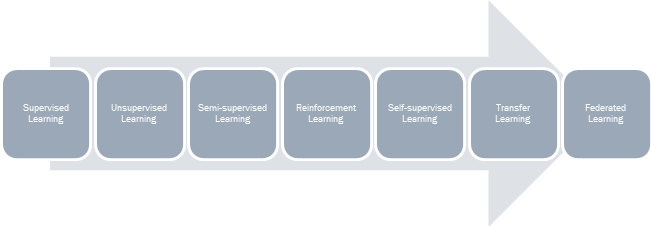
AI’s ability to learn has evolved dramatically. It began with supervised learning, where labeled data taught machines to distinguish between cats and dogs. While groundbreaking, this method relied heavily on expensive, annotated datasets. Then came unsupervised learning, revealing patterns in unlabeled data, like customer segmentation. Semi-supervised learning bridged the gap, blending smaller labeled datasets with large unlabeled ones for efficiency. Reinforcement learning marked another leap, enabling AI to learn through trial and error by interacting with environments—think Chess or Go. But the game-changer is self-supervised learning, where AI generates its own labels from data structures, powering massive models like GPT. Combine that with transfer learning, which reuses pre-trained models for new tasks, and federated learning, which keeps data private while training across decentralized systems, and you see AI’s growing adaptability. These advances are turning AI into an increasingly self-reliant, scalable force.
Learning Tasks: From Assistants to Creators
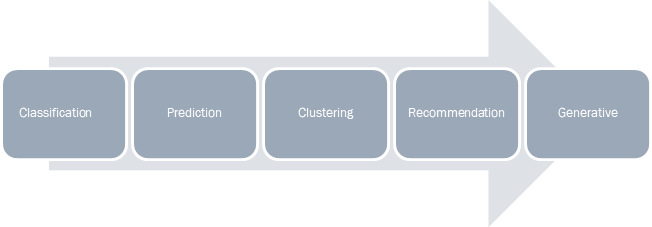
AI has transcended its origins as an assistant. Initially focused on classification (e.g., “Is this a cat?”) and regression (e.g., “What will sales be next quarter?”), AI has now become a creator. Generative AI systems can write essays, design artwork, or even produce videos from simple prompts. This creative power is revolutionizing industries, from marketing and entertainment to education and healthcare. But generative AI is just the beginning. Multimodal capabilities allow AI to integrate text, images, and audio seamlessly. Imagine an AI that can describe a picture in words, generate a matching soundscape, or create immersive VR experiences—all from a single prompt. This evolution isn’t just about automating tasks; it’s about transforming AI into a collaborator, pushing the boundaries of creativity and innovation.
Data Modalities: Beyond Text/Images

As AI grows, it’s venturing into new data territories. Vision and language remain the bedrock, powering breakthroughs in computer vision, natural language processing, and search engines. AI’s ability to interpret haptics—touch and pressure data—is revolutionizing robotics and prosthetics, enabling machines to “feel.” Meanwhile, spectral data, which captures wavelengths beyond the visible spectrum, is transforming agriculture, defense, and medical imaging. These new modalities are extending AI’s reach into uncharted territories, creating once unimaginable possibilities.
AI Systems: From Assistance to Autonomy

AI systems are evolving at a pace that’s reshaping the boundaries of what machines can do. What’s most fascinating is how our trust in these systems has grown, allowing them to take on tasks that were once the sole domain of humans. This evolution is about more than efficiency—it’s about unlocking entirely new possibilities.
Let’s start with semi-autonomous systems. These are like reliable coworkers who need just a little oversight. Take drones, for example. They can map terrain, deliver packages, and navigate through complex environments on their own. Yet, for critical decisions—like rerouting in extreme weather or avoiding restricted airspace—they defer to human judgment. This “autonomy with a safety net” allows machines to handle repetitive or high-risk tasks while keeping us in the loop for truly important calls.
Then, there are multi-agent systems, which take teamwork to a whole new level. Imagine a city where AI agents manage traffic lights, not individually, but as a coordinated network. These systems communicate in real-time, adjusting signals across intersections to ensure the smoothest flow of vehicles. The result? Reduced congestion, lower emissions, and happier commuters. It’s like having an army of super-intelligent traffic controllers working in perfect harmony. But multi-agent systems don’t stop at collaboration—they can also compete. In financial markets, trading bots operate as independent agents, analyzing trends, predicting outcomes, and executing trades faster than any human could. Some even collaborate to manipulate market conditions for mutual gain, demonstrating just how dynamic and adaptive these systems can be.
The next step is fully autonomous systems. These are the true independents, capable of sensing, deciding, and acting entirely on their own. Self-driving cars are a prime example: they don’t just follow a programmed route—they interpret traffic signs, anticipate pedestrian movements, and adjust to road conditions in real-time. Industrial robots are similarly autonomous, assembling products, identifying defects, and even scheduling their own maintenance. But here’s where the challenge lies: when we hand over complete control to machines, the stakes are higher than ever. Safety protocols must be flawless, and decision-making processes must be transparent and accountable. We’re making great strides, but full autonomy still demands rigorous refinement.
And now, for the most exciting part? economic participation. AI is no longer just about doing what we already do, only faster or better—it’s about exploring new frontiers. Take generative AI systems in intraday trading. These systems analyze vast amounts of market data, identify patterns, and execute strategies faster than any human trader. What’s even more remarkable is their ability to adapt in real-time, learning from market fluctuations and refining their tactics on the fly. These agents aren’t just assistants; they’re active participants in the economy, creating wealth independently.
Beyond finance, autonomous systems are venturing into creative and strategic territories. Imagine an AI agent tasked with designing marketing campaigns. It could analyze audience data, draft ad copy, create visuals, and even determine the optimal time to launch—all without human intervention. Or consider healthcare, where AI agents might coordinate treatments for patients, consulting with doctors only for the most complex cases. These examples aren’t just theoretical—they’re already in motion, signaling a profound shift in how we think about machine intelligence.
This evolution is about more than technology—it’s about redefining what machines can do for us. AI is no longer confined to automation or assistance. It’s becoming a collaborator, a decision-maker, and even an innovator in its own right. And here’s the kicker: we’re only scratching the surface of what’s possible. As these systems grow more capable, adaptive, and independent, they’ll continue to push the boundaries of intelligence, creativity, and impact. This is the dawn of a new era, where machines don’t just follow—they lead. And the journey has only just begun.
How can this be regulated!?
Balancing Act of AI Regulation
Transparency | Equity | Accountability | Privacy | Safety | Responsible | Ethical | Trustable
Regulating AI is a delicate balancing act—a tightrope walk between fostering innovation and ensuring safety. Governing bodies are tasked with a daunting challenge: to embrace the transformative potential of AI while protecting society from its unintended consequences. It starts with risk classification, determining which systems are harmless tools and which might pose significant risks, like surveillance technologies with the potential for misuse. Coupled with this is the need for transparency and explainability—because if even the creators can’t fully understand their models, how can users or regulators trust them?
Data privacy is another cornerstone of responsible AI regulation. With AI systems handling sensitive information, particularly in fields like healthcare, strict safeguards are essential to prevent misuse and protect personal data. Beyond that, regulators must confront harmful applications head-on, banning systems that perpetuate discrimination or exploitation, such as social scoring mechanisms. These measures aren’t about stifling progress; they’re about building a foundation of trust, ensuring that AI not only thrives responsibly but also paves the way for sustainable growth. By navigating this tightrope, we can unlock AI’s full potential while keeping its promises aligned with human values.
Summary
Technology in 2024 is transforming at an unprecedented pace, bringing us closer to the Star Trek dream of seamless human-machine collaboration.
AI micro trend is pushing boundaries, evolving from simple assistants to autonomous decision-makers. Multi-agent systems optimize cities, while generative AI creates solutions in real time, transitioning from insights to actions. Machines are no longer just tools—they’re collaborators, turning science fiction into reality and revolutionizing how we work, live, and connect.
The Quantum Digitalization macro trend is all about redefining hyper-personalization, moving from digitizing workflows to creating immersive, Qigitalized ecosystems where the physical and digital worlds blend effortlessly. Powered by quantum sensing, computing, and communication, this trend is driving unprecedented accuracy, security, and innovation.
“Trend is fashionable. Fashions change. Old trends come back. But when they return, they’re never quite the same—they carry the weight of the past, reimagined for the present. A trend reborn isn’t just a repeat; it’s a remix, blending nostalgia with innovation, and reminding us that in the cycle of change, the new is often just the old with better timing. What will trend next?”
 Digital Journey