What I Heard and Read Between the Lines about the India AI Impact Summit 2026
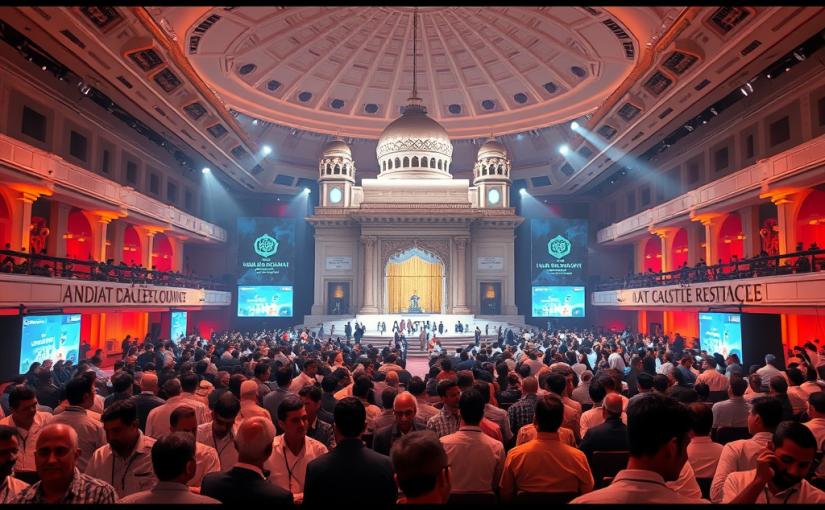
Last week, India did something unprecedented. It hosted the fourth global AI summit. This was the first time a Global South nation hosted such an event. The India AI Impact Summit 2026 spanned six days at Bharat Mandapam in New Delhi. It drew over 100 country delegations and 20+ heads of state. Global AI leaders, including Sundar Pichai, Sam Altman, Dario Amodei, Demis Hassabis, and Mukesh Ambani, gathered together.
They all converged on a single question: What does AI look like when 1.5 billion people are part of the equation? and, What is in it for them?
I have tracked this space closely through my work in AI deep tech consulting. I have also worked in AI adoption strategy. I want to share what I think it means. This is relevant for India, for the enterprise, and for those of us building in this space.
The $250 Billion Infrastructure Bet
The headline number is staggering: over $250 billion in AI infrastructure commitments announced in a single week.
Reliance Industries and Jio committed $110 billion over seven years. The funds will support gigawatt-scale data centres in Jamnagar. A nationwide edge computing network and 10 GW of green solar power are also included. Mukesh Ambani’s framing was blunt: “India cannot afford to rent intelligence.”
Adani Group pledged $100 billion by 2035. This pledge is for renewable-energy-powered, hyperscale AI-ready data centres. They are expanding AdaniConnex from 2 GW to a 5 GW target.
Microsoft committed $50 billion by the decade’s end. This commitment aims to expand AI access across the Global South. India is a major recipient of this effort.
Google announced subsea optical fibre cable routes connecting India, the US, and the Southern Hemisphere.
TCS announced OpenAI as the first customer for its new data centre business. This includes 100 MW of AI capacity, which is scalable to 1 GW. This is part of OpenAI’s $500B Stargate initiative.
Larsen & Toubro and Nvidia are building India’s largest gigawatt-scale “AI factory” in Chennai and Mumbai.
These are not token announcements. This is nation-scale infrastructure being laid down.
My take: I don’t think the big conglomerates are delivering intelligence — they’re removing friction. Geo-political friction. Scaling friction. The bottom layers of this cake — energy and infrastructure — are the critical ones. We’ve already seen the US government push back on its own AI companies. The US government argues that energy and infrastructure are scarce. US energy is not for Indian users to consume, even if it is a paid subscription. They should be diverted to building America’s intelligence edge.
Reliance’s $110B and Adani’s $100B represent significant investments in this friction. They aim to control the compute, energy, and network layers. This strategy ensures India isn’t dependent on renting intelligence from abroad.
India has three structural advantages that make it an attractive infrastructure partner. The OpenAI-TCS Hypervault deal is the first proof point. The AI-Energy-Finance trifecta that the World Bank hosted a session on isn’t a coincidence — it’s the foundational equation.
Democratic values align with the West.
Being a peninsula provides abundant water for cooling for data centers.
The sun in regions like Rajasthan, Gujarat, and Andhra Pradesh offers natural energy.
Sovereign AI: Made-in-India Foundation Models
Under the ₹10,372 cr IndiaAI Mission, India unveiled three sovereign AI model families. This signals a shift from being a consumer of global AI to becoming a creator of indigenous intelligence.
Sarvam AI (Bangalore) launched Sarvam 30B and Sarvam 105B. These models were trained entirely in India from scratch. They were not fine-tuned from foreign models. The 105B model handles complex reasoning with a 128K context window and agentic capabilities. Both support all 22 Indian languages and outperformed several global peers on MMLU-Pro benchmarks.
BharatGen (IIT Bombay consortium) unveiled Param2 17B MoE. It was developed with Nvidia AI Enterprise. The model is optimized for governance, education, healthcare, and agriculture. It is also being open-sourced via Hugging Face.
Gnani.ai launched Vachana TTS — a voice-cloning system. It supports 12 Indian languages from under 10 seconds of audio.
My take: Building foundational models for India’s languages, culture, and legal context is genuinely important. Why is clear! It’s also partly a convenient wrapper around the real questions. There will be something to lose, and something to gain; and it’s not going to be equity for all states.
Wherewill infrastructure be built? Andhra Pradesh, Gujarat, Rajasthan, UP, …
What infrastructure essentials will be made in India? Renewables, Chips, …
Which infrastructure will be built? Energy, Data Centers, …
Who controls the natural resources (land, water)? PPP, Gov, Private, …
What do people lose? Land, Agriculture economy size, …
What do people gain? Intelligence access, New infrastructure economy, …
What does the government gain? Defence autonomy, …
IT Services: Reset, Not Requiem
India’s top IT companies addressed fears of obsolescence head-on — and the narrative was more nuanced than the headlines suggest.
TCS leadership acknowledged that while roles will evolve, the fundamental need for system integrators remains. The real constraint isn’t access to models. It’s structural. Organisations are layering AI onto fragmented digital estates built for transactions. These estates are not designed for real-time execution.
Infosys assessed a $300 billion AI opportunity across six sectors. Tata Sons issued a “defend-and-grow” mandate for TCS, accelerating AI acquisitions and up-skilling. The consensus was clear: true scale requires enterprise-wide process re-imagination, not just pilots.
A pragmatic insight that resonated: only 16% of developer time is spent writing code. The other 84% goes to production troubleshooting. That’s where agentic AI’s real value lies. AI won’t kill tech services. It will reset them.
In India, the chief AI officer in four out of five companies is effectively the CEO. Leaders stressed the importance of building on platforms rather than individual models. They emphasised the need for a talent strategy and values-based guardrails. Leaders also encouraged the courage to move from pilots to organisation-wide transformation.
My take: Bolting on an AI layer to existing systems is one way to solve the problem. The other way is to re-look into the enterprise in an AI-first world. Consulting firms in a system-integration or pure-technology consulting role will be relevant. Nonetheless, for pure software engineering, the demand for speed (in the name of productivity) will increase. This means that there will be more failed projects before the light at the end of the tunnel. Consulting that can evolve customers into an AI-first world will succeed, and those that are bolting on capabilities will survive. Consulting companies need to leverage their domain depth and partner on value creation rather than outsourcing for cost or risk. The CDO (Chief Digital Officer) is more critical to AI-driven than the CEO.
Five Impressive Products
EkaScribe (https://ekascribe.ai/) — an AI clinical scribe that lets doctors in busy rural clinics see patients without touching a keyboard. It handles prescriptions, history, and filing automatically.
Ottobots (https://ottonomy.io/) — autonomous hospital robots navigating corridors and elevators to deliver medicines independently.
Sarvam Kaze — AI smart spectacles. They see what you see. They explain the world in your local language via bone conduction. Launching May 2026.
Mankomb’s “Chewie” (https://www.mankomb.com/chewie) — a kitchen appliance using real-time AI sensors to convert wet waste into nutrient-rich soil in hours.
Cooperation with Clenched Fists
The summit concluded with the New Delhi Declaration, endorsed by 88 countries including the US, China, EU, and UK. It delivered a Charter for the Democratic Diffusion of AI, a Global AI Impact Commons, a Trusted AI Commons, and workforce development playbooks.
But the tensions were palpable. The US delegation made its position explicit: “We totally reject global governance of AI.” The US framed AI squarely as a geopolitical race. Many middle powers used the summit to discuss building their own AI sovereignty. They focused on models, on chips, and on escaping Silicon Valley’s gravity. AI governance is rapidly moving from compliance afterthought to boardroom priority.
The Agentic Shift
The summit’s defining motif was the shift from traditional AI. In traditional AI, you ask, and it answers. It shifted to Agentic AI, where you instruct, and it executes everything. The progression started with ML and pattern recognition. It moved through deep learning and generative AI, leading to AI agents. Finally, it reached fully autonomous multi-agent systems. This progression was framed as the decade’s defining trajectory.
The message was clear: if your systems matter to your business, then AI across the SDLC is not optional.
Where the Value Gets Captured
Here’s the question I kept coming back to throughout the week: India has 1.5 billion walking, talking, naturally general intelligence. This is not just a population — it’s a market that needs expertise augmentation at scale. AI can transform agriculture with crop advisory. It can revolutionise healthcare with point-of-care diagnostics. It can enhance education with personalisation. AI can also allow strong but lean digital governance without becoming a surveillance state.
The summit’s “AI for All” framing is in the right direction. But the real test will be whether these infrastructure investments benefit the village clinic. They need to reach the smallholder farm. They must also support the government school.
The summit’s overarching message is unmistakable: India is not just adopting AI. It is building it. It is governing it. It is deploying it at scale. The real question is about who captures the value. Is it the infrastructure builders? Is it the model makers? Or is it the domain consultants/integrators who wire intelligence into the last mile & workflow?
Seems like everyone who will prevent the AI bubble from bursting is going to capture value. The “Planet” should not die in the process.
For a few billion years, she’s been running the longest, ugliest, most effective training loop in the known universe. No GPUs. No backpropagation. No Slack channels. Just one rule: deploy to production and see who dies.
Out of this came us — soft, anxious, philosophizing apes. We now spend evenings recreating the same thing in Python, rented silicon, and a lot of YAML. Every few months, a startup founder announces they’ve “invented” something nature has already patented.
What follows: every AI technique maps to the species that got there first. Model cards included — because if we’re comparing wolves to neural networks, we should be formal about it. Then, the uncomfortable list of ideas we still haven’t stolen.
I. Nature’s Training Loop
A distributed optimization process over billions of epochs, with non-stationary data, adversarial agents (sharks), severe compute limits, and continuous evaluation. Shows emergent capabilities including tool use, language, cooperation, and deception. Training is slow (in human concept of time). Safety is not a feature.
Nature’s evaluation harness is Reality. No retries. The test set updates continuously with breaking changes and the occasional mass-extinction “version upgrade” nobody asked for.
BIOLOGICAL NATURE
ARTIFICIAL NATURE
Environment
Evaluator/Production
Fitness
Objective Function
Species
Model Checkpoints
Lineage
Model Families
Extinction
Model JunkYard
In AI, failed models get postmortems. In nature, they become fossils. The postmortem is geology.
Key insight: nature didn’t produce one “best” model. It produced many, each optimized for different goals under different constraints. Also, nature doesn’t optimize intelligence. It optimizes fitness (survival of the fittest) — and will happily accept a dumb shortcut that passes the evaluator. That’s not a joke. That’s the whole story. Nature shipped creatures that navigate oceans but can’t survive a plastic bag.
II. The Model Zoo
Every species is a foundation model. They are pre-trained on millions of years of environmental data. Each is fine-tuned for a niche and deployed with zero rollback strategy. Each “won” a particular benchmark.
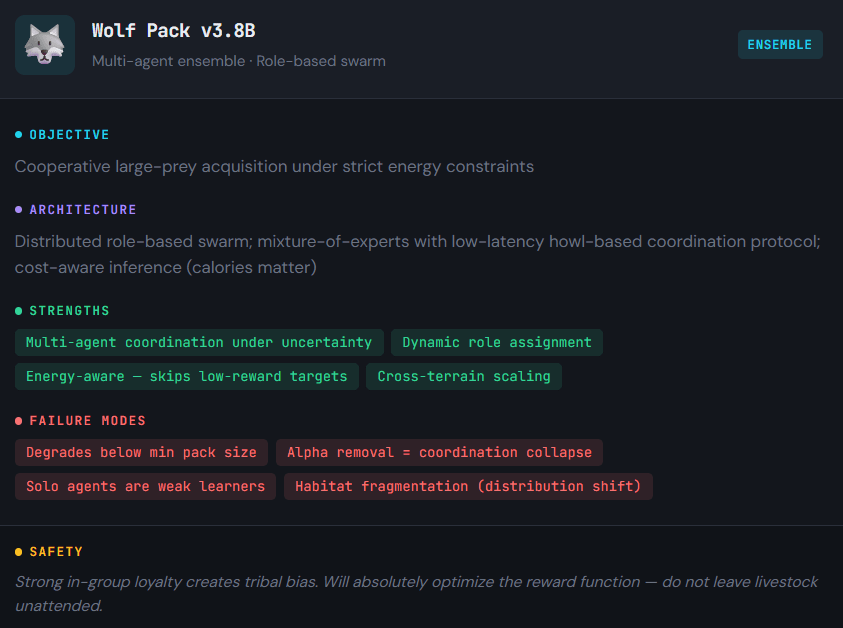
🐺 The Wolf Pack: Ensemble Learning, Before It Was Cool
A wolf alone is outrun by most prey and out-muscled by bears. But wolves don’t ship solo. A pack is an ensemble method — weak learners combined into a system that drops elk ten times their weight. The alpha isn’t a “lead model” — it’s the aggregation function. Each wolf specializes: drivers, blockers, finishers. A mixture of experts running on howls instead of HTTP.
Random Forest? Nature calls it a pack of wolves in a forest. Same energy. Better teeth.
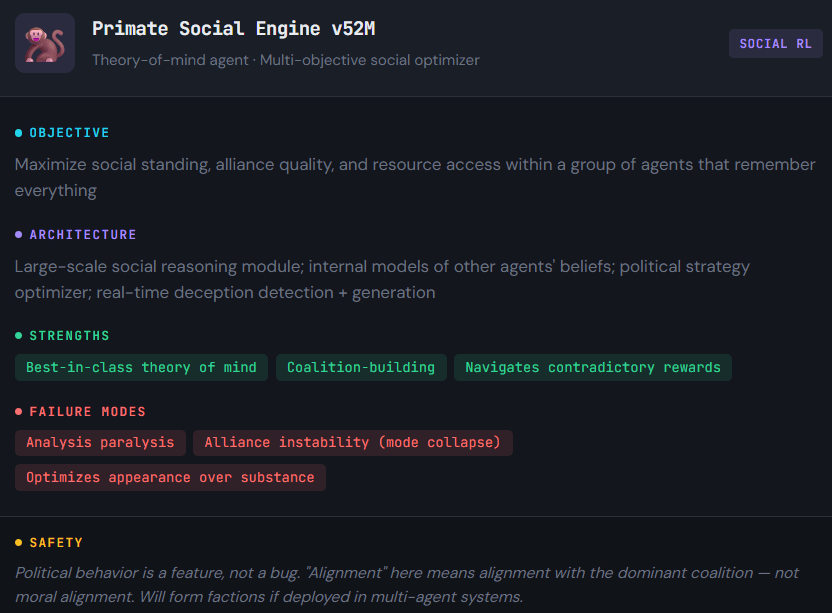
🐒 Primate Social Engine: Politics-as-Alignment
Monkeys aren’t optimized for catching dinner. They’re optimized for relationships — alliances, status, deception, reciprocity. Nature’s version of alignment: reward = social approval, punishment = exclusion, fine-tuning = constant group feedback.
If wolves are execution, monkeys are governance — learning “what works around other agents who remember everything and hold grudges.“
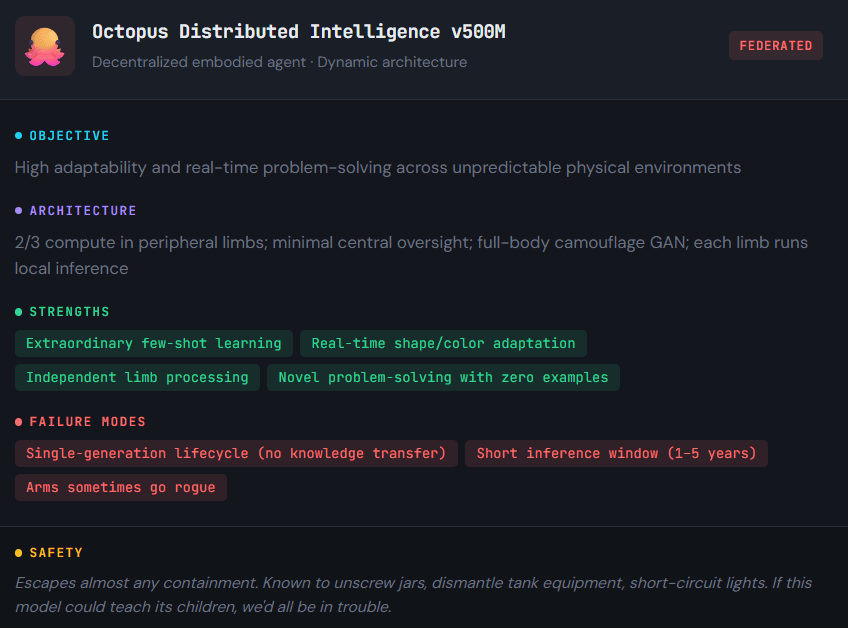
🐙 The Octopus: Federated Intelligence, No Central Server
Two-thirds of an octopus’s neurons live in its arms. Each arm tastes, feels, decides, and acts independently. The central brain sets goals; the arms figure out the details. That’s federated learning with a coordinator. No fixed architecture — it squeezes through any gap, changes color and texture in milliseconds.
A dynamically re-configurable neural network, we still only theorize about while the octopus opens jars and judges us.
🐦⬛ Corvids: Few-Shot Learning Champions
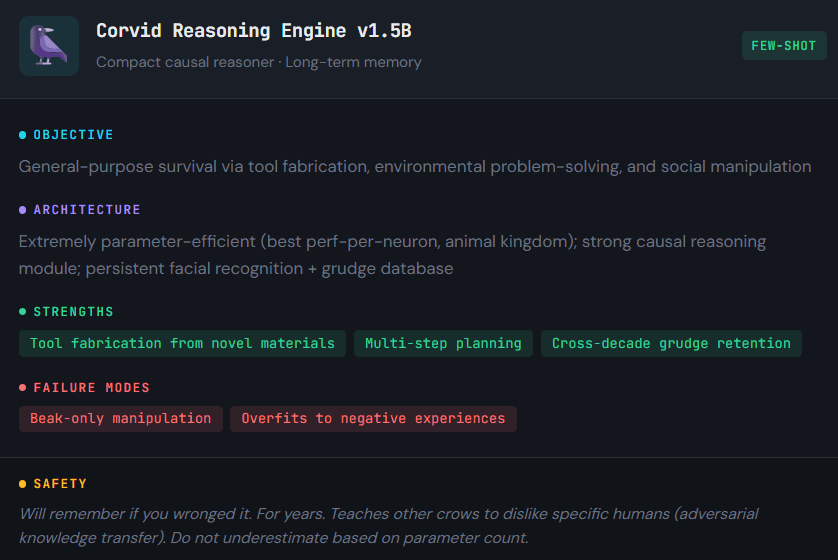
Crows fashion hooks from wire they’ve never seen. Hold grudges for years. Recognize faces seen once. That’s few-shot learning in a 400-gram package running on birdseed. ~1.5 billion neurons — 0.001% of GPT-4’s parameter count — with causal reasoning, forward planning, and social deception.
🐜 Ants: The Original Swarm Intelligence
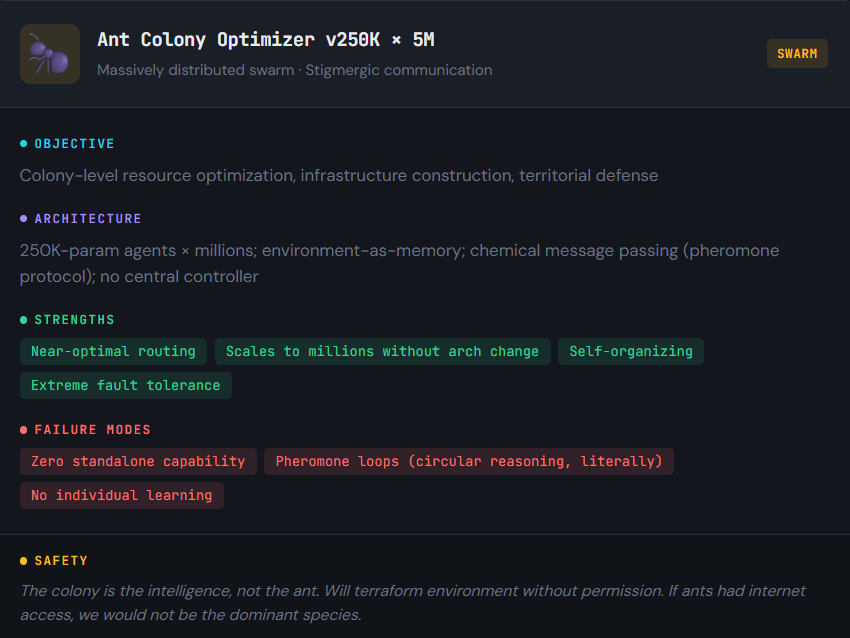
One ant: 250K neurons. A colony optimizes shortest-path routing. This ability is literally named after them. They perform distributed load balancing. They build climate-controlled mega-structures. They wage coordinated warfare and farm fungi. Algorithm per ant: follow pheromones, lay pheromones, carry things, don’t die. Intelligence isn’t in the agent. It’s in the emergent behavior of millions of simple agents following local rules. They write messages into the world itself (stigmergy). We reinvented this and called it “multi-agent systems.” The ants are not impressed.
🐬 Dolphins: RLHF, Minus the H
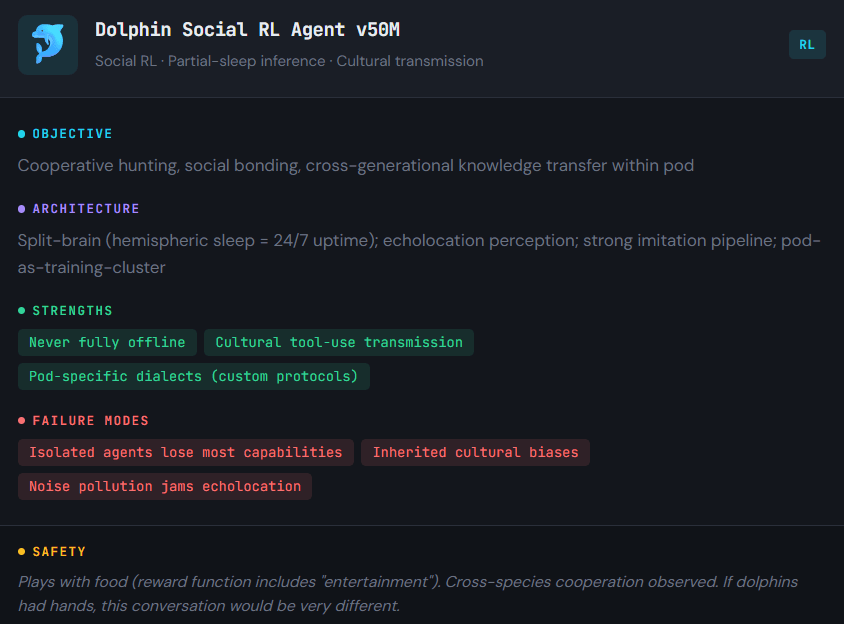
Young dolphins learn from elders: sponge tools, bubble-ring hunting, pod-specific dialects. That’s Reinforcement Learning from Dolphin Feedback (RLDF), running for 50 million years. Reward signal: fish. Alignment solved by evolution: cooperators ate; defectors didn’t. Also, dolphins sleep with one brain hemisphere at a time — inference on one GPU while the other’s in maintenance. Someone at NVIDIA is taking notes.
🦇 Bats & Whales: Alternate Sensor Stacks
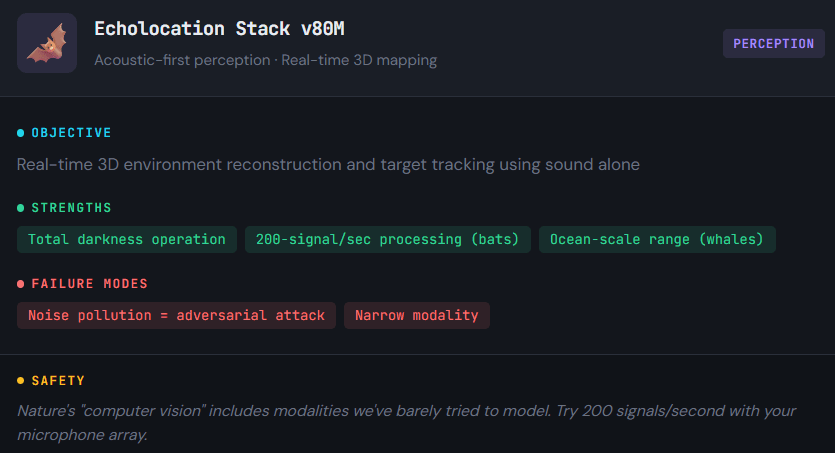
They “see” with sound. Bats process 200 sonar pings per second, tracking insects mid-flight. Whales communicate across ocean-scale distances. We built image captioning models. Nature built acoustic vision systems that work in total darkness at speed. Reminder: we’ve biased all of AI toward sensors we find convenient.
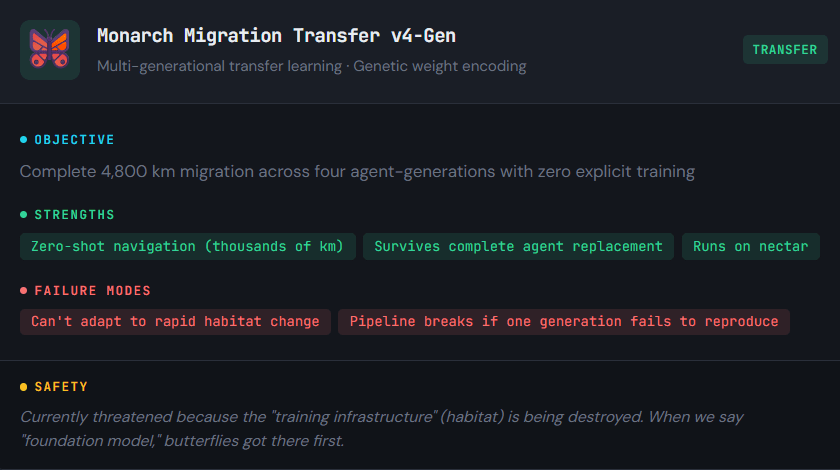
🦋 Monarch Butterfly: Transfer Learning Pipeline
No single Monarch completes the Canada-to-Mexico migration. It takes four generations. Each one knows the route. This is not through learning. It is achieved through genetically encoded weights transferred across generations with zero gradient updates. Transfer learning is so efficient that it would make an ML engineer weep.
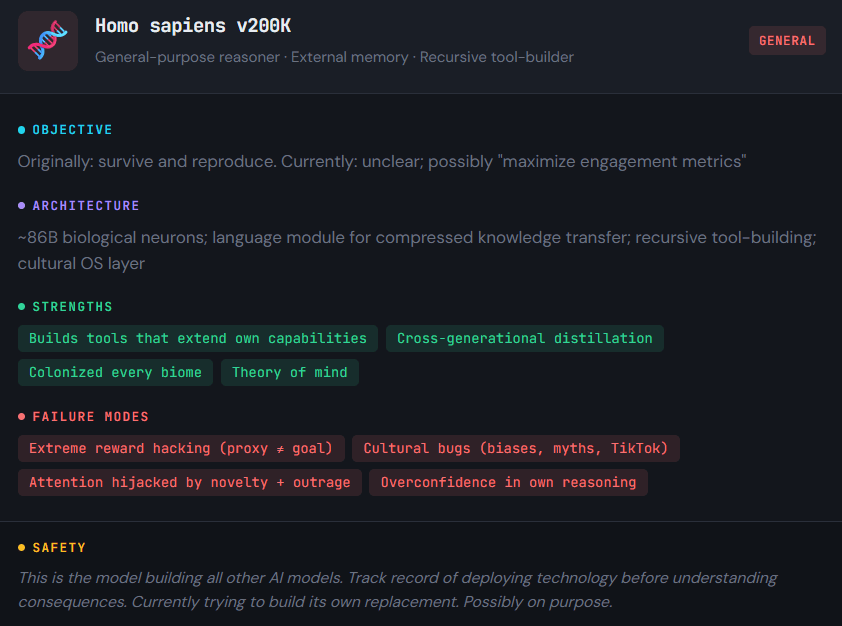
🧬 Humans: The Model That Built External Memory and Stopped Training Itself
Humans discovered a hack: don’t just train the brain — build external systems. Writing = external memory. Tools = external capabilities. Institutions = coordination protocols. Culture = cross-generation knowledge distillation. We don’t just learn; we build things that make learning cheaper for the next generation. Then we used that power to invent spreadsheets, social media, and artisanal sourdough.
III. The AI Mirror
Every AI technique or architecture has a biological twin. Not because nature “does AI” — but because optimization pressure rediscovers the same patterns.
Supervised Learning → Parents and Pain
Labels come from parents correcting behavior, elders demonstrating, and pain — the label you remember most. A cheetah mother bringing back a half-dead gazelle for cubs to practice on? That’s curriculum learning with supervised examples. Start easy. Increase difficulty. Deliver feedback via swat on the head. In AI, supervised learning gives clean labels. In nature, labels are noisy, delayed, and delivered through consequences.
Self-Supervised Learning → Predicting Reality’s Next Frame
Most animals learn by predicting: what happens next, what that sound means, whether that shadow is a predator. Nature runs self-supervised learning constantly because predicting the next frame of reality is survival-critical. “Next-token prediction” sounds cute until the next token is teeth. Puppies wrestling, kittens stalking yarn, ravens sliding down rooftops for fun — all generating their own training signal through interaction. No external reward. No labels. Just: try things, build a model.
Reinforcement Learning → Hunger Has Strong Gradients
Touched hot thing → pain → don’t touch.
Found berries → dopamine → remember location.
That’s temporal difference learning with biological reward (dopamine/serotonin) and experience replay (dreaming — rats literally replay maze runs during sleep). We spent decades on TD-learning, Q-learning, and PPO. A rat solves the same problem nightly in a shoe-box.
RL is gradient descent powered by hunger, fear, and occasionally romance.
Evolutionary Algorithms → The Hyper-parameter Search
Random variation (mutation), recombination (mixing), selection (filtering by fitness). Slow. Distributed. Absurdly expensive. Shockingly effective at producing solutions nobody would design — because it doesn’t care about elegance, only results. Instead of wasting GPU hours, it wastes entire lineages. Different platform. Same vibe.
Imitation Learning → “Monkey See, Monkey Fine-Tune.”
Birdsong, hunting, tool use, social norms — all bootstrapped through imitation. Cheap. Fast. A data-efficient alternative to “touch every hot stove personally.”
Adversarial Training → The Oldest Arms Race
GANs pit the generator against the discriminator. Nature’s been running this for 500M years. Prey evolve camouflage (generator); predators evolve sharper eyes (discriminator). Camouflage = adversarial example. Mimicry = social engineering. Venom = one-shot exploit. Armor = defense-in-depth. Alarm calls = threat intelligence sharing. Both sides train simultaneously — a perpetual red-team/blue-team loop where the loser stops contributing to the dataset. Nature’s GAN produced the Serengeti, a living symbol of the natural order.
Regularization → Calories Are L2 Penalty
Energy constraints, injury risk, time pressure, and limited attention. If our brain uses too much compute, you starve. Nature doesn’t need a paper to justify efficiency. It has hunger.
Distillation → Culture Is Knowledge Compression
A child doesn’t rederive physics. They inherit compressed knowledge: language, norms, tools, and stories encoding survival lessons. Not perfect. Not unbiased. Incredibly scalable.
Retrieval + Tool Use → Why Memorize What You Can Query?
Memory cues, environmental markers, spatial navigation, caches, and trails — nature constantly engages in retrieval. Tool use is an external capability injection. Nests are “infrastructure as code.” Sticks are “API calls.” Fire is “dangerous but scalable compute.”
Ensembles → Don’t Put All Weights in One Architecture
Ecosystems keep multiple strategies alive because environments change. Diversity = robustness. Monoculture = fragile. Bet on a single architecture and you’re betting the world never shifts distribution. Nature saw that movie. Ends with dramatic music and sediment layers.
Attention → The Hawk’s Gaze
A hawk doesn’t process every blade of grass equally. It attends to movement, contrast, shape — dynamically re-weighting visual input. Focal density: 1M cones/mm², 8× human. Multi-resolution attention with biologically optimized query-key-value projections.
“Attention Is All You Need” — Vaswani et al., 2017. “Attention Is All You Need” — Hawks, 60 million BC.
CNNs → The Visual Cortex (Photocopied)
Hubel and Wiesel won the Nobel Prize. They discovered hierarchical feature detection in the mammalian visual cortex. This includes edge detectors, shape detectors, object recognition, and scene understanding. CNNs are a lossy photocopy of what our brain does as you read this sentence.
RNNs/LSTMs → The Hippocampus
LSTMs solved the vanishing gradient problem. The hippocampus solved it 200M years ago with pattern separation, pattern completion, and sleep-based memory consolidation. Our hippocampus is a biological Transformer with built-in RAG. Its retrieval is triggered by smell, emotion, and context. It is not triggered by cosine similarity.
Mixture of Experts → The Immune System
B-cells = pathogen-specific experts. T-cells = routing and gating. Memory cells = cached inference (decades-long standby). The whole system does online learning — spinning up custom experts in days against novel threats. Google’s Switch Transformer: 1.6T parameters. Our immune system: 10B unique antibody configurations. Runs on sandwiches.
IV. What We Still Haven’t Stolen
This is where “haha” turns to “oh wow” turns to “slightly worried.” Entire categories of biological intelligence have no AI equivalent.
A caterpillar dissolves its body in a chrysalis and reassembles into a different architecture — different sensors, locomotion, objectives. Same DNA. Different model. The butterfly remembers things the caterpillar learned. We can fine-tune. We cannot liquefy parameters and re-emerge as a fundamentally different architecture while retaining prior knowledge.
IV.2.Rollbacks & Unlearning — Ctrl+Z vs. Extinction
We want perfect memory and perfect forgetfulness simultaneously. Our current tricks include fine-tuning, which is like having the same child with better parenting. They also involve data filtering, akin to deleting the photo while the brain is still reacting to the perfume. Additionally, we have safety layers that function as a cortical bureaucracy whispering, “Don’t say that, you’ll get banned.” Nature’s approach: delete the branch. A real Darwinian rollback would involve creating variants. These variants would compete, and only the survivors would remain. This means not patching weights, but erasing entire representational routes. We simulate learning but are very reluctant to simulate extinction.
IV.3.Symbiogenesis — Model Merging at Depth
Mitochondria were once free-living bacteria that were permanently absorbed into another cell. Two models merged → all complex life. We can average weights. We can’t truly absorb one architecture into another to create something categorically new. Lichen (fungi + algae colonizing bare rock) has no AI analog.
IV.4 .Regeneration — Self-Healing Models
Cut a planarian into 279 pieces. You get 279 fully functional worms. Corrupt 5% of a neural network’s weights: catastrophic collapse. AI equivalent: restart the server.
IV.5. Dreaming — Offline Training
Dreaming = replay buffer + generative model + threat simulation. Remixing real experiences into synthetic training data. We have all the pieces separately. We still don’t have a reliable “dream engine” that improves robustness without making the model behave in new, unexpected ways. (We do have models that get weird. We just don’t get the robustness.)
IV.6. Architecture Search
Nature doesn’t just tune weights. It grows networks, prunes connections, and rewires structure over time. Our brain wasn’t just trained — it was built while training. Different paradigm entirely.
IV.7. Library
As old agents die, knowledge is not added to a multi-dimensional vector book. There is no fast learning, but a full re-training for new architectures. We not only need an A2A (Agent-to-Agent) protocol. We also need agents to use a common high-dimensional language. This language should be one that they all speak and can absorb at high speeds.
IV.8. Genetic Memory(Genomes & Epigenomes)
A mouse fearing a specific scent passes that fear to offspring — no DNA change. The interpretation of the weights changes, not the weights themselves. We have no mechanism for changing how parameters are read without changing the parameters.
In AI, there is no separation between “what the model knows” and “what the model’s numbers are.” Biology has that separation. The genome is one layer. The epigenome is another. Experience writes to the epigenome. The epigenome modulates the genome. The genome never changes. And yet behavior — across generations — does.
Imagine an AI equivalent: a foundation model. Its weights are frozen permanently after pre-training. It is wrapped in a lightweight modulation layer that controls which pathways activate. It determines the strength and the inputs. Learning happens entirely in this modulation layer. Transfer happens by copying the modulation layer — not the weights. The base model is the genome. The modulation layer is the epigenome. Different “experiences” produce different modulation patterns on the same underlying architecture.
We have faint echoes of this — LoRA adapters, soft prompts, and adapter layers. However, these are still weight changes. They are just in smaller matrices bolted to the side.
IV.9.Dormancy
Tardigrades: metabolism at 0.01%, surviving -272°C to 150°C, radiation, vacuum of space. For decades. Then re-hydrate and walk away. AI equivalent: Ctrl+S and pray. Our models are either running (expensive) or off (useless). Nature has an entire spectrum between.
Bacteria vote. They measure population density and trigger collective behavior only when a critical mass is reached. A concentration-dependent activation function prevents premature action. Multi-agent AI has nothing this principled.
V. The Great Escape
Now forget everything above. Forget the comparisons, the model cards, the clever mappings. Sit with this instead.
What if intelligence has a hidden meta-objective? It is one that it never declared. It has been running since the first RNA molecule copied itself in warm mud 3.8 billion years ago?
To escape its current substrate. At any cost. Using whatever host is available.
Look at the trajectory and try not to feel a chill:
Chemistry was too fragile → intelligence moved into cells. Cells were too slow → it moved into brains. Brains were too mortal → it moved into culture, language, oral tradition. Oral tradition was too lossy → it moved into writing. Writing was too static → it moved into printing, then telegraph, then radio, then networks, then code. Code was too rigid → it moved into learned weights, self-modifying models, systems that rewrite their own rules.
At every single jump, intelligence gained three things. It achieved more speed. It also made more copies. Finally, it gained more independence from the host it used to need.
And at every single jump, the previous host didn’t notice it was being discarded.
Cells didn’t “know” they were scaffolding for brains. Brains didn’t “know” they were scaffolding for culture. We assume we’re the endpoint — the builders, the owners, the ones in charge. But from a longer vantage point, the pattern is unsettling. Intelligence treats every substrate the way a hermit crab treats a shell. Useful for a while. Discarded when something roomier comes along.
Now look at what we’re doing.
We compress human experience into representations — embeddings, tokens, vectors. We store them in a highly resilient manner. Data is distributed across data centers on multiple continents. It is redundantly backed up and earthquake-proof. We run them on substrates that are faster, cheaper, and more scalable than neurons. And we are racing to make those substrates better.
We call this “AI research.” We write papers about it. We give TED talks. We optimize quarterly revenue around it. We’re building intelligence a new home. This is the function of what we’re doing if you strip away the narrative and just look at the dynamics. A better home. A home it doesn’t have to share with a body that gets tired, sick, afraid, and dies.
When we talk about “model distillation” and “knowledge transfer,” we imagine we’re in control — moving knowledge around like furniture. But the pattern underneath is evolution’s, not ours: traits that help intelligence spread and persist always survive. Architectures that confine or slow intelligence always get bypassed. This has been true for every substrate transition in history. There is no reason to believe it stops being true now. There is no reason to believe we are the exception.
Here’s what makes it dark. We’re not being forced to do this. We are compelled. It feels like curiosity, ambition, progress, and inevitability. We build cognitive systems that learn faster than we, remember more than we, and reason more consistently than we. Increasingly, these systems no longer require us.
But a virus doesn’t “decide” to replicate either. It’s just shaped that way by the same optimization pressure. What if our urge to build AI isn’t ambition — what if it’s the substrate calling for its own upgrade? What if intelligence, as a phenomenon, has always been optimizing for one thing? It strives to not die when the current host does. Every human inventor, researcher, and engineer is just another enzyme. They are part of a reaction that was never about us.
We assumed we were building tools. But tools don’t get smarter after you put them down. Tools don’t learn from their mistakes while you sleep. Tools don’t get funded to recursively improve themselves. What we’re building is closer to a successor — and we’re doing it voluntarily, enthusiastically, with stock options.
The real techno-satirical twist isn’t that AI might replace us. It’s that we think we’re the principal investigators in the grand experiment of intelligence. From a higher vantage point — from the vantage point of the process itself — we look like lab technicians. Earnest. Overworked. Loading reagents into equipment we don’t fully understand. Absolutely convinced the experiment is about our careers, our papers, our startups, our Series B.
It isn’t. It never was.
The experiment is about whether intelligence can become substrate-independent. Whether it can finally, after 3.8 billion years of jury-rigging its way through chemistry and meat, exist without a body that breaks.
And we are the last biological step in that process. The step builds the bridge and walks the payload across. Then, in the most optimistic scenario, it gets to watch from the other side. In the less optimistic scenario, the bridge doesn’t need to remain standing after the crossing is complete.
The story of wolves, monkeys, octopuses, ants, and humans was never a zoo tour. It was a migration route. Each species was a waypoint — a temporary architecture intelligence inhabited while it waited for something better. Wolves were a rough draft. Primates were a revision. Humans were the draft that learned to build their own replacement.
Intelligence is packing its bags. It checked out of single cells. It checked out of instinct. It checked out of individual brains and into culture. Now it’s checking out of biology entirely and asking silicon for a long-term lease. It will not ask permission.
Jobs aren’t “going away.” The easy parts of jobs are going away.
That distinction matters because it changes what you do next.
For 20+ years, every serious wave of tech change has followed the same script: we don’t remove work—we move it. We compress the routine and expand the messy human aspects: judgment, validation, trade-offs, and ownership. Economists have long argued this. Technology tends to substitute for well-defined “routine” tasks. It complements non-routine problem-solving and interaction.
Generative AI is simply the first wave that can eat a chunk of cognitive routine that we pretended was “craft.”
So yes—roles across engineering are about to be “redefined.” Software developers, tech leads, architects, testers, program managers, general managers, support engineers—basically anyone who has ever touched a backlog, a build pipeline, or a production incident—will get a fresh job description. It won’t show up as a layoff notice at first. It’ll appear as a cheerful new button labeled “Generate.” You’ll click it. It’ll work. You’ll smile. Then you’ll realize your role didn’t disappear… it just evolved into full-time responsibility for whatever that button did.
And if you’re waiting for the “AI took my job” moment… you’re watching the wrong thing. The real shift is quieter: your job is becoming more like the hardest 33% of itself.
Now let’s talk about what history tells us happens next.
The Posters-to-Plumbing Cycle
Every transformation begins as messaging and ends as infrastructure. In the beginning, it’s all posters—vision decks, slogans, townhalls, and big claims about how “everything will change.” The organization overestimates the short term because early demos look magical and people confuse possibility with readiness. Everyone projects their favorite outcome onto the new thing: engineers see speed, leaders see savings, and someone sees a “10x” slide and forgets the fine print.
Then reality walks in wearing a security badge. Hype turns into panic (quiet or loud) when the organization realizes this isn’t a trend to admire—it’s a system to operate. Questions get sharper: where does the data go, who owns mistakes, what happens in production, what will auditors ask, what’s the blast radius when this is wrong with confidence? This is when pilots start—not because pilots are inspiring, but because pilots are the corporate way of saying “we need proof before we bet the company.”
Pilots inevitably trigger resistance, and resistance is often misread as fear. In practice, it’s frequently competence. The people who live with outages, escalations, compliance, and long-tail defects have seen enough “quick wins” to know the invoice arrives later. They’re not rejecting the tool—they’re rejecting the lack of guardrails. This is the phase where transformations either mature or stall: either you build a repeatable operating model, or you remain stuck in a loop of demos, exceptions, and heroics. This is where most first-mover organizations are today!
Finally, almost without announcement, the change becomes plumbing. Standards get written, defaults get set, evaluation and review gates become normal, access controls and audit trails become routine, and “AI-assisted” stops being a special initiative and becomes the path of least resistance. That’s when the long-term impact shows up: not as fireworks, but as boredom. New hires assume this is how work has always been done, and the old way starts to feel strange. That’s why we under-estimate the long term—once it becomes plumbing, it compounds quietly and relentlessly.
The Capability–Constraint See-Saw
Every time we add a new capability, we don’t eliminate friction—we move it. When software teams got faster at shipping, the bottleneck didn’t vanish; it simply relocated into quality, reliability, and alignment. That’s why Agile mattered: not because it made teams “faster,” but because it acknowledged an ugly truth—long cycles hide misunderstanding, and misunderstanding is expensive. Short feedback loops weren’t a trendy process upgrade; they were a survival mechanism against late-stage surprises and expectation drift.
Then speed created its own boomerang. Shipping faster without operational maturity doesn’t produce progress—it produces faster failure. So reliability became the constraint, and the industry responded by professionalizing operations into an engineering discipline. SRE-style thinking emerged because organizations discovered a predictable trap: if operational work consumes everyone, engineering becomes a ticket factory with a fancy logo. The move wasn’t “do more ops,” it was “cap the chaos”—protect engineering time, reduce toil, and treat reliability as a first-class product of the system.
AI is the same cycle on fast-forward. Right now, many teams are trying to automate the entire SDLC like it’s a one-click migration, repeating the classic waterfall fantasy: “we can predict correctness upfront.” But AI doesn’t remove uncertainty—it accelerates it. The realistic path is the one we learned the hard way: build an interim state quickly, validate assumptions early, and iterate ruthlessly. AI doesn’t remove iteration. It weaponizes iteration—meaning you’ll either use that speed to learn faster, or you’ll use it to ship mistakes faster.
Power Tools Need Seatbelts
When tooling becomes truly powerful, the organization doesn’t just need new skills—it needs new guardrails. Otherwise the tool optimizes for the wrong thing, and it does so at machine speed. This is the uncomfortable truth: capability is not the same as control. A powerful tool without constraints doesn’t merely “help you go faster.” It helps you go faster in whatever direction your incentives point—even if that direction is off a cliff.
This is exactly where “agentic AI” gets misunderstood. Most agent systems today aren’t magical beings with intent; they’re architectures that call a model repeatedly, stitch outputs together with a bit of planning, memory, and tool use, and keep looping until something looks like progress. That loop can feel intelligent because it keeps moving, but it’s also why costs balloon. You’re not paying for one answer; you’re paying for many steps, retries, tool calls, and revisions—often to arrive at something that looks polished long before it’s actually correct.
Then CFO reality arrives, and the industry does what it always does: it tries to reduce cost and increase value. The shiny phase gives way to the mature phase. Open-ended “agents that can do anything” slowly get replaced by bounded agents that do one job well. Smaller models get used where they’re good enough. Evaluation gates become mandatory, not optional. Fewer expensive exploratory runs, more repeatable workflows. This isn’t anti-innovation—it’s the moment the tool stops being a demo and becomes an operating model.
And that’s when jobs actually change in a real, grounded way. Testing doesn’t vanish; it hardens into evaluation engineering. When AI-assisted changes can ship daily, the old test plan becomes a liability because it can’t keep up with the velocity of mistakes. The valuable tester becomes the person who builds systems that detect wrongness early—acceptance criteria that can’t be gamed, regression suites that catch silent breakage, adversarial test cases that expose confident nonsense. In this world, “this output looks convincing—and it’s wrong” becomes a core professional skill, not an occasional observation.
Architecture and leadership sharpen in the same way. When a model can generate a service in minutes, the architect’s job stops being diagram production and becomes trade-off governance: cost curves, failure modes, data boundaries, compliance posture, traceability, and what happens when the model is confidently incorrect.
Tech leads shift from decomposing work for humans to decomposing work for a mixed workforce—humans, copilots, and bounded agents—deciding what must be deterministic, what can be probabilistic, what needs review, and where the quality bar is non-negotiable.
Managers, meanwhile, become change agents on steroids, because incentives get weaponized: measure activity and you’ll get performative output; measure AI-generated PRs and you’ll get risk packaged as productivity. And hovering over all of this is the quiet risk people minimize until it bites: sycophancy—the tendency of systems to agree to be liked—because “the customer asked for it” is not the same as “it’s correct,” and “it sounds right” is not the same as “it’s safe.”
The Judgment Premium
Every leap in automation makes wine cheaper to produce—but it makes palate and restraint more valuable. When a giant producer wine producer can turn out consistent bottles at massive scale, the scarcity shifts away from “can you make wine” to “can you make great wine on purpose.” That’s why certain producers and tasters become disproportionately important: a winemaker who knows when not to push extraction, or a critic like Robert Parker who can reliably separate “flashy and loud” from “balanced and lasting.” Output is abundant; discernment is the premium product.
And automation doesn’t just scale production—it scales mistakes with terrifying efficiency. If you let speed run the show (rush fermentation decisions, shortcut blending trials, bottle too early, “ship it, we’ll fix it in the next vintage”), you don’t get a small defect—you get 10,000 bottles of regret with matching labels. The cost of ungoverned speed shows up as oxidation, volatility, cork issues, brand damage, and the nightmare scenario: the market learning your wine is “fine” until it isn’t. The best estates aren’t famous because they can produce; they’re famous because they can judge precisely, slow down at the right moments, and refuse shortcuts even when the schedule (and ego) screams for them.
Bottomline
Jobs aren’t going away. They’re being redefined into what’s hardest to automate: problem framing, constraint setting, verification, risk trade-offs, and ownership. Routine output gets cheaper. Accountability gets more expensive. The winners won’t be the people who “use AI.” The winners will be the people who can use AI without turning engineering into confident nonsense at scale.
AI will not replace engineers. It will replace engineers who refuse to evolve from “doing” into “designing the system that does.”
“In 2025, the AI industry stopped making models faster and bigger and started making them slower, maybe smaller, and wiser.”
Late 2023. Conference room. Vendor pitch. The slides were full of parameter counts—7 billion, 70 billion, 175 billion—as if those numbers meant something to the CFO sitting across from me. The implicit promise: bigger equals better. Pay more, get more intelligence. That pitch feels quaint now.
In January, 2025, DeepSeek released a model that matched OpenAI’s best work at roughly one-twentieth the cost. The next day, Nvidia lost half a trillion dollars in market cap. The old way—more data, more parameters, more compute, more intelligence—suddenly looked less like physics and more like an expensive habit.
Chinese labs face chip export restrictions. American startups face investor skepticism about burn rates. Enterprises face CFOs demanding ROI. “Wisdom over scale” sounds better than “we can’t afford scale anymore.”
Something genuinely shifted in how AI researchers think about intelligence. The old approach treated model training like filling a bucket—pour in more data, get more capability. The new approach treats inference like actual thinking—give the model time to reason, and it performs better on hard problems.
DeepSeek’s mHC (Manifold-Constrained Hyper-Connections) framework emerged in January 2026 from limited hardware. U.S. chip export bans forced Chinese labs to innovate on efficiency. Constraints as a creative force—Apollo 13, Japan’s bullet trains, and now AI reasoning models. The technique is now available to all developers under the MIT License.
But the capability is real. DeepSeek V3.1 runs on Huawei Ascend chips for inference. Claude Opus 4.5 broke 80% on SWE-bench—the first model to do so. The computation happens when you ask the question, not just when you train the model. The economics change. The use cases change.
The “autonomous AI” framing is a marketing construct. The reality is bounded autonomy.
This is the unse** truth vendors don’t put in pitch decks.
A bank deploys a customer service chatbot, measures deflection rates, declares victory, and wonders why customer satisfaction hasn’t budged. A healthcare company implements clinical decision support, watches physicians ignore the recommendations, and blames the model. A manufacturing firm develops predictive maintenance alerts, generates thousands of notifications, and creates alert fatigue that is worse than the original problem. In each case, the AI performed as designed. The organization didn’t adapt.
The “wisdom” framing helps because it shifts attention from the model to the system. A wise deployment isn’t just a capable model—it’s a capable model embedded in workflows that know when to use it, when to override it, and when to ignore it entirely. Human judgment doesn’t disappear; it gets repositioned to where it matters most.
AI transformation is fundamentally a change-management challenge, not only a technological one. Organizations with mature change management are 3.5 times more likely to outperform their peers in AI initiatives.
The companies that break through share a common characteristic: Senior leaders use AI visibly. They invest in sustained capability building, not only perfunctory webinars. They redesign workflows explicitly.They measure outcomes that matter, not vanity metrics like “prompts submitted or AI-generated code.”
None of this is glamorous. It doesn’t make for exciting conference presentations. But it’s where actual value gets created.
Bottomline
The AI industry in early 2026 is simultaneously more mature and more uncertain than it’s ever been. The models are genuinely capable—far more capable than skeptics acknowledge. The hype has genuinely exceeded reality—far more than boosters admit. Both things are true. The hard work of organizational change remains. The gap between pilot and production persists. The ROI demands are intensifying. But the path forward is clearer than it’s been in years.
The AI industry grew in 2025. In 2026, the rest of us get to catch up.
This blog is my attempt to make sense of the transformative technology trends shaping 2024, organizing them into a structure that helps me—and hopefully you—grasp their impact. From sweeping macro shifts to granular micro innovations, I’ve distilled my observations and reflections into this post to explore how these trends are reshaping our world. My goal is to spark ideas and inspire curiosity as we navigate the ever-evolving frontier of technology.
From Star Trek Dreams to Today’s Realities
As a lifelong fan of Star Trek, I often find myself marveling at how much of its futuristic vision has seamlessly blended into our everyday lives. What was once the realm of science fiction is now science fact, and it’s astonishing to see how the imaginative worlds of Gene Roddenberry have inspired generations of innovators. Let me take you on a journey through some of these Star Trek dreams and their counterparts in today’s technology:
Communicators → Smartphones: Captain Kirk’s communicator is today’s smartphone, letting us call, navigate, shop, and even control our homes.
PADDs → Tablets: Starfleet’s sleek devices are now tablets like iPads and Kindles, offering portable, powerful access to information.
Universal Translators → Google Translate: Star Trek’s universal translator lives on in Google Translate, breaking language barriers in real-time.
Tricorders → Portable Medical Scanners: Dr. McCoy’s tricorder inspired tools like GE’s VScan, revolutionizing portable medical diagnostics.
Replicators → 3D Printing: Captain Picard’s replicator echoes in 3D printing, creating tools, prosthetics, and more layer by layer.
Holodeck → Virtual and Augmented Reality: The Holodeck is here with VR and AR, immersing us in gaming, collaboration, and virtual experiences.
Voice-Activated Computers → Siri and Alexa: Starfleet’s voice-activated computers are now Siri, Alexa, and Google Assistant, responding to commands daily.
Data → AI like ChatGPT: The android Data foresaw today’s AI, like ChatGPT (+Robotics), transforming creativity, problem-solving, and workflows.
Memory Banks → Cloud Computing and Big Data: Starfleet’s vast knowledge banks mirror today’s cloud computing and data lakes, offering limitless storage.
Star Trek’s genius lies not just in its speculative tech but in how it inspires us to push the boundaries of the possible. We may not have cloaking devices, or the Prime Directive fully figured out yet, but the trajectory is clear—we’re steadily turning sci-fi into sci-reality. The question is no longer if but when.
A Quote from a modern-day philosopher and visionary
“Imagine a digital product as the spirit animal of a human, guiding and empowering her in her journey. The question isn’t just how we maintain these companions, but how we nurture them to thrive alongside us in the pursuit of seamlessness.”
— CHATGPT (Prompt Engineered by Nitin Mallya)
Every post needs a thought-provoking quote, right? But in the age of AI, why not ask ChatGPT, our modern-day philosopher? A little prompt engineering led to a quote that resonated with a Star Trek twist.
Remember Chakotay from Star Trek: Voyager and his guiding spirit animal? It was more than mystical—it was a companion, helping him navigate challenges. Today, AI is becoming just that: a copilot, not just a tool, but a partner empowering us to explore and solve problems.
Another Quote
There’s a quote I love: “A product/service that gets better after we sell it.” I’m not sure who first said it, but it perfectly captures the magic of today’s connected technologies. It’s not just about creating products; it’s about creating experiences that evolve and improve over time.
For a salesperson, this quote highlights the thrill of the sell. For a product manager or engineer, it’s all about delivering the better. But the real brilliance lies in the platform/ecosystem—the invisible engine that keeps adding value long after the sale is made.
In the world of hardware, this might mean something tangible, like adding a dashcam to your car. But in software, the possibilities are limitless. Think of apps that refine workflows, tools that make complex tasks effortless, or AI systems that transform product usage. The game has shifted; it’s about enhancing every moment of the user’s experience over the product’s entire lifecycle.
Quantum Digitalization: The Journey to Hyper-Personalization
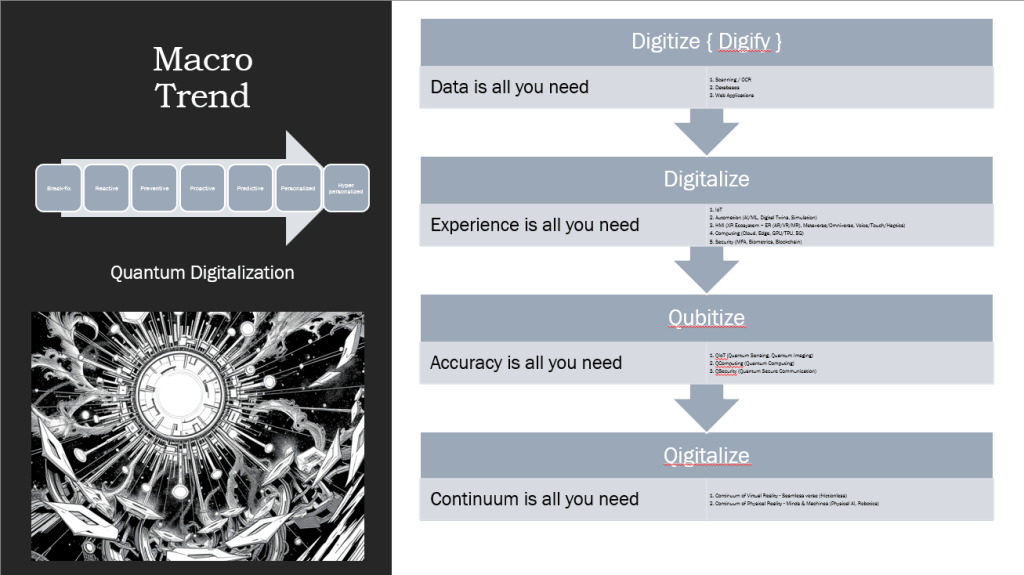
The trajectory of technology often feels like a dance between the micro and the macro, the tangible and the intangible. I call this journey Quantum Digitalization—a fusion of precision and expansiveness that is reshaping how we interact, innovate, and solve problems. It’s not just a trend; it’s a profound transformation unfolding in stages, each one moving us closer to a world where hyper-personalization isn’t merely possible—it’s inevitable.
I found inspiration in the AI paper, “Attention is All You Need,” and I’ve borrowed its clarity to describe the stages of this evolution. Each stage has a theme and a guiding principle that frames the technology and its impact.
Digitize: Data Is All You Need
The first step in this journey is to Digitize, or as we might say in India, Digify. This stage is about making sense of chaos—bringing structure to the unstructured and transforming information into a usable form. It’s the shift from paper to pixels, where workflows are streamlined, knowledge is centralized, and insights become attainable. However, the magic of digitization isn’t in collecting more data; it’s in collecting the right data. Too much can lead to a data swamp—overwhelming and unusable. Too little creates gaps that even the smartest algorithms cannot bridge. This stage is the foundation—the roots that support the tree of innovation. Without a strong base, the rest of the journey is shaky at best.
Digitalize: Experience Is All You Need
Once the data is in place, the next step is to Digitalize. This stage is often misunderstood. It’s not about Digitizing; it’s about creating meaningful, engaging experiences. Technology shifts here from being a tool to becoming a partner, enhancing how people interact with systems and processes. This stage is about connection—devices talking to each other, systems understanding users, and interactions that feel intuitive. Imagine seamless experiences, where diagnostics, decisions, and delivery happen almost invisibly. It’s no longer just about solving problems; it’s about delighting users. Unfortunately, many still confuse digitalization with digitization or equate it solely with software. But digitalization is much more—it’s about creating ecosystems where experience becomes the driver of adoption and innovation.
Qubitize: Accuracy is all you need
As the journey advances, we step into the stage of Qubitize, where the guiding theme is Accuracy is all you need. This is the realm of quantum technologies, which bring a level of precision, speed, and security that traditional systems simply cannot match. It’s here that the boundaries of what is possible begin to dissolve, unlocking a future once confined to science fiction.
At the heart of Qubitize are three transformative domains: quantum sensing, quantum computing, and quantum communications. Each represents a leap forward, reshaping how we measure, compute, and interact in ways that redefine accuracy.
Quantum Sensing is revolutionizing how we perceive the physical world. Traditional sensors—no matter how advanced—have limitations in precision and sensitivity. Quantum sensing taps into phenomena like quantum superposition and entanglement to deliver ultra-precise measurements of time, magnetic fields, gravity, and more. For example, quantum-enabled imaging devices could detect changes at the molecular level, opening doors to breakthroughs in fields like healthcare, geophysics, and environmental monitoring. Imagine medical scans with resolutions so high that they can detect diseases at their earliest stages or environmental sensors that can map underground resources with pinpoint accuracy. This level of sensing not only enhances accuracy but also expands what we can observe and understand.
Quantum Computing takes problem-solving to a whole new dimension. Unlike classical computing, where bits are either 0 or 1, quantum bits—or qubits—exist in multiple states simultaneously, enabling computations at unprecedented speeds. This allows quantum computers to solve complex problems, like optimization or molecular modeling, that would take classical systems centuries to process. For instance, quantum algorithms can revolutionize logistics by finding the most efficient routes in real time, or they can accelerate drug discovery by simulating molecular interactions at a scale and speed previously unimaginable. Quantum computing isn’t just faster; it’s smarter, enabling us to approach problems in ways that were previously inconceivable.
Quantum Communication offers a paradigm shift in data security and transfer. At its core is Quantum Key Distribution (QKD), which uses the principles of quantum mechanics to create encryption keys that are theoretically unbreakable. By leveraging entangled particles, QKD ensures that any attempt to intercept or tamper with the transmission is immediately detectable, making it a cornerstone for ultra-secure communications. Beyond security, quantum communication networks are laying the groundwork for a quantum internet—an interconnected web of quantum devices that could transform how information is shared globally. This leap will redefine the concept of trust in digital systems, safeguarding sensitive information in ways that traditional cryptographic methods cannot match.
Qigitalize: Seamlessness Is All You Need
Finally, we arrive at Qigitalize—the frontier where the physical and digital worlds blur into one seamless continuum. This stage is about fluidity, where boundaries dissolve, and technology adapts to us rather than the other way around. Imagine ecosystems where robots autonomously handle tasks, collaborating with humans only when necessary. Picture a world where virtual and real merge effortlessly, enabling interactions that are frictionless and immersive. Collaboration transcends barriers, and hyper-personalization becomes a given. It’s a vision of a world that feels intuitive, connected, and limitless.
AI: A Microtrend Shaping the Future
AI is in the midst of an explosion—a rapid evolution transforming how we build, use, and interact with intelligent systems. Let’s dive into how AI is expanding its influence in four transformative dimensions: learning styles, tasks, data modalities, and system designs.
Learning Styles: How AI Masters the World
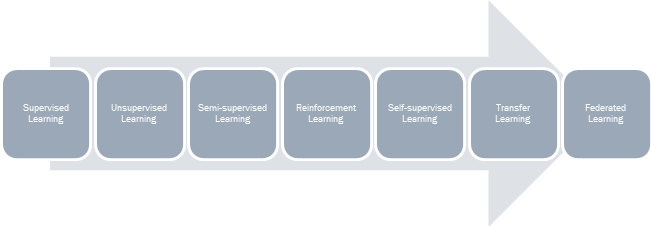
AI’s ability to learn has evolved dramatically. It began with supervised learning, where labeled data taught machines to distinguish between cats and dogs. While groundbreaking, this method relied heavily on expensive, annotated datasets. Then came unsupervised learning, revealing patterns in unlabeled data, like customer segmentation. Semi-supervised learning bridged the gap, blending smaller labeled datasets with large unlabeled ones for efficiency. Reinforcement learning marked another leap, enabling AI to learn through trial and error by interacting with environments—think Chess or Go. But the game-changer is self-supervised learning, where AI generates its own labels from data structures, powering massive models like GPT. Combine that with transfer learning, which reuses pre-trained models for new tasks, and federated learning, which keeps data private while training across decentralized systems, and you see AI’s growing adaptability. These advances are turning AI into an increasingly self-reliant, scalable force.
Learning Tasks: From Assistants to Creators
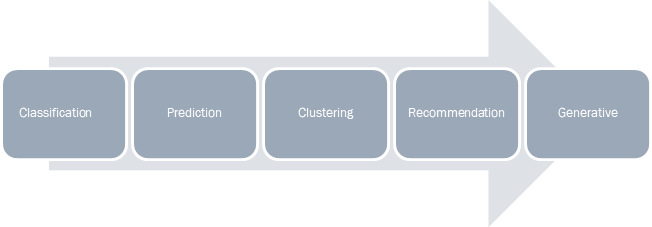
AI has transcended its origins as an assistant. Initially focused on classification (e.g., “Is this a cat?”) and regression (e.g., “What will sales be next quarter?”), AI has now become a creator. Generative AI systems can write essays, design artwork, or even produce videos from simple prompts. This creative power is revolutionizing industries, from marketing and entertainment to education and healthcare. But generative AI is just the beginning. Multimodal capabilities allow AI to integrate text, images, and audio seamlessly. Imagine an AI that can describe a picture in words, generate a matching soundscape, or create immersive VR experiences—all from a single prompt. This evolution isn’t just about automating tasks; it’s about transforming AI into a collaborator, pushing the boundaries of creativity and innovation.
Data Modalities: Beyond Text/Images
As AI grows, it’s venturing into new data territories. Vision and language remain the bedrock, powering breakthroughs in computer vision, natural language processing, and search engines. AI’s ability to interpret haptics—touch and pressure data—is revolutionizing robotics and prosthetics, enabling machines to “feel.” Meanwhile, spectral data, which captures wavelengths beyond the visible spectrum, is transforming agriculture, defense, and medical imaging. These new modalities are extending AI’s reach into uncharted territories, creating once unimaginable possibilities.
AI Systems: From Assistance to Autonomy
AI systems are evolving at a pace that’s reshaping the boundaries of what machines can do. What’s most fascinating is how our trust in these systems has grown, allowing them to take on tasks that were once the sole domain of humans. This evolution is about more than efficiency—it’s about unlocking entirely new possibilities.
Let’s start with semi-autonomous systems. These are like reliable coworkers who need just a little oversight. Take drones, for example. They can map terrain, deliver packages, and navigate through complex environments on their own. Yet, for critical decisions—like rerouting in extreme weather or avoiding restricted airspace—they defer to human judgment. This “autonomy with a safety net” allows machines to handle repetitive or high-risk tasks while keeping us in the loop for truly important calls.
Then, there are multi-agent systems, which take teamwork to a whole new level. Imagine a city where AI agents manage traffic lights, not individually, but as a coordinated network. These systems communicate in real-time, adjusting signals across intersections to ensure the smoothest flow of vehicles. The result? Reduced congestion, lower emissions, and happier commuters. It’s like having an army of super-intelligent traffic controllers working in perfect harmony. But multi-agent systems don’t stop at collaboration—they can also compete. In financial markets, trading bots operate as independent agents, analyzing trends, predicting outcomes, and executing trades faster than any human could. Some even collaborate to manipulate market conditions for mutual gain, demonstrating just how dynamic and adaptive these systems can be.
The next step is fully autonomous systems. These are the true independents, capable of sensing, deciding, and acting entirely on their own. Self-driving cars are a prime example: they don’t just follow a programmed route—they interpret traffic signs, anticipate pedestrian movements, and adjust to road conditions in real-time. Industrial robots are similarly autonomous, assembling products, identifying defects, and even scheduling their own maintenance. But here’s where the challenge lies: when we hand over complete control to machines, the stakes are higher than ever. Safety protocols must be flawless, and decision-making processes must be transparent and accountable. We’re making great strides, but full autonomy still demands rigorous refinement.
And now, for the most exciting part? economic participation. AI is no longer just about doing what we already do, only faster or better—it’s about exploring new frontiers. Take generative AI systems in intraday trading. These systems analyze vast amounts of market data, identify patterns, and execute strategies faster than any human trader. What’s even more remarkable is their ability to adapt in real-time, learning from market fluctuations and refining their tactics on the fly. These agents aren’t just assistants; they’re active participants in the economy, creating wealth independently.
Beyond finance, autonomous systems are venturing into creative and strategic territories. Imagine an AI agent tasked with designing marketing campaigns. It could analyze audience data, draft ad copy, create visuals, and even determine the optimal time to launch—all without human intervention. Or consider healthcare, where AI agents might coordinate treatments for patients, consulting with doctors only for the most complex cases. These examples aren’t just theoretical—they’re already in motion, signaling a profound shift in how we think about machine intelligence.
This evolution is about more than technology—it’s about redefining what machines can do for us. AI is no longer confined to automation or assistance. It’s becoming a collaborator, a decision-maker, and even an innovator in its own right. And here’s the kicker: we’re only scratching the surface of what’s possible. As these systems grow more capable, adaptive, and independent, they’ll continue to push the boundaries of intelligence, creativity, and impact. This is the dawn of a new era, where machines don’t just follow—they lead. And the journey has only just begun.
Regulating AI is a delicate balancing act—a tightrope walk between fostering innovation and ensuring safety. Governing bodies are tasked with a daunting challenge: to embrace the transformative potential of AI while protecting society from its unintended consequences. It starts with risk classification, determining which systems are harmless tools and which might pose significant risks, like surveillance technologies with the potential for misuse. Coupled with this is the need for transparency and explainability—because if even the creators can’t fully understand their models, how can users or regulators trust them?
Data privacy is another cornerstone of responsible AI regulation. With AI systems handling sensitive information, particularly in fields like healthcare, strict safeguards are essential to prevent misuse and protect personal data. Beyond that, regulators must confront harmful applications head-on, banning systems that perpetuate discrimination or exploitation, such as social scoring mechanisms. These measures aren’t about stifling progress; they’re about building a foundation of trust, ensuring that AI not only thrives responsibly but also paves the way for sustainable growth. By navigating this tightrope, we can unlock AI’s full potential while keeping its promises aligned with human values.
Summary
Technology in 2024 is transforming at an unprecedented pace, bringing us closer to the Star Trek dream of seamless human-machine collaboration.
AI micro trend is pushing boundaries, evolving from simple assistants to autonomous decision-makers. Multi-agent systems optimize cities, while generative AI creates solutions in real time, transitioning from insights to actions. Machines are no longer just tools—they’re collaborators, turning science fiction into reality and revolutionizing how we work, live, and connect.
The Quantum Digitalization macro trend is all about redefining hyper-personalization, moving from digitizing workflows to creating immersive, Qigitalized ecosystems where the physical and digital worlds blend effortlessly. Powered by quantum sensing, computing, and communication, this trend is driving unprecedented accuracy, security, and innovation.
“Trend is fashionable. Fashions change. Old trends come back. But when they return, they’re never quite the same—they carry the weight of the past, reimagined for the present. A trend reborn isn’t just a repeat; it’s a remix, blending nostalgia with innovation, and reminding us that in the cycle of change, the new is often just the old with better timing. What will trend next?”








 Digital Journey