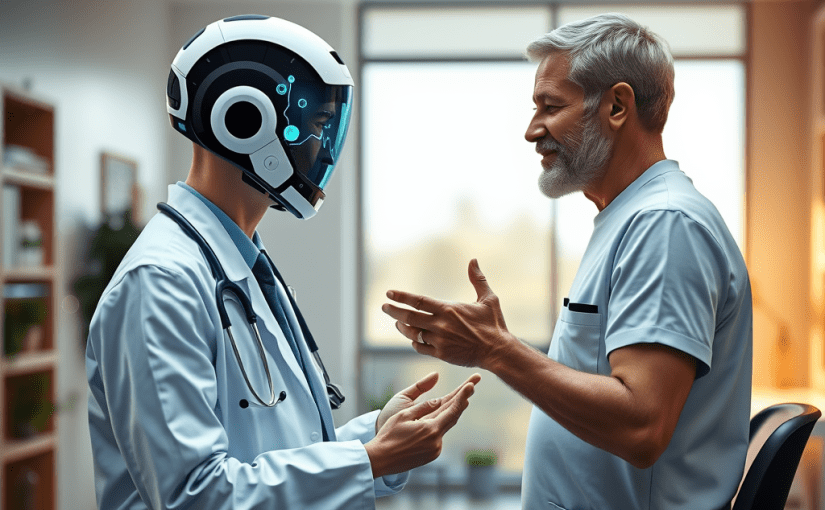
Today’s popular ChatBots have evolved to the point where they can ‘search’ the internet to build a profile of a person. While the idea of profiling might seem unsettling, what’s even more fascinating is their ability to dynamically integrate with external tools. This means these bots don’t just acquire context—they actively use it to take meaningful actions. And that’s a game-changer. In industries like healthcare, where inaction and delays can have serious consequences, this capability to bridge information and execution is nothing short of revolutionary.
Insights Are Necessary But Not Sufficient
We can design a world-class computer vision algorithm to detect potholes on roads—no doubt about that. The real value of such technology lies in its ability to prevent small potholes from escalating into traffic nightmares. But here’s the catch: insight without action is as good as scrap metal. Knowing there’s a pothole on Road A is useful, but if it’s not fixed, that insight is wasted. This is where Generative AI steps in, not just to detect problems but to close the loop by orchestrating solutions. Imagine a team of AI agents—a detector, a work approver, a fixer, and even a finance approver—all collaborating to decide which potholes get priority. Given limited budgets and resources, the challenge becomes an optimization problem: which roads to repair to maximize safety, improve traffic flow, and minimize frustration. With high volumes of insights, this kind of collaborative decision-making can cut through the ‘insights fatigue’ and turn knowledge into action.
Healthcare faces a similar dilemma. There’s a heavy emphasis on monitoring—producing insights that are supposed to drive action—but the gap between knowing and doing often remains wide. Take the case of a diabetic patient struggling to lower their HbA1c from 8.5. The problem might not be awareness but action: lifestyle changes like regular walks, strength training, better diet choices, or even adhering to medication schedules. The truth is, most people know what to do; the challenge lies in execution.
This is where a hyper-personalized approach becomes critical—like having a health coach who not only reminds you to do your sit-ups but makes sure you squeeze in 10 while you’re still on the call. Habits, once formed, become second nature (think brushing your teeth). But doctors don’t have the bandwidth to coach every patient. Enter Generative AI, which can act as a virtual co-pilot for healthcare professionals. Imagine a digital assistant that mirrors a doctor’s conversational style while incorporating a coach’s motivational touch. This AI can identify when a patient is straying off course, focus discussions on actionable lifestyle changes, and tackle one problem at a time. If medication compliance isn’t the issue, it can hone in on diet or exercise—whatever the patient needs most. Generative AI brings the promise to move insights to actions.
Generative AI Use Case Sampler
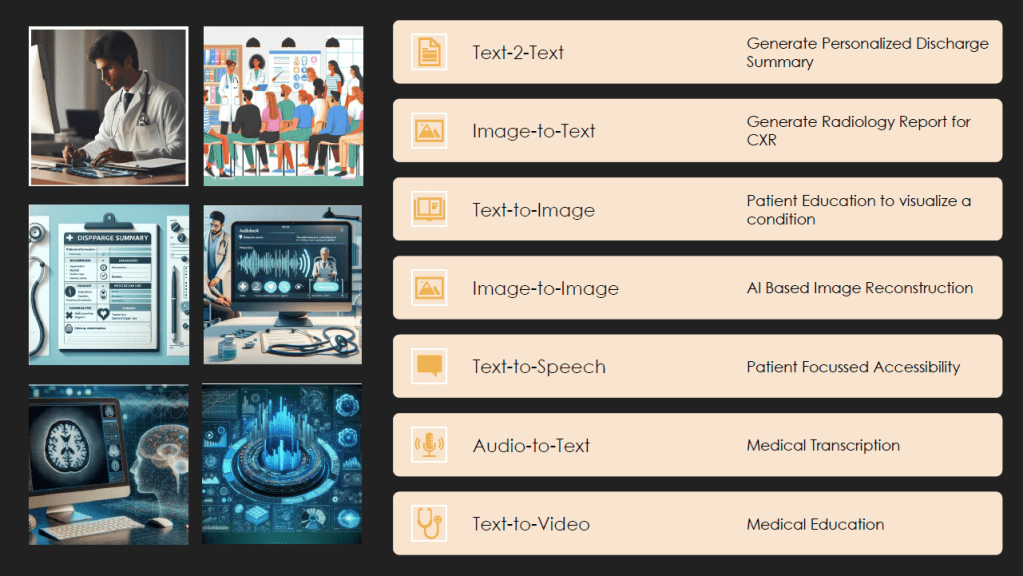
Generative AI has the potential to revolutionize healthcare by enabling smarter, more personalized, and action-oriented solutions. By leveraging diverse modalities like text, images, audio, and video, this technology can bridge gaps in patient care, education, and operational efficiency. Here are some potential use cases:
Text-to-Text: Personalized Discharge Summaries
Generative AI can generate hyper-personalized discharge summaries tailored to individual patients. By pulling data from EMRs and provider-recommended templates, these summaries can be presented in clear, actionable language, preferably in the patient’s preferred language. From follow-up instructions to medication schedules, this empowers patients to take control of their recovery with confidence.
Image-to-Text: Radiology Reports Made Smarter
Deep learning has already enabled precise interpretation of radiology images. Generative AI can take this further by generating highly personalized reports for different audiences, such as PCPs, patients, or specialists. By reducing radiologists’ workload and improving turnaround times, it can ensure quicker and more efficient delivery of critical insights. Moreover, Generative AI can allow radiologists to query images for specific details or compare similar images by vectorizing (creating embeddings) the image and reports.
Text-to-Image: Visualizing Patient Education
Generative AI can help patients better understand their diagnoses and treatment options by creating personalized visualizations. A picture truly is worth a thousand words, especially in healthcare, where complex concepts can be challenging to convey through text or speech alone.
Image-to-Image: AI-Powered Image Reconstruction
Generative AI can enhance the quality of medical images through advanced reconstruction techniques, improving both speed and resolution. This capability can boost diagnostic accuracy and provide healthcare professionals with the clarity needed for more informed decisions.
Text-to-Speech: Accessibility for All
For patients with disabilities or language barriers, text-to-speech technology can make medical information more accessible. Whether through audio outputs or Braille conversion, Generative AI ensures inclusivity in patient communication and care delivery.
Audio-to-Text: Seamless Medical Transcription
Generative AI can convert conversations—between doctors and patients or among clinicians—into structured medical records. This technology streamlines documentation, allowing healthcare professionals to focus on patient care while simultaneously generating structured, actionable records.
Text-to-Video: Transforming Medical Education
Generative AI can transform training and education by generating personalized, easy-to-follow video content. From simplifying complex medical topics to creating interactive learning experiences, it offers a more engaging way to educate both patients and healthcare professionals.
Text-2-Text: Generative AI

A Text-2-Text generator can be used to build a story to recite to a child to help her develop better study habits. With a simple prompt, Generative AI (courtesy: ChatGPT) can craft a compelling story—like one inspired by Harry Potter—that captures the child’s imagination while embedding useful lessons. For example, a magical artifact like a “Focus Fuser” might serve as the centerpiece of the story, teaching readers how small, consistent actions can lead to meaningful progress.
Now shift to a healthcare setting. Medical jargon, while essential for precision, often confuses patients. Generative AI can take complex radiology reports and translate them into clear, patient-friendly language. For example, instead of saying, “Impression: The findings are consistent with a moderate right-sided pleural effusion,” the AI might explain: “The results of your imaging test show a moderate amount of fluid in the space around your right lung, known as a pleural effusion. There’s no sign of pneumonia or a collapsed lung. Your doctor may recommend further tests to get more clarity if needed.”
This translation doesn’t just simplify language—it empowers patients to understand their health better, enabling them to make informed decisions.
Text-2-Image: Generative AI

A Text-2-Image Generator can recreate familiar concepts with stunning precision and creativity. Take the classic representation of the “Three Wise Monkeys”—each embodying the principles of “see no evil, hear no evil, speak no evil.” With a simple prompt, AI can generate a vivid image of three monkeys, each covering their eyes, ears, or mouth, perfectly capturing the symbolic meaning behind the concept.
This same technology demonstrates its utility in healthcare through advanced imaging capabilities. For instance, it can generate a synthetic frontal chest X-ray (CXR) image of a patient with specific features, such as simple pleural effusion and focal airspace opacity. This isn’t just an exercise in realism—it supports medical education, research, and even diagnostic validation. The ability to generate medically accurate images empowers healthcare professionals and researchers to innovate and enhance patient care. It also supports the cause of patient privacy.
Image-2-Text: Generative AI

The image-to-text generator capability is a game-changer for accessibility, enriching experiences for visually impaired individuals and enabling deeper engagement with visual content through natural language. Auto-generation of key features from an image can enable search (E.g., get me pictures with a blue lake and snow-capped mountains).
On the other hand, in a healthcare radiology context, Generative AI can generate detailed radiology reports (E.g. CXR 2 views – AP/LAT) such as: “The heart size and mediastinal contours are normal. There is no evidence of focal airspace consolidation, pleural effusion, or pneumothorax. No acute bony abnormalities are observed, although degenerative changes are present in the thoracic spine.”. This not only reduces the workload on radiologists but also enhances accuracy and efficiency in delivering diagnostic insights. By automating the creation of such reports, AI enables healthcare professionals to focus more on patient care while ensuring timely and precise interpretations.
Reasoning is Complex

(*) The above reasoning is not to show any tool or technology in a Bad light.
Reasoning can be a tricky beast, as you’ve probably noticed by now. While a human might have gone for answers like, ‘Maybe the male prisoner was released!’ or ‘Plot twist—he escaped!’, AI takes a different approach. It sticks to the context you give it, like a dog chasing a stick. But here’s the catch: if you want AI to keep doing its mind-blowing, jaw-dropping, ‘WOW’ job, you’ve got to toss it the right stick—clear context and solid rules. Otherwise, you might end up with answers as wild as a soap opera plot!
Closing Quote
‘The machine does not think, but it reveals our thinking.’
Generative AI quality is proportional to the quality of the information and context we give it—whether it’s clear or confusing. This means the responsibility isn’t just on the AI (or its builders) but also on us (the users) to ensure it is used in a way that reflects important values. When used wisely, it can help us improve care, build stronger connections, and create a fairer world for everyone.

 Digital Journey
Great article! We always appreciate valuable insights like these. Thanks for sharing!
Healthcrm.ai
LikeLike