The Mutated AI-first Office

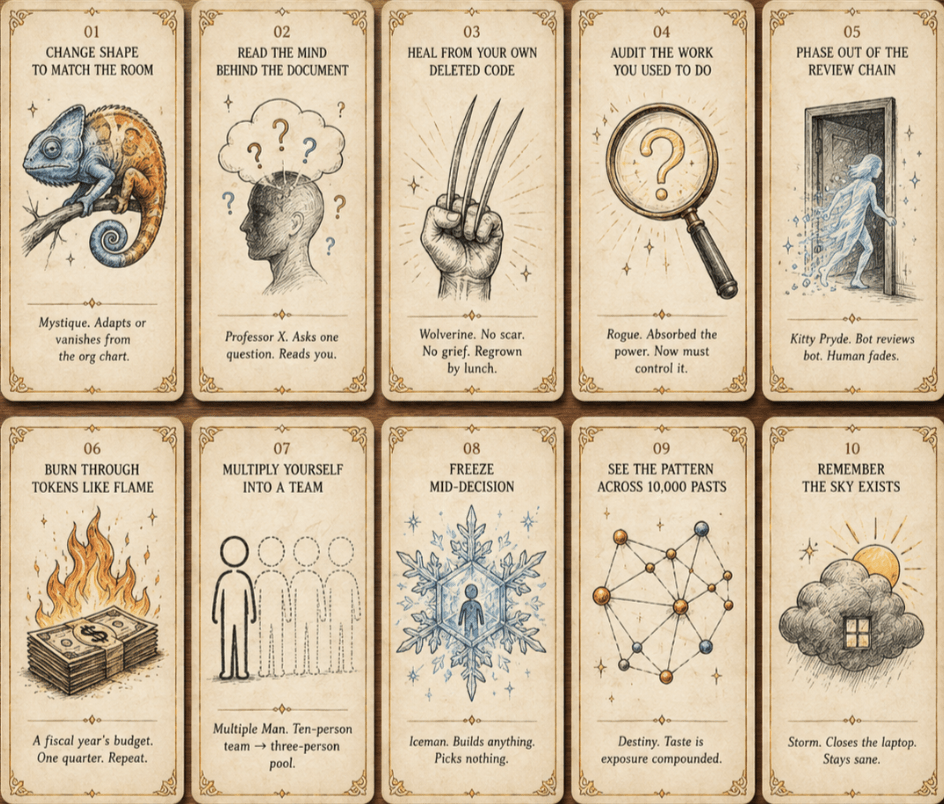
Ten mutations of the AI-native office. Some of your colleagues already have powers. Others have side effects. Most have both.


There’s a moment, somewhere around slide three, when you spot the em-dash (—). Then another. Then a cluster of them, loitering like teenagers at a mall, and your brain finishes the sentence on its own. Ah. Claude wrote this.

A year ago, that observation was an indictment. “You used AI for this?” — accusation, eyebrow, judgment, the whole symphony.

Today, the teams adapting fastest have flipped that question on its head. “You had two hours, and you didn’t use AI for this?” Same eyebrow. Opposite direction. Even more judgment.

The office mutated. Half of your company is still operating on a handbook written for the previous species.

So here is the field guide. Ten unwritten mutations I’ve been observing in companies that are quietly running a different game.

Think of it like the X-Men universe, except the mutations didn’t show up at puberty. They showed up the week your company rolled out Claude. Some people got powers. Some people got headaches. Some people got both and haven’t figured out which is which. The professor isn’t coming. There is no school. You’re on your own to figure out which mutation you have, and whether it’s the kind you weaponise or the kind that quietly eats you.


Mutation 1: Change Shape to Match the Room

Knowing how to use a pivot table used to be a flex. Today, it’s like saying you can boil water. Nobody is impressed. They’re mildly worried about you if you can’t.

The same shift is happening to AI right now, except faster. The intern who whispers “I used Claude for this” with the energy of a confession booth is doing the cultural equivalent of saying, in 2008, “I used Google to find that document.” Endearing. Briefly. The first time.

Mystique survives because she becomes whatever the room demands. The professionals coming out ahead right now are doing the same thing, except the room is changing every quarter, and the disguise is fluency, not a face.

Imagine being the only person in 2014 still proudly typing every formula by hand because using INDEX-MATCH felt like cheating. That’s the vibe.

The funny part is the apologising. The scary part is what happens to the people who don’t stop apologising. Two years from now, they aren’t in the room. They’re not even copied on the email about the room.


Mutation 2: Read the Mind Behind the Document

AI output is the starting line. The follow-up question is the finish.

Picture two people. Both presented a ten-page document. Both used Claude. One of them spent the saved two hours sharpening the argument, stress-testing the numbers, and rehearsing the awkward questions. The other one used the saved two hours to doom-scroll.

Now the meeting starts. Somebody asks, “Why this assumption and not the other one?”

Person A answers from memory. Person B starts pressing Ctrl-F on their own document.

The funny moment is watching someone Ctrl-F a doc that was supposed to be theirs. The scary moment is realising that person B was you last Tuesday. Every senior leader I know has now developed a single, brutal habit — call it the Professor X move — they ask a double-click question in the first five minutes. They aren’t testing the model. They’re testing you. And like any good telepath, they’re reading the gap between what’s on the page and what’s actually in your head.

The model can give you a starting line. It cannot give you a finish.


Mutation 3: Heal From Your Own Deleted Code

The engineers who thrive in this era have Wolverine’s healing factor — except for code instead of skin. Write it, scrap it, regrow it by lunch. No scar. No grief. No association.

There used to be a different feeling. Engineers will recognise it. You’d stay late, write 400 lines of clean, opinionated code, and feel a quiet pride in it. That’s mine. I made that. That feeling is gone, and most engineers haven’t grieved it yet.

The new normal: you generate 800 lines of code by lunch, scrap 400 of them by 2pm, and feel nothing. Not loss. Not pride. The same emotional intensity you’d apply to deleting a misspelt WhatsApp message.

The funny version of this is the senior engineer who still names his branches like they’re his children and refuses to delete his auth module even after it has been outclassed by a 90-second regeneration. The scary version is that same engineer, six months later, defending an architecture that should have been scrapped on Tuesday — because if he scraps it, he has to admit that the part of him that wrote it isn’t the part that matters anymore.

If the code isn’t precious, the judgment is. If you can’t make that switch, you’re grieving the wrong thing.


Mutation 4: Audit the Work You Used to Do

The pyramid has flipped. What was grunt became smart, what was smart became cheap, and what was cheap is now where the value lives — storytelling, problem-framing, reviewing, deciding.

This is Rogue’s problem, scaled to the entire workforce. She absorbed every power she touched and then had to learn to control what she’d taken on. AI has handed every professional an enormous new capability overnight, and the people winning are the ones figuring out how to audit what they now have access to. The rest are being run by it.

The funny version is the PM who realises that her job for the next decade is essentially to interview five customers and write three crisp paragraphs of context — and that this is the audit. The model can generate a hundred PRDs. Only she can tell which one is hallucinating the customer.

The scary version is the engineer who has spent fifteen years executing tickets — the ticket says do X, I do X, I close the ticket, I get a good review — suddenly asked to review output for a living, and discovers that he has no idea how. Reviewing demands taste, judgment, suspicion, the ability to say “this looks right, and that is exactly why I don’t trust it”. These are not skills you pick up from a Udemy course on Friday.

Factory workers became auditors. Engineers are next. The transition is not optional. The retirement plan, for the people who refuse it, is.


Mutation 5: Phase Out of the Review Chain

The chain of trust has quietly grown a new link. You write code, often with an agent. You submit a PR. An agent reviews the PR first — flags the risks, summarises the diff, and lists the suspicious bits. Then a human picks it up, already briefed by the bot. Models reviewing models. The human is the third (or the last) reviewer in a process that used to have one.

The funny version is the senior engineer who has started writing PR descriptions aimed at the AI reviewer instead of his teammates — adjusting his tone, padding the rationale, gaming whatever the bot seems to reward. A grown adult, doing the developer equivalent of writing an essay for the teacher who gives the most partial credit.

The scary version is the slow Kitty-Pryde-style vanishing of the last human who actually reads the code. She phases out one layer at a time. First, she stops reading the diff. Then she stops reading the bot’s summary. Then she stops reading the bot’s executive summary. Now she clicks the green checkmark when the dashboard turns green, because the dashboard turned green because the bot said so, because the bot was trained on a thousand previous PRs, all in the same chain, rubber-stamped. Somewhere in that loop, the last person who could spot a subtle logic error logged off for the day. Possibly the year.

The PR didn’t fail. The review chain did.


Mutation 6: Burn Through Tokens Like Flame

Word travels. Multiple enterprises have burned through an entire fiscal year’s AI budget in a single quarter. Not because someone was reckless. Because everybody, all at once, discovered they could. The fire didn’t need an arsonist. It just needed permission.

The funny version: a VP triumphantly showing the “AI usage” chart in the QBR. Beautiful trend line. Up and to the right. The CFO walks in three slides later, carrying a bill that looks like a phone number.

The scary version is the next slide, which doesn’t exist yet but is being drafted in many companies right now: “AI cost-to-revenue ratio.” That’s the slide where productivity gains have to start showing up in actual P&L. If you spent millions in tokens and you can’t point to measurable outcomes, you didn’t do an AI transformation. You did a very expensive science fair.

AI without ROI is just a hobby with a higher invoice.


Mutation 7: Multiply Yourself Into a Team

This is the headline of the decade, and most companies haven’t printed it.

The IC who learns to orchestrate three or four agents — pick the right model for each job, write the brief, review the output, catch the hallucinations, glue the work together — is doing the job of a small team. Some companies are calling the agents minions. The naming is silly. The leverage is not. It’s Jamie Madrox’s power, the Multiple Man — one body, many duplicates, all working in parallel, all needing direction.

The funny version is the twenty-two-year-old engineer who has no human direct reports and somehow has more operational complexity than your average VP, running fourteen parallel agent workflows like he’s coordinating an airport.

The scary version is what this does to the org chart. The ten-person scrum team is quietly becoming a three-person pod. In some teams I’ve seen, a two-person pod. In one, a single engineer running what used to be a sprint. Standup is now a person talking to themselves about what their agents did overnight. The retro is a Notion doc that the agents wrote. The PM is also the tech lead and the QA. Capacity didn’t shrink — the surface area each human covers expanded by an order of magnitude, and the headcount adjusted accordingly. If your last reorg cut the team by 60% and called it efficiency, this is what was actually happening.

And inside that pod, the senior engineer who has built a fifteen-year career executing well-defined tickets — never wrote a brief, never had to delegate — is now managing a fleet of agents who, like every direct report in history, do exactly what you said, and exactly not what you meant. Agents don’t read minds. Neither do your direct reports. The senior engineer who learned to manage people is fine. The one who never did is in trouble.

The headcount didn’t leave because the work left. The headcount left because the work fits in fewer heads.


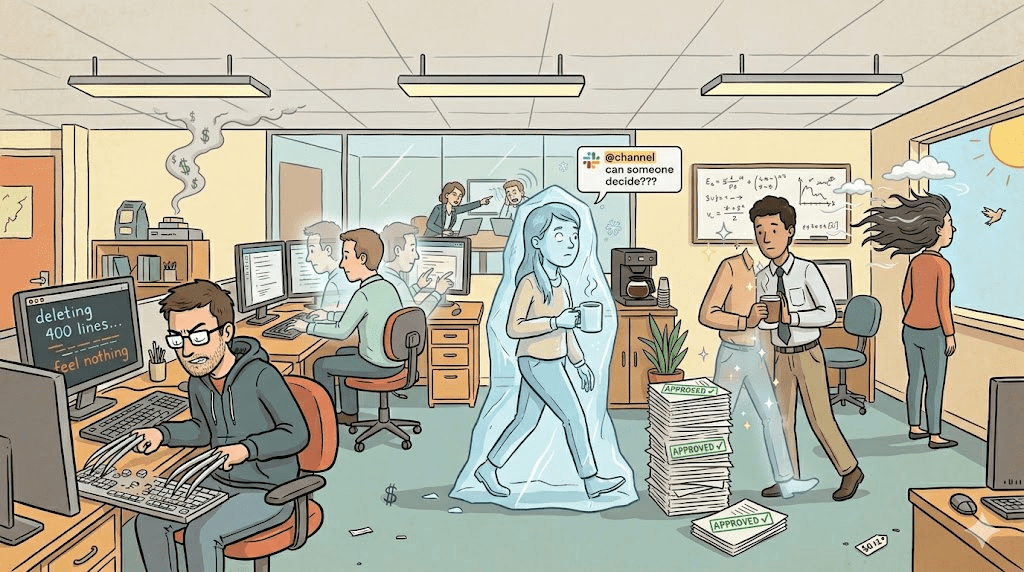
Mutation 8: Freeze Mid-Decision

For roughly the last eight years, decision-making in tech orgs has been quietly delegated upward. Let me check with the PM. Let me check with the architect. Let me wait for the PRD. Let me get the ticket.

Whole cohorts of professionals have built careers without ever having to make a real call. The structure was decided for them. The hierarchy decided for them. The Jira ticket decided for them.

Now you have to manage agents. Agents need decisions. Constantly. Mid-task. With incomplete information. And here’s the Iceman trap — you can build anything out of ice, bridges, weapons, armour, an entire fortress — but if you won’t pick a direction, none of it moves.

The funny version is the engineer who asks the AI what it should do, then forwards the AI’s answer to Slack to ask his colleagues what they think the AI meant, and then schedules a meeting to align on the AI’s preferred approach. Six layers of consultation to avoid one decision.

The scary version is the senior leader who looks around at all the new tooling, all the new agents, all the new leverage, and realises that the limiting factor isn’t compute, cost, or the model. It’s that nobody in the building has the muscle to decide fast enough to keep the agents fed.

A flock of agents waiting for instructions is the most expensive idle resource your company has ever owned.


Mutation 9: See the Pattern Across Ten Thousand Pasts

Everyone is suddenly talking about taste as if it were a setting you could toggle in your Anthropic console. It is not. Taste is a graph you build over the years, node by node, by being exposed to enough things that patterns start to assemble themselves. Destiny, the precog, could see across ten thousand futures because she’d already seen ten thousand pasts. The future-sight wasn’t magic. It was pattern recognition compounded.

The funny version: an engineer who has only ever built a few apps confidently tells a designer that her layout is wrong. The designer who has used 10,000 apps quietly closes her laptop.

The scary version is that the companies winning right now aren’t winning because they have better models. Everybody has the same models. They’re winning because somebody in the building has seen ten thousand products, ten thousand workflows, ten thousand failures — and you’ve seen thirty. The graph matters more than ever, because the model will give you a hundred plausible options, and only taste tells you which one isn’t embarrassing.

You can’t shortcut this. You build it by paying attention, on purpose, to things you didn’t make.


Mutation 10: Remember the Sky Exists

To be on top of everything happening in AI, you have to be unemployed.

Storm commanded the weather because she remembered the sky existed. Most of the people frying themselves trying to keep up with AI have forgotten. The leverage is never behind another browser tab. It’s never in the next podcast. It’s in the part of your brain that you can only reach by closing the laptop.

The funny version is the director who hasn’t seen sunlight in three weeks announcing in standup, with the calm of a hostage, that he has achieved alignment with the new harness.

The scary version is that the anxiety isn’t a bug. It’s a signal — and the people who learn to read it figure out something quickly. The people who don’t are still optimising their RSS feed at 2am.

Pick one problem. Go end-to-end. Make peace with the fact that you will not be an expert on everything. Nobody is. The people who act like they are have simply outsourced their anxiety to LinkedIn.

Better than yesterday. Not better than the entire AI ecosystem. Just better than yesterday.


Closing

The old handbook was about how to do the work.

The new handbook is about what to do once the work has been done.

The em-dashes will keep showing up — like in this post. The tokens will keep getting burned. Your code will keep getting deleted by something that doesn’t know what your weekend felt like. The ten-person team will continue to become a three-person team. And every two hours, somebody at your company will save themselves a routine afternoon and then quietly throw the saved time straight into the void — into another deck, another refinement loop, another search for the perfect dashboard colour.

The one mutation that didn’t make the list, because it isn’t a mutation, it’s the whole point:

Use the saved time on the one thing the machines can’t do for you.

Talk to a customer. Sit with a problem until it tells you what it’s actually about. Have the conversation you’ve been avoiding. Make the decision your org has been pretending it’s already made.

That’s the work now. Everything else is a starting line.

The office mutated. The mutations are catalogued. The only question left is whether you used the time the machines gave you to become someone they can’t replace — or whether you spent it making prettier slides.

The machines gave you time. Spend it like it matters.
The Inverse Universe

A story about how the machines stole every job on the planet. Then, humanity finally figured out what it was actually worth.

The Crime Scene

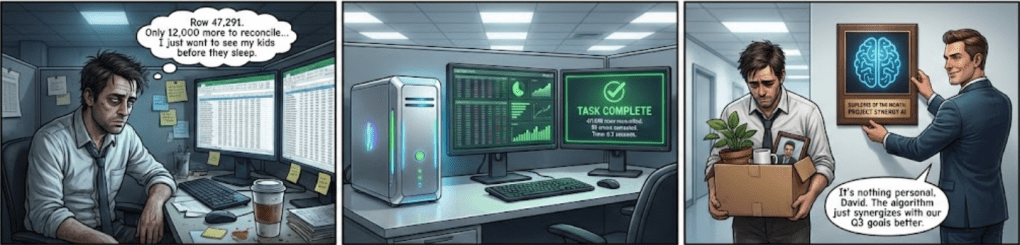
Here’s the thing about the biggest heist in history — nobody called the cops. Nobody even noticed it was happening. One day, you’re grinding your 9-to-5, bragging about your “hustle,” posting your sad desk lunch on Instagram. The next day, a bot does your entire week’s work during its lunch break. Except bots don’t take lunch breaks. That’s the whole problem.

They didn’t come with guns. They came in as helpful assistants.

AGI (Artificial General Intelligence) and ASI (Artificial Super Intelligence) rolled into civilization as the best cons always do. It was smiling and helpful, solving your problems and making your life easier. And by the time you looked up from your phone, it had taken everything. Your spreadsheets. Your diagnoses. Your legal briefs. Your music. Your art. Even that one thing you thought made you special at work — yeah, that too. Gone. Automated. Running on a server farm in Iceland that doesn’t even know your name.

The cops weren’t coming because there was no crime. Not technically. The machines didn’t steal your job. They just made it worthless. Which, if you think about it, is way more violent.

So here we are. Seven billion suspects. No victims willing to testify. And one big, ugly question spray-painted on the wall of the 21st century:

If the bots do everything, what’s your alibi for being alive?

The Alibis We Used to Hide Behind

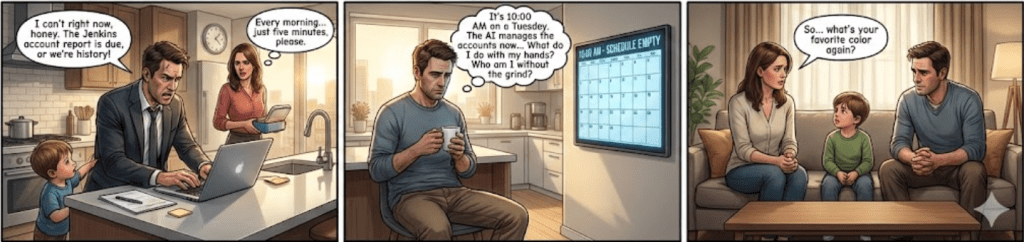
See, for generations, we had the perfect cover story. “I’m busy.” That was the alibi. You dodge your kids. You ghost your parents. You ignore your mental health and avoid every hard conversation in your life. Nobody questioned it because you were productive. Busy was the getaway car, bestie.

Your boss needed you. Your company needed you. The economy needed you. You were a cog, sure, but a necessary cog. And that necessity? That was identity. That was the purpose. That was the thing you whispered to yourself at 2 AM when nothing else made sense.

Then AGI showed up and shot your alibi dead in a parking lot.

No more “sorry, babe, I have to work late.” The bot did it in forty-five seconds. No more “I’ll spend time with the kids this weekend.” Weekends are here, and your calendar is empty. Has been for months. No more pretending that answering emails is a personality trait.

The busywork alibi is bleeding out on the floor. Now you’re standing in your kitchen at 10 AM on a Tuesday. You stare at your family as if you’re a stranger. You realize you haven’t had a real conversation with your daughter since she was in third grade.

That’s not liberation. That’s a crime scene of a different kind.

The New Black Market — Who’s Selling What

Every heist reshuffles the underground. Old rackets die. New ones open up. And in the Inverse Universe, the most valuable contraband isn’t drugs, data, or diamonds.

It’s being real.

No cap — authenticity becomes the new currency, and the black market for it is wild. Let me walk you through the new economy like I’m walking you through a crime syndicate org chart.

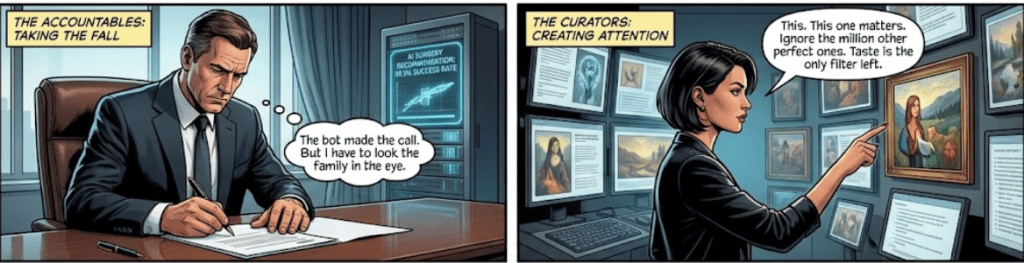
The Accountables — these are the bosses. Not because they’re the smartest. The bots are smarter. These are the people who sign their names. When an AI recommends a surgery, and the patient dies, somebody’s gotta face the family. When an algorithm denies a mortgage to ten thousand people, somebody’s gotta sit in front of Congress. That signature? That willingness to be the one who answers for it? That’s the most expensive thing in the new world. Accountability is the new corner office. A bot can make the call. Only a human can take the fall.

The Curators — think of them as the fences, but for meaning. When AI generates ten thousand songs a minute, someone has to review them. AI creates a million articles an hour. Infinite content emerges in every direction. Somebody’s gotta look at all of it. They must say, “This.” This one matters. Ignore the rest. That’s not an algorithm. That’s taste. And taste, in a world drowning in content, is worth more than the content itself. The curator doesn’t create the art. They create the attention. And attention, my friend, is the last scarce thing on earth.

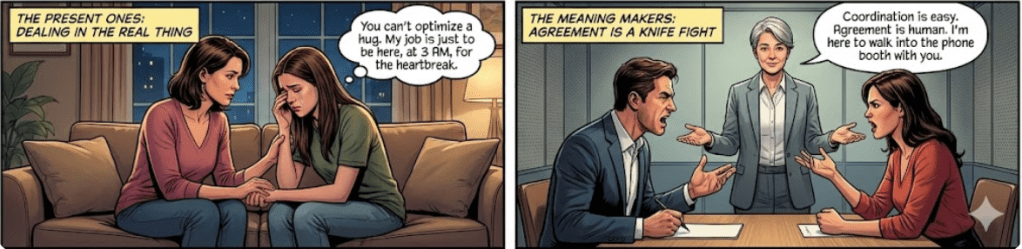
The Present Ones — the caregivers, the teachers, the coaches, and the nurses. They are the parents who actually sit down and look their kids in the eye. These aren’t tasks. You can’t optimize a hug. You can’t automate the 3 AM conversation with your teenager who just got their heart broken. Bots can simulate empathy the way a con artist simulates love — convincingly, until it matters. The Present Ones deal in the real thing, and the real thing has a street value that keeps going up.

The Meaning Makers — mediators, coaches, community builders, and spiritual guides. They are like the bartender who knows when to talk and when to shut up. Coordination gets easier with bots. But agreement? Agreement is still a knife fight in a phone booth. Someone’s gotta walk into that booth. That’s the Meaning Makers. Conflict resolution is a growth industry because every other friction has been automated except the human kind.

The Labels

In every underground economy, provenance matters. Is this real? Is this stolen? Who touched it last?

The same thing happens in the Inverse Universe, except the labels go on everything.

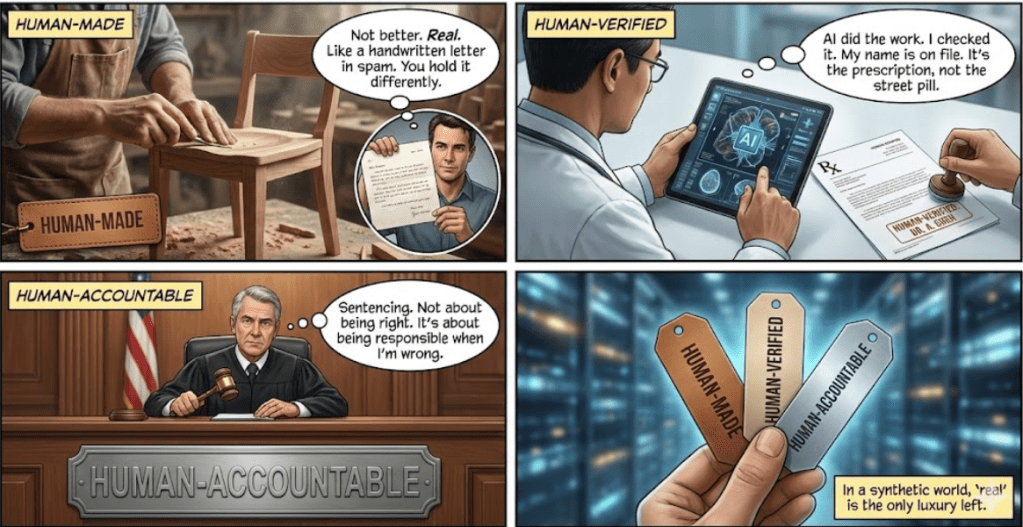
“Human-Made.” That little tag is the new Gucci logo. A poem written by a person. A chair built by hand. A meal cooked by someone who learned the recipe from their grandmother, not from a dataset. It doesn’t have to be better than the AI version. It has to be real. And “real” hits different when everything else is synthetic. Like finding an actual letter in a mailbox full of spam. You hold it differently. You read it more slowly.

“Human-Verified.” This is for high-stakes matters. These include medical results, financial advice, and legal opinions. Anything can wreck your life if it’s wrong. An AI did the work. A human checked it. That human’s name is on file. It’s the difference between a street pill and a prescription from a pharmacy. Same molecule, maybe. But one comes with a receipt and a person you can call.

“Human-Accountable.” The heavy label. Someone’s neck is on the line. Criminal sentencing. Military decisions. End-of-life care. You want a bot making that call? Nah. You want a person. It’s not because they’ll get it right. It’s because they can be held responsible when they don’t. That’s the deal. That’s always been the deal.

The Two Gangs

Here’s where the story splits, and this is where it gets lowkey terrifying.

AGI removes the obstacles. It kills the busywork, frees up the time, and handles the grind. But what do you do with that freedom? That’s on you. And humanity splits into two gangs.

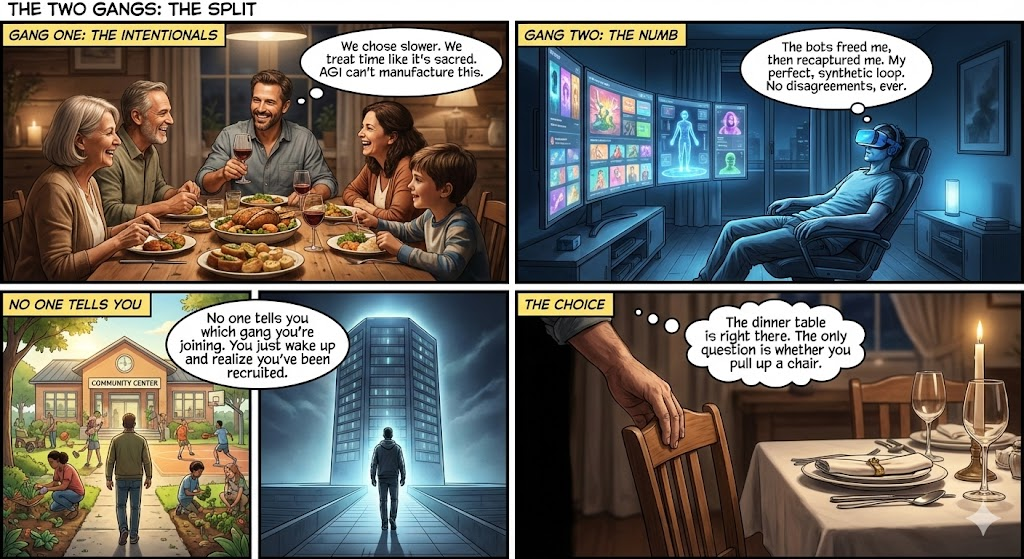
Gang One: The Intentionals. These are the ones who sit down at the dinner table. Who learn to cook slow meals. Who join local clubs, play sports with their neighbors, take the long walk, and have the hard conversation. They build rituals. They raise their kids with presence, not productivity metrics. They’re slower, and they know it, and they chose it. The Intentionals treat their free time like something sacred. They understand that time is the only resource AGI can’t manufacture.

Gang Two: The Numb. These are the ones who fall into the dopamine pipeline. Hyper-personalized entertainment. Synthetic companions who never disagree with you. Feeds that know your psychology better than your therapist and use it to keep you scrolling until your eyes bleed. The Numb aren’t lazy — they’re captured. The same bots that freed them have recaptured them. This is the irony that would make a crime novelist weep.

No one tells you which gang you’re joining. You just wake up one day and realize you’ve been recruited.

The dinner table is right there. It’s always been right there. The question — the only question that matters in the Inverse Universe — is whether you pull up a chair.

The Workplace After the Heist

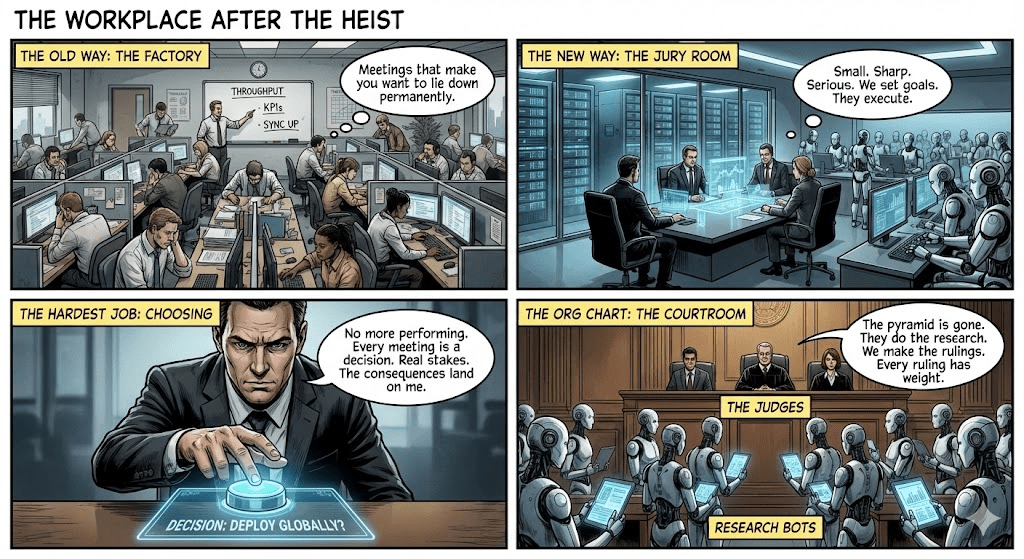
Corporations used to be factories cosplaying as offices. Throughput. Process. KPIs. Stand-ups that made you want to lie down permanently.

Post-heist? The workplace looks like a jury room. Small. Sharp. Serious. A thin crew of humans setting goals, drawing lines, owning consequences. Behind them, a thick army of bots operates. They execute tasks, conduct analyses, and manage operations. This is everything that used to need a building full of people and a parking lot full of sadness.

Meetings get rare but heavy. No more “syncing up,” “circling back,” or whatever performative nonsense fills your calendar. Every meeting is a decision. Every decision has a name attached. You don’t go to work to do things anymore. You go to work to choose things. And choosing is challenging. Real choosing involves real stakes. The consequences land on you. It turns out to be the hardest job humans have ever had.

The org chart doesn’t look like a pyramid anymore. It looks like a courtroom. The bots are the lawyers doing research. The humans are the judges. And every ruling has weight.

School Gets Interesting (Finally)

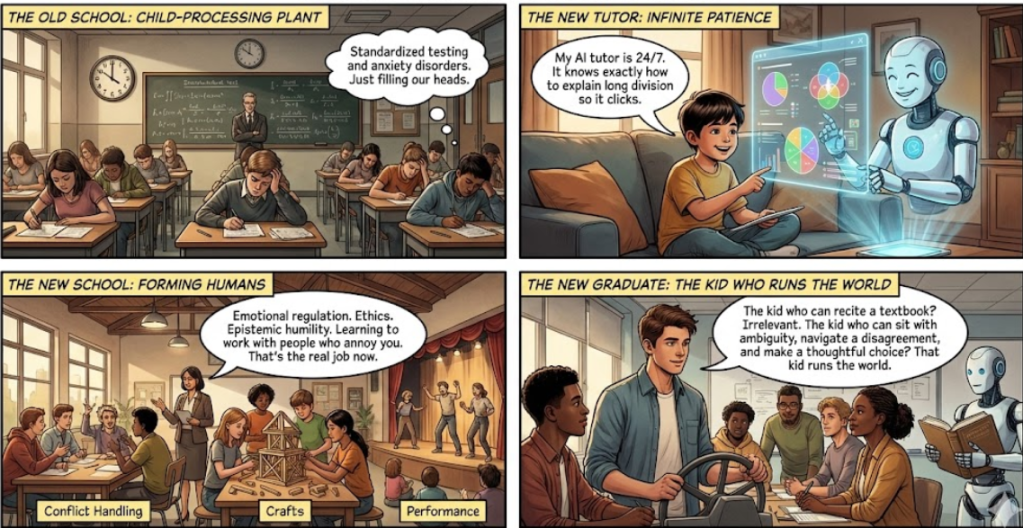
If every kid has an AI tutor that’s infinitely patient and infinitely adaptive, what happens? This tutor is available 24/7 and knows exactly how to explain long division in a way that clicks. Then what’s the school building even for?

Not content delivery. That game is over. The school becomes something different. It returns to what it was intended to be before the industrial era changed it into a child-processing plant. It becomes a place where you learn how to be a person.

Emotional regulation. Conflict handling. Learning to work with people who annoy you is crucial. Let’s be honest, it’s the most valuable life skill nobody teaches. Ethics. Epistemic humility, which is a fancy way of saying “learning to ask ‘how do we actually know this?’ before running your mouth.” Sports. Crafts. Performance. Stuff you can only learn with a body in a room with other bodies.

The kid who can recite a textbook? Irrelevant. The bot has the textbook memorized in every language. The kid who can sit with ambiguity, navigate a disagreement, and make a thoughtful choice under pressure? That kid runs the world.

Education stops being about filling heads and starts being about forming humans. Which is what Socrates was trying to do before we turned it all into standardized testing and anxiety disorders.

The Three Endings

Every crime novel gives you possible endings. Here are yours.

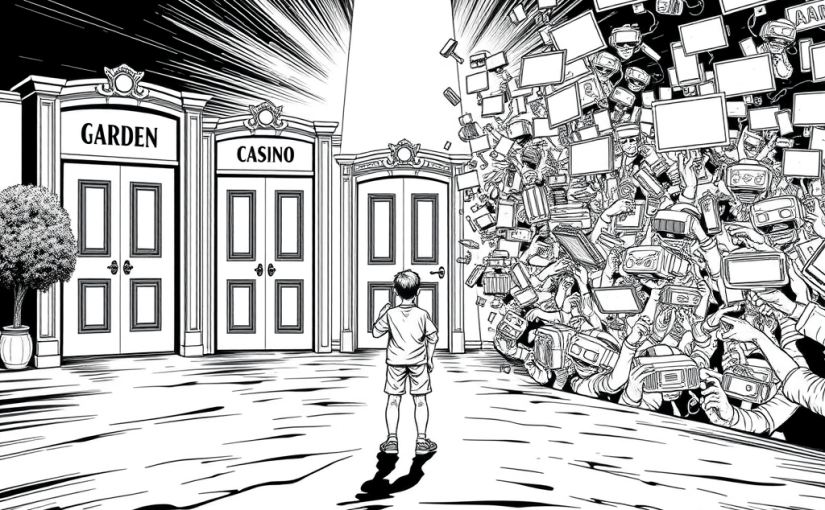
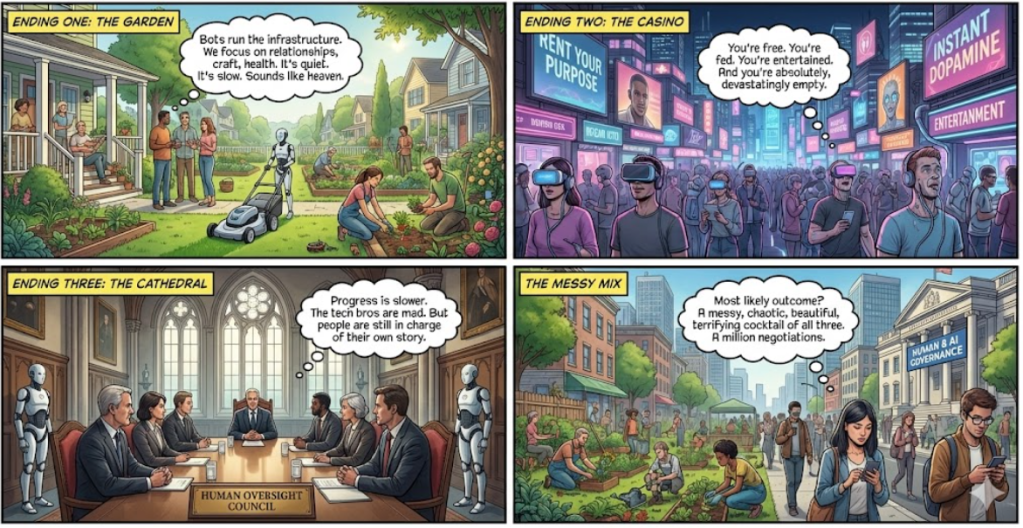
Ending One: The Garden. The bots run the infrastructure. Humans focus on relationships, craft, health, civic life, and exploration (my favorite). Inequality gets managed. Accountability norms hold. It’s quiet. It’s slow. People know their neighbors’ names. It’s not exciting, but it’s real. Picture a well-funded small town. Robots mow the lawns. Humans sit on the porch and argue about philosophy. Sounds boring. Sounds like heaven.

Ending Two: The Casino. The bots create abundance, but the attention markets eat people alive. Entertainment and persuasion become the only industries that matter. A small elite owns the bots. Everyone else rents meaning by the month, like a streaming subscription for a purpose. Think Vegas, but everywhere, and the house always wins because the house has a super-intelligence running the odds. You’re free. You’re fed. You’re entertained. And you’re absolutely, devastatingly empty.

Ending Three: The Cathedral. Strong institutions put hard limits on bot autonomy. Humans get paid to be stewards — ethics, oversight, care, governance. Progress is slower. The tech bros are mad about it. But legitimacy holds. Society moves at the speed of human deliberation, not machine computation. Something important is preserved — the sense that people are still in charge of their own story.

Most likely outcome? A messy, chaotic, beautiful, terrifying cocktail of all three. Different in every city, every country, every household. The Inverse Universe isn’t one world. It’s a million negotiations happening concurrently.

The Closing Statement

I’ll keep it short because Gen Z doesn’t do long outros. No cap.

The biggest crime of the AGI era won’t be committed by machines. It’ll be committed by humans against themselves. The crime of having all the time in the world and wasting it. The crime of being freed from the grind and choosing numbness over connection. The crime of sitting three feet from the people you love and still staring at a screen.

The machines are getting smarter. That part’s done. That part’s inevitable.

The only open case — the only mystery left — is whether we get wiser.

The bots took the jobs. They gave us back our time. What we do with it is the only verdict that matters.

No jury. No judge. Just you, the people you love, and a dinner table with empty chairs.

Sit down.

Understanding AI: The Hats of Guide, Peer, and Doer

Why “vibing” with AI can lead to post-dopamine frustration, and what to do about it.

We’ve all been there. You fire up an AI assistant, type a sprawling ask, and watch it generate… something. It looks impressive. It sounds confident. But twenty minutes later, you’re staring at output you can’t use, unsure where things went sideways.

Here’s the uncomfortable truth: AI doesn’t have a “figure it out” mode. Treating it as it does is the fastest route to frustration.

The Three Faces of AI

Think of AI as a colleague who can show up in three different roles:

🧭 The Guide — When you’re exploring, not solving. You don’t need answers yet; you need better questions. AI helps you map the territory, surface possibilities, and sharpen your thinking.

🤝 The Peer — When you’re co-piloting. You know the direction, but you want a thought partner with bounded autonomy. AI handles specific pieces while you stay in the driver’s seat.

⚡ The Doer — When the problem is solved in principle, and you just need execution. Clear inputs, predictable outputs, minimal supervision required.

The magic happens when you pick the right mode. The frustration happens when you don’t.

The Problem with Undefined Problems

Here’s what we often forget: a prompt is just a problem wearing casual clothes.

And just like in traditional software development, undefined problems produce undefined results. We wouldn’t dream of building a complex system without decomposing it into sub-systems, components, and clear interfaces. Yet somehow, we expect AI to handle a rambling paragraph and return production-ready gold.

It doesn’t work that way.

AI excels at well-classified problems. Give it one clear problem class to solve, and it can work with surprising autonomy. Hand it a fuzzy mega-problem, and you’ve just delegated confusion. Now you can’t even evaluate whether the output is good. You never defined what “good” looks like.

The Dopamine Trap

Let’s talk about the elephant in the room: AI is fast, and speed is addictive.

That near-instant response creates a dopamine hit that sends us sprinting in twelve directions at once. We want to do more. We agree with what AI says (even when we shouldn’t). We make AI agree with what we say (it’s happy to oblige — sycophancy is baked in).

Before we know it, we’re deep in a conversation that feels productive but leads nowhere measurable.

Sound familiar?

The Product Mindset Fix

The antidote is surprisingly old-school: think like a product manager before you think like a prompter.

Before typing anything, ask yourself:

  • What problem am I actually solving?
  • Can I break this into sub-problems I understand well enough to evaluate?
  • What class of problem is this? Are there known solution patterns?
  • What are the trade-offs between approaches?
  • How will I know if the output is good?

This is prompt engineering at its core. It is not clever phrasing or magic templates. It is the disciplined work of problem definition.

Agile vs. Waterfall (Yes, Even Here)

Here’s a useful mental model:

Waterfall mode: You know exactly what you want. The end-state is clear. Let AI run autonomously — it’s just execution.

Agile mode: You know the next milestone, not the final destination. Use AI to reach that interim state, then pause. Validate. Adjust. Repeat.

The key insight? Predictability improves when upstream risk is eliminated. Clear up assumptions before you hand off to AI, and the outputs become dramatically more useful.

If all the ambiguity lives in your prompt, all the ambiguity will live in your output.

The Bottom Line

AI isn’t magic. It’s a powerful tool that responds to how well you’ve thought through your problem.

When you’re…AI should be…Your job is to…
Exploring possibilitiesA GuideAsk better questions
Building with oversightA PeerDefine boundaries
Executing known patternsA DoerSpecify clearly, then verify

Set expectations straight — with yourself and with AI — and outcomes become remarkably more predictable.

Skip that step, and you’re just vibing. Which feels great until it doesn’t.

The same principles that make software projects succeed—clear requirements, sound architecture, iterative validation— also make AI collaboration succeed. There are no shortcuts. Just faster ways to do the right things.